

There are instruments that challenge your technique. Then there are instruments that challenge your entire idea of what an instrument is. The SOMA Laboratory ENIGMA belongs firmly in the second category — and it arrives at a moment when the experimental synthesis space is more crowded than ever with gear claiming to be “unconventional.”
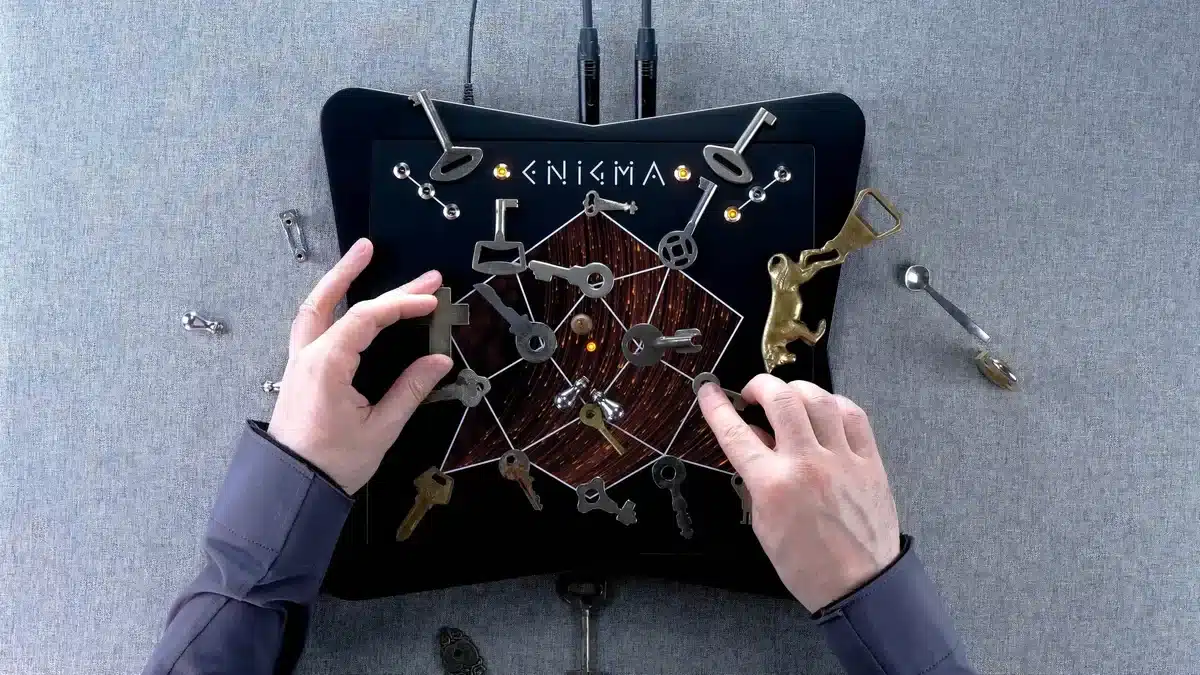
ENIGMA has no keys. No knobs. No screen. No patch memory. What it has is a sensing field — a high-sensitivity inductive scanner that detects the presence and movement of conductive metal objects placed on its surface or hovering within 20mm above it. Your interface is whatever you find in your pocket, your toolbox, or your kitchen drawer. Coins, gears, screwdrivers, fragments of copper pipe — all valid. The sonic result is determined by the object’s geometry, mass, conductivity, and spatial position on the field. Move something a fraction of a millimetre and the sound changes. Remove it and the patch disappears with it.

SOMA Laboratory turned ten this year, and ENIGMA reads like a deliberate statement of intent from the Polish maker. We sat down with Vlad Kreimer back in 2018, and his “Romantic Engineering” philosophy hasn’t shifted an inch since — ENIGMA is that thinking taken to its logical, slightly alarming conclusion.
A Scanner, Not a Keyboard
The underlying technology is an inductive sensing field — the same broad principle that makes wireless charging and metal detectors work, but here applied to real-time audio synthesis at extremely high resolution. SOMA describes the sensitivity as capable of responding to sub-millimeter object shifts, and early hands-on reports from SuperBooth 2026 confirm this isn’t marketing exaggeration. The sound is unstable — alive, reactive, and tied to physical gesture in a way no knob can replicate.
Eight touch sensors sit alongside the sensing field, letting you switch between eight operating states — described as “different perceptual modes of the same underlying field.” Think of them less as preset slots and more as different lenses through which the scanner interprets the same physical arrangement. The same coin in position X can sound entirely different in mode 3 versus mode 7. That’s the core interaction loop — and also where the instrument gets complicated.

For connectivity, SOMA kept things deliberate: MIDI input for note control, CV clock input for external sync, and stereo quarter-inch outputs alongside a headphone jack. The surface itself is covered in a scratch-resistant industrial-grade film — a practical necessity when you’re placing metal objects directly on expensive electronics hundreds of times per session.

No Memory, No Recall, No Workaround
ENIGMA has no patch memory. None. When you lift your objects off the surface, the patch is gone. There is no save function, no snapshot, no recall. Every performance is a one-take document. That’s philosophically coherent — SOMA is explicitly framing this as an instrument of exploration, not repetition — but it creates real workflow friction for anyone who finds a sound they love and wants to return to it.
The early Reddit reception was tellingly split. A subset of users described prototype demos as “godawful noise” before more polished session videos surfaced showing the instrument capable of atmospheric drones, complex percussive textures, and expressive leads. The learning curve appears steep and deeply personal. Your results will depend almost entirely on how seriously you curate your collection of metal objects — and whether you approach the instrument as a sound artist or as a musician who expects a reproducible outcome.
There is also no internal sequencer, no effects processing, and no built-in sound engine in the traditional sense. ENIGMA generates sound from the interaction between the field and the object; it is not running oscillators or filters behind the scenes in any conventional way. For some, this is the point. For others, it will feel sparse at €680 net — plus VAT and shipping from Poland, putting real-world EU buyers closer to €850 delivered.
A Consistent Philosophy, Taken Further
ANR covered SOMA’s FLUX at SuperBooth 2024, another instrument built around a touchless, unquantized interface using magnets. The pattern is consistent: SOMA builds instruments that demand a complete renegotiation of your relationship with sound. The Lyra-8 did it with touch-sensitive oscillators and feedback paths. Terra did it with a continuous surface controller. ENIGMA takes that logic to its furthest point yet — the interface is no longer part of the instrument at all. You are expected to bring it.
Buy it as a sound artist with a hardware-store budget for experiments. Approach it as a musician expecting repeatable results and you’ll be frustrated inside a week.
Pricing and Availability
The SOMA ENIGMA is available now. An initial “Family & Friends” release price is set at €590 net (excluding VAT and delivery). The regular net price, purchased directly from SOMA’s Poland factory, is €680. Factor in VAT and international shipping for a realistic landed cost.
For full specifications and ordering, visit the official SOMA ENIGMA product page.