

Arturia Memory V landed today as an “Analog Ladder Titan” for people who always loved the idea of a Moog Memorymoog, but never loved the reality of its price, weight, or repair bills.
The “Not So Well-Tempered” Moog
In the early 80s, the Moog Memorymoog tried to be the polyphonic Moog everyone was asking for: six voices, three oscillators per voice and that classic ladder filter punch, arriving just as digital synths and cheap polys were taking over. It sounded outrageous, but it was built at a difficult moment for Moog, with limited production numbers, a high price tag and reliability issues that helped push it into cult‑instrument territory.
Fast‑forward to now: original Memorymoogs are rare, expensive and temperamental, while producers are more in love than ever with big, cinematic, Moog‑ish poly sounds for synthwave, scoring and alt‑R&B. Arturia Memory V drops right into that gap, promising the “six Minimoogs in one” feeling in a DAW‑friendly, recallable, automation‑ready instrument that can actually survive a laptop session.
What Arturia Memory V Actually Does
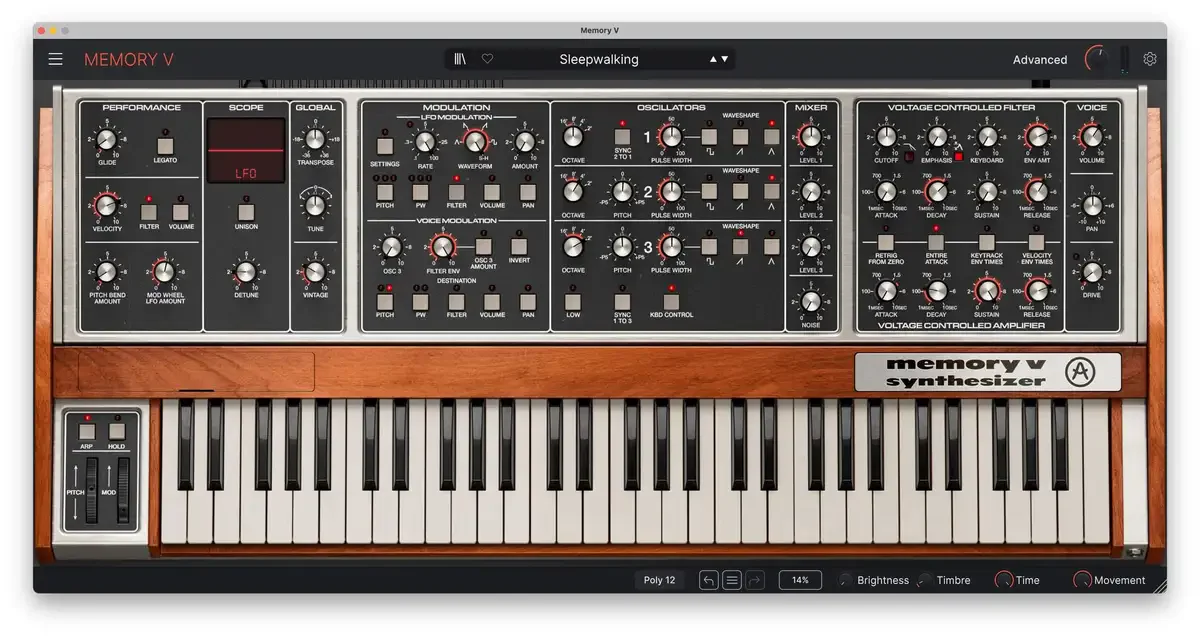
Memory V is a software instrument (VST3, AU, AAX and standalone) that recreates the core architecture of the Memorymoog and then extends it for modern production. You get three modelled voltage‑controlled oscillators per voice feeding discrete‑style ladder filters, with a dedicated drive stage per voice so you can go from rounded Moog warmth to the snarling, overdriven edge that made the original infamous.
The polyphony starts at six voices, mirroring the hardware, but can be expanded to twelve when you want wide pads and stacked chords without the classic “voice stealing” drama. On top of that, a Unison mode lets you pile up to six triple‑VCO voices into one huge mono sound – effectively eighteen oscillators in one key press for leads and basses that don’t need much help from extra plugins.

Arturia’s advanced panel adds a drag‑and‑drop modulation system, a flexible multi‑FX section and a multi‑arpeggiator, plus quality‑of‑life features like macros, MPE support, NKS integration and MTS‑ESP for alternative tunings. The factory sound bank leans into what this synth does best: dense 80s pads, bold brass, cutting leads and Moog basses that sit at the front of the mix with minimal effort.
How does it sound? Here’s a quick reel from our Instagram account (what? Not following us yet? Now’s your chance!):
A Quick Refresher On The Moog Memorymoog
The original Memorymoog was produced between roughly 1982 and 1985 and is often described as “six Minimoogs in one” thanks to its six voices, each with three independent oscillators and a 24 dB/oct Moog ladder filter. It was Moog’s last big analog flagship before the company’s bankruptcy, and its timing meant it arrived in a market already tilting towards the DX7, samplers and cheaper Japanese polys.

On paper it was a dream machine: 18 oscillators, patch memory, an arpeggiator and, on the Memorymoog Plus, MIDI and a simple sequencer. In practice it was expensive, heavy, power‑hungry and notoriously unstable – tuning, power supplies and voice cards all demanded regular attention from a qualified tech.
Those contradictions are why it’s such a mythic instrument now: one of the fattest‑sounding analog polys ever made, but also one of the least practical to own in 2026 unless you’re running a vintage‑heavy studio with a proper maintenance budget. Memory V is clearly designed to capture that “over the top” scale and tone, without the very 80s reality of blown fuses and uncertain gigs.
Sound And Feel: Not Just Another 80s Poly
Plenty of plugins can do lush 80s pads and brass, but the Memorymoog’s personality comes from how much energy per note you can throw into the filter. Three analog‑style oscillators per voice, detuned just enough, give chords a density that feels closer to a modular patch than a polite polysynth.
Memory V leans into that behaviour. With the drive opened up and a bit of “vintage” dispersion on the oscillators, you get that slightly unstable, breathing quality that made the original sound alive rather than mathematically perfect. The built‑in effects are tuned for “mix‑ready” results, so you can get straight to big pads, angry stabs or evolving score sounds without reaching for third‑party reverbs and choruses just to make patches sit.

If you’ve ever tried to fake this kind of tone by layering several generic VA plugins and still felt like something was missing, this is exactly the sort of instrument that simplifies that process into a single instance.
Modern Extras The Hardware Never Had
Arturia’s recent instruments all share a pattern: a faithful front panel and a deeper “lab” hiding behind it, and Memory V follows that template. You still get a Memorymoog‑inspired front end, so existing users can dial in familiar patches quickly, but clicking into the advanced view opens up a very 2026‑style synth workstation.
Highlights include:

- Modulation matrix with per‑voice options
LFOs, envelopes and performance sources can be routed to almost anything, including per‑voice parameters like pan, pitch and envelope times, letting each note of a chord evolve slightly differently.
- Multi‑Arpeggiator
You can run layered arps with different patterns per layer, dotted‑note rhythms, octave spreads and more, turning Memory V into a self‑contained sequence generator for synthwave, Berlin‑school patterns or complex score textures.
- Integrated effects
Filters, chorus, delay, reverb and other processors are built in, so you can design complete, mix‑ready sounds inside the plugin instead of building long chains in your DAW.
- Ecosystem integration
MPE support, NKS compatibility and tight mapping to Arturia controllers (KeyLab, MiniLab etc.) make Memory V feel more like a playable instrument than a mouse‑only plugin.
Crucially, it still behaves like a synth, not a preset player: all the macro‑ready and live‑performance design comes from real control of the engine, not from flipping between static sample layers.
Other Memorymoog Emulations
Arturia isn’t the first company to go after the Memorymoog in software, so it’s worth being clear about where Memory V sits. IK Multimedia’s Syntronik Memory‑V is a sample‑based instrument built from recordings of a real Memorymoog, offering a library of curated patches rather than a fully modelled signal path. Cherry Audio’s Memorymode takes more of a circuit‑modelled approach, aiming to emulate the analog behaviour with a modern DSP engine.
Memory V falls firmly into the “modelled synth” camp. Instead of playing back pre‑baked samples, it generates sound in real time via oscillators and filters, which means every parameter is continuously tweakable and can be modulated at audio‑rate if needed.
Context Inside Arturia’s Ecosystem
Memory V is also strengthening the company’s broader hardware/software ecosystem. It’s reasonable to expect its engine and presets to surface inside Analog Lab, AstroLab and whatever stage‑keyboard spin‑offs come next.
If you’re already living with Arturia controllers and instruments, this is less “one more plugin” and more “a new colour for everything else to tap into.
Price, Value And The “One More Synth” Question
According to the marketing brief, Memory V launches at $/€149, in line with other individual Arturia instruments. On a pure feature‑for‑money basis that’s easy to justify: you’re getting a full‑fat analog polysynth emulation with extended modulation, effects, ecosystem support and a deep preset library.
The nuance is in where you are with Arturia already. If you own a recent V Collection, you may be waiting to see when Memory V shows up in an update or bundle deal; if you’re just after a flagship analog‑style poly without caring about brand history, you’re choosing between this, various Jupiter/Prophet clones and some very strong modern originals.
From a niche point of view, Memory V makes the most sense for three groups:
- Producers who specifically want the Memorymoog flavour – thick, slightly wild, Moog‑voiced polys – without chasing down a real unit or a LAMM‑modded one.
- Arturia ecosystem users who appreciate having tightly integrated instruments, presets and controller maps instead of mixing lots of isolated plugins.
- Sound designers and scorers looking for a “wall of analog” that can move from subtle detune to full‑on instability without resorting to five layered synths.
If you’re mainly into lean, bright, modern digital tones, or you already own multiple Memorymoog‑inspired libraries and Cherry Audio’s Memorymode, you’ll want to demo Memory V before committing.
Trend Watch: Deep Cuts And Heritage Synths
The arrival of Memory V also says something about where virtual instruments are going next. The obvious “Mount Rushmore” of synths – Minimoog, Jupiter‑8, Juno‑60, DX7, Prophet‑5 – has been cloned many times. Developers are now mining a second tier of historically important but less ubiquitous instruments: Elka Synthex, oddball stringers, and, in this case, the Memorymoog.
That shift matters because it broadens the sonic vocabulary producers reach for by default. Instead of every “80s‑inspired” track leaning on the same Roland‑ish chorus pad, you start to hear more of that Moog‑style density, the Synthex‑style shimmer, or other flavours that were previously locked up in rare hardware.
In parallel, we’re seeing more companies emulate their own hardware (MiniBrute V, MiniFreak V, etc.), blurring the line between “vintage remake” and “in‑house ecosystem piece.” Memory V sits at the intersection of these trends: a tribute to a vintage Moog and a new brick in Arturia’s wall.
Where This Leaves Memory V
Arturia Memory V isn’t trying to be a neutral “bread and butter” polysynth; it’s unapologetically big, Moog‑voiced and aimed at people who want their chords to feel like they’re pushing air. For producers who’ve always loved the idea of a Memorymoog but have only ever met it through stories, sample packs or Instagram clips, this is the most practical way so far to live with that aesthetic day in, day out.
The interesting question now is how quickly it becomes part of the broader Arturia ecosystem – showing up inside Analog Lab, AstroLab and future controllers – and how many modern records quietly start leaning on “six Minimoogs in one” without ever touching a piece of 80s hardware.
Pricing and Availability
At launch, Arturia Memory V is listed at 149, in the usual Arturia region‑equivalent pricing tiers, with an introductory offer flagged as limited‑time in the marketing copy. It’s available as a download via Arturia’s site and through authorised dealers, and runs on current macOS and Windows systems in VST3, AU, AAX and standalone formats.
For the latest pricing and system requirements, head to Arturia’s product pages: Arturia – Software Instruments
If you’re already invested in controllers like KeyLab, you may also want to revisit our feature on the current flagship controller to see how Memory V might slot into that workflow: Arturia KeyLab Mk3 88: Premium MIDI Controller for Studio and Stage