Arturia has expanded the AstroLab family with the AstroLab 37, a compact 37-key stage keyboard that packs the sonic power of the company’s acclaimed V Collection into an ultra-portable format. Priced at €699 (or $699), this new addition sits below the 61-key AstroLab (€1,599) and the flagship 88-key model (€2,499), making it the most accessible entry point into the laptop-free performance concept.
AstroLab 37’s standalone power delivers V Collection magic. Gig tweaks and FX, all laptop-free
Hardware and Design
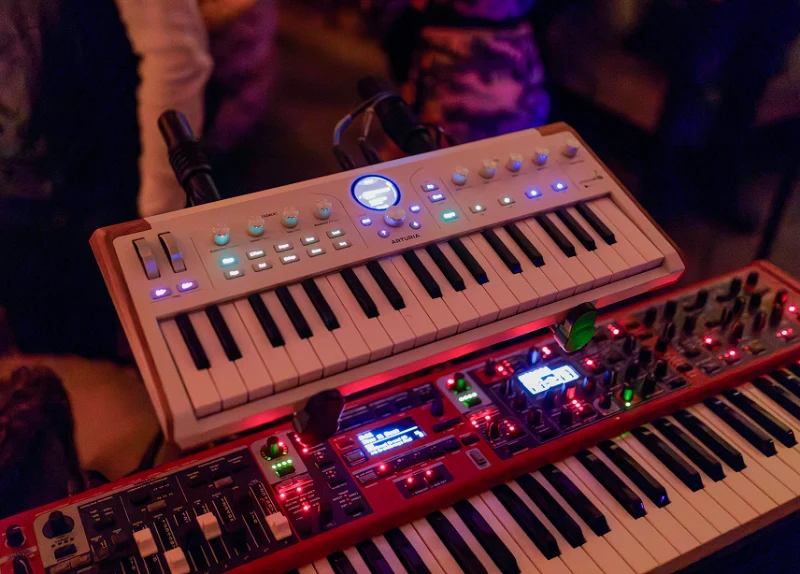
The AstroLab 37 maintains the distinctive design language of its larger siblings while prioritizing portability. The build quality strikes a smart balance for its price point. It feels solid and sturdy enough to handle the rigors of the road, even if it doesn’t quite match the premium construction of the 61 and 88-key models. The chassis is robust, the encoders are solid with good tactile feedback, and the overall construction inspires confidence for gigging musicians.
One of the most distinctive features is the rounded 400-pixel color screen that sits prominently on the panel. This curved display gives the AstroLab 37 a futuristic aesthetic while providing clear visibility of presets, parameters, and performance settings. Paired with the navigation encoder, it makes browsing through the extensive sound library intuitive and fast.
The 37-note slim keyboard features velocity sensitivity and aftertouch across all keys, allowing for expressive playing despite the compact format. The aftertouch adds a crucial dimension for controlling vibrato, filter sweeps, or other modulation parameters, making the keyboard feel much more dynamic than typical controllers in this size range.

The control surface includes 10 preset buttons for instant recall during performance, 4 macro controls (Brightness, Timbre, Time, Movement) for quick sound shaping, and 4 dedicated FX knobs including separate Delay and Reverb controls. This layout keeps everything accessible without cluttering the interface.
What Makes AstroLab 37 Different
The AstroLab 37 delivers 11 advanced sound engines spanning virtual analog, samples, wavetable, FM, granular, physical modeling, vector synthesis, harmonic, phase distortion, vocoder, and Karplus synthesis. Unlike traditional MIDI controllers, it’s designed for standalone operation with 44 instruments and 1,800+ presets built in, expandable to 10,000+ sounds via Arturia software.
The onboard sound library spans reference synths, classic keyboards, acoustic instruments, and cinematic hybrids. You get emulations of iconic instruments like the Moog Minimoog, Prophet-5, Hammond B3, Rhodes, Wurlitzer, DX7, and many more, all accessible without needing a computer on stage.
Check out the video overview below:
Cool Things You Can Do
The AstroLab 37 goes beyond basic ROMpler-like preset playback with creative performance features. You can perform dynamic sequences or arpeggios with both hands using split multis, essentially turning the keyboard into two independent zones. Add a vocoder on top of any sound for instant vocal processing. Play along with backing tracks using the Bluetooth audio input, eliminating the need for cables or mixers.
Deep sound customization is possible thanks to fully modeled instruments. You can fine-tune the hardness of a piano’s hammers or tweak the cutoff of an analog filter, bringing nuanced control to your performances.

The One-Finger Song Mode combines chord, scale, and arpeggio modes, letting you play full songs with minimal finger movement. This is particularly useful for producers sketching ideas or performers who want to trigger complex musical passages effortlessly.
Playlist mode lets you organize and build your live sets directly on the keyboard, keeping your performance streamlined and ready to go. You can also access artist presets, a curated selection of sounds from iconic artists that give you the chance to perform with professionally crafted tones.
Vocoder Integration
One of the standout features is the integrated vocoder, which allows you to add vocal processing on top of any sound. The keyboard includes a vocoder-ready mono input (mic/TRS) for connecting a microphone, letting you transform your voice into synthesized textures and robot vocals. This opens creative possibilities for electronic music producers, synthwave artists, and live performers who want vocal effects without bringing additional gear.

The Trade-Off: Portability vs Control
The AstroLab concept has always involved a fundamental compromise, and the 37-key model emphasizes this more than ever. While you get instant access to thousands of professional sounds, the onboard control remains limited to basic macro knobs.
As Sound on Sound noted in their review, “The philosophy of the AstroLab is that you don’t need to program your sounds in detail when using it.” The AstroLab 37 provides four macro controls plus four dedicated FX knobs for real-time sound shaping. Deep sound editing requires connecting to a computer and using Analog Lab Pro, which somewhat contradicts the laptop-free ethos.
For keyboardists who need extensive sound sculpting during performance, this remains a significant limitation across the entire AstroLab range. The onboard controls work well for quick adjustments, but detailed synthesis work requires external editing.
The Upside: Take-Anywhere Performance Power
What the AstroLab 37 sacrifices in deep control, it gains in portability and immediacy. From studios and stages to bedrooms and DJ booths, the AstroLab 37 adapts to every space. Its compact design makes it an ideal second keyboard for band members, a flexible live instrument, or a portable tool for producers on the go.
The sound quality remains exceptional across all AstroLab models, powered by fully modeled instruments where you can fine-tune sonic details with precision. The ability to perform dual-hand sequences using split multis means you can create complex arrangements with both hands independently.
The AstroLab ecosystem continues to expand through firmware updates. As we covered in our AstroLab 1.3 update article, Arturia regularly adds new instruments and presets to the platform.
Tip: There’s already a firmware update available for the Astrolab 37. If you’re curious about how to update your Astrolab 37, you’ll need to use the Analog Lab (V or Pro) application on your computer. However, the process isn’t particularly intuitive, so I suggest referring to the step-by-step guide provided by Arturia for guidance.
AstroLab Connect: Your Mobile Sound Library

The included AstroLab Connect app for iOS and Android transforms how you interact with your sound library.
This mobile companion app lets you browse presets with ease on a larger screen, build playlists efficiently for your live sets, and most importantly, get more sounds directly from the Arturia store without needing to connect to a computer.
You can transfer sound patches from your Arturia sound library wirelessly to the AstroLab 37, making it incredibly convenient to expand your sonic palette on the go.
The app also allows you to edit effects and assign custom macros, giving you more control over your sounds than the hardware alone provides.
When you own the full instruments, you can even design sounds in-depth with full instrument views right from your phone or tablet.
In my opinion, this app is a reliable and useful tool. It might not be the most visually appealing, but it does what it’s meant to do, and it’s great to see it available on both Android and iOS. Browsing, previewing, and adding presets are all a breeze. I also liked that it offers a super-fast 1-tap registration, so I could add the Astrolab 37 to my Arruria account.I’ve only noticed a slight delay when trying to edit preset’s master and FX macro parameters, but it’s not a major issue.
Worth knowing: this is actually a great time to expand your AstroLab sound library, as Arturia currently has nice deals on their sound packs.
I recently picked up Electronica Selection, Explorations Vol. 4, and Evolving Electro, all of which bring fresh textures and modern production-ready sounds to the AstroLab platform.
Desktop Integration with Analog Lab Pro
Analog Lab Pro is also included, offering seamless control in your DAW and deep sound customization capabilities when working in the studio. This creates a smooth workflow between studio sound design and stage performance. You can design complex patches on your computer, save them to your library, and have them instantly available on the AstroLab 37.

Connectivity Options
Connectivity is comprehensive for such a compact instrument. You get 5-pin MIDI In/Out for connecting to external gear, balanced stereo output for professional audio quality, mic and TRS input for the vocoder and external audio sources, USB-C plus USB-A host port for computer connection and storage devices, Bluetooth audio input for wireless playback of backing tracks, and Wi-Fi for wireless control via the mobile app. There’s also a pedal input for expression or sustain pedals.
The Bluetooth audio input is particularly useful for practicing or performing along with backing tracks from your phone without any cables.
Who Should Consider the AstroLab 37
At €699, I think the AstroLab 37 hits a sweet spot for a specific type of musician. If you prioritize portability and immediate access to quality sounds over deep sound design capabilities, this is worth serious consideration.
I see this being perfect for gigging musicians who need a compact second keyboard to layer classic synth and keyboard sounds over their main rig. It’s also ideal for producers who want a portable sketch pad with professional sounds that doesn’t require dragging a laptop to the couch or hotel room. And if you’re one of those performers who absolutely refuses to bring computers on stage, the AstroLab 37 delivers that laptop-free freedom at an accessible price point.
The vocoder feature is a genuine bonus that adds creative possibilities, particularly if you’re into electronic music production or want instant vocal processing integrated into your performance setup without additional gear.
In short, AstroLab 37’s standalone power delivers V Collection magic. Gig tweaks and FX, all laptop-free
Now, here’s my honest take on the elephant in the room: the 37-key format. If Arturia had released this exact same keyboard with 49 keys instead, it would be an absolute must-buy with zero hesitation from me. The 37-key range, while incredibly portable, does feel restrictive depending on how you play. Three octaves plus one extra note is compact even for lead work, and if you’re used to spreading your hands across a wider keyboard range, you might find yourself wishing for those extra keys. It’s a trade-off that makes perfect sense for ultra-portability, but it’s worth trying before buying if keyboard range matters to your playing style.
That said, if you can work within the 37-key limitation and value the take-anywhere convenience, the AstroLab 37 delivers incredible value. You get classic keyboard sounds without the size, weight, and hassle of vintage instruments or computer setups.
For those of us already invested in the Arturia ecosystem, the AstroLab 37 is essentially a hardware extension of the Analog Lab world we’ve often praised here on ANR. You get the same sound engines we know and love, just freed from the computer and ready to travel.
Pricing and Availability
The Arturia AstroLab 37 is available at €699 / $699. More information will be available on the official Arturia AstroLab 37 product page.