

When Oberheim released the Matrix-12 in 1985, it was the deepest analog polysynth money could buy. You got twelve voices, a 15-mode filter, and a virtual patching system so involved that Oberheim printed the routing map straight onto the front panel because the narrow fluorescent display couldn’t show it all at once. Vangelis, Depeche Mode, The Orb, and Technotronic all leaned on it for thick pads, sweeps, and basses. Originals are now rare, heavy, and expensive to keep running, which has kept the hardware out of reach for most studios.
GForce Software has spent the last few years building out the Oberheim catalog with Tom Oberheim and original Matrix-12 co-designer Marcus Ryle, starting with their acclaimed 8-voice OB-E. Today they’ve released the GForce Oberheim Matrix-12 for macOS and Windows, covering both the keyboard flagship and the 6-voice Xpander. The pitch is simple: keep the exact voice architecture of the 1985 hardware, but ditch the button-mashing and menu paging.

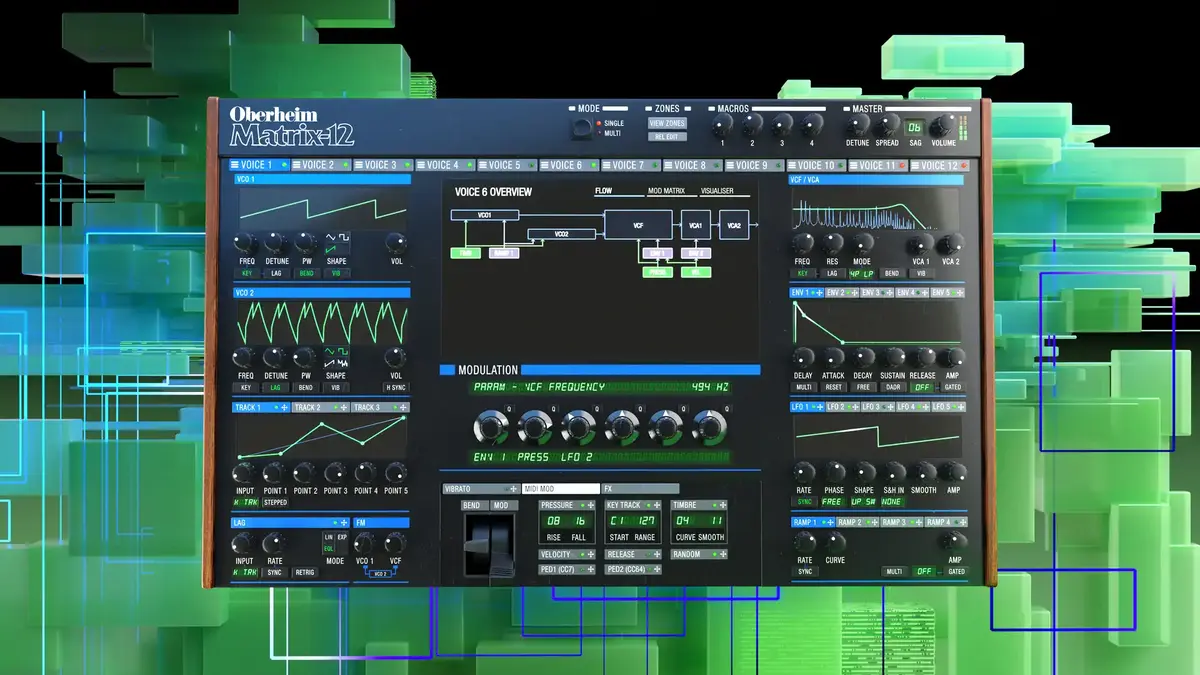
Putting the Modulation Matrix on Screen
Each of the twelve voices uses two modeled VCOs with triangle, saw, and pulse waves. Oscillator two adds noise, hard sync, and FM, feeding into the 15-mode filter (1- to 4-pole low-pass, high-pass, band-pass, notch, phase, and combo modes) and two VCAs in series. GForce modeled the oscillators, filter stages, and envelope curves directly against original hardware units to nail the way those twelve voices stack and drift against each other.
https://www.youtube.com/watch?v=Z82CZIRhZ0g
On the original synth, programming five envelopes, five LFOs, four ramps, three trackers, and a lag processor per voice meant endless paging through a tiny readout. Here, you drag a crosshair from any modulation source and drop it onto a knob. Each parameter has six bipolar modulation slots with quantize options and a green ring around the dial showing the modulation range in real time.

Instead of hunting through sub-pages, you can switch between three main views. Flow draws a live diagram of the signal path as you patch it. The Mod Matrix puts every routing connection into a single table you can sort, filter, and edit. And the Visualiser gives each module its own scope, filter curve, envelope shape, or tracker graph that you can grab and drag directly with the mouse. GForce also added tempo-synced ramps with variable curves, LFO smoothing, and a stepped tracker mode that turns any LFO into a four-step sequence.

Six Zones, Micro-Arpeggiators, and MPE
Single mode plays all twelve voices together with polyphony, unison, detune, and stereo spread. Flip over to Multi mode and each voice can run its own patch across six overlapping keyboard zones, each with independent voice allocation, MIDI channel, and its own micro-arpeggiator. You can solo, copy, lock, or load individual voices from any patch, or use Relative Edit to adjust an entire zone at once.
Expressive control goes well beyond standard 1980s MIDI, building on GForce’s recent push into expressive MPE sound design. The synth responds to velocity, release velocity, polyphonic pressure with adjustable rise and fall, and full MPE, alongside four global macros. Stereo delay and matrix reverb are built in (with per-voice sends in Multi mode), and the browser ships with over 570 patches, including more than 190 original Matrix-12 and Xpander presets.
There’s an obvious catch with a synth this deep: twelve voices with five envelopes and five LFOs apiece adds up to 60 envelopes and 60 LFOs running at once. Even with a clean visual interface, piling up multi-zone patches can get out of hand quickly, both for your mix space and your CPU meter.
The New Subscription Plans
The GForce Oberheim Matrix-12 lands just a couple of weeks after GForce refreshed its website, rolled out a single unified installer, and introduced three annual subscription tiers: Essentials (£99/year for five core synths), Core (£179/year for the main synth and drum line), and Ultimate (£249/year for every instrument and expansion pack, including new releases). To sweeten the relaunch, they’re also giving away perpetual licenses for M-Tron Select and Axxess for free until 1 December 2026, plus a copy of UJAM’s Retrocraft with any purchase.
Here at ANR, we’re not big fans of subscription plans—there are simply way too many of them competing for studio budgets at this point. Still, considering the consistently high bar GForce sets with its instruments, a yearly plan could be a smart option for producers who haven’t invested in their catalog yet and want the whole lot in one go. For everyone else, perpetual licenses aren’t going anywhere.
Pricing and Availability
The GForce Oberheim Matrix-12 is available now from the GForce Software website and authorized resellers.
It is priced at £99 / $119.99 / €119.99 (including 20% VAT), with an introductory price of £69 / $83.99 / €83.99 (30% off) until 5 December 2026. A 14-day trial is available.
It runs on macOS and Windows in standalone, AU, AAX, VST, and VST3 formats.