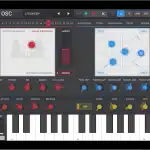
For the past decade, Alex Smith’s Castagniers-based workshop has built a reputation on small, unruly instruments that celebrate hardware quirks—most notably Twisted-Electrons’ characterful MegaFM, which turned vintage Sega Genesis YM2612 chips into a gritty, fader-laden desktop synth. Now Smith is going after much bigger game. First shown at Superbooth 26 in Berlin, the Twisted-Electrons FLEXfm is an eight-voice hybrid groovebox that combines four-operator synthesis, micro-sampling, analog and digital filtering, and a 128-step arranger in a single box.
At €999, it also pushes Twisted-Electrons straight into Elektron Syntakt and Digitakt II territory. Smith says he has been dreaming up the machine for ten years, aiming for something immediate enough to catch a quick idea without feeling like a spreadsheet of menus. Looking at the spec sheet, though, there is an undeniable tension between that immediacy and the sheer density packed under the hood.

Four Operators, 30+ Engines, and Dual-Function Knobs
Each of the eight voices in the Twisted-Electrons FLEXfm runs four operators, and they go well beyond clean DX-style sine waves. You can load over 30 operator engines—spanning wavetables, vocal formants, wavefolders, physical models, hand-drawn waveforms, and user samples—then wire those four sources together via FM, AM, or ring modulation. A shifted voicing section determines how each voice behaves: `4OP MONO` stacks all four interacting operators into a single complex voice, `POLY` opens up four-note overlapping polyphony, `CHORD` handles voiced and strummed harmonies, and `SYNC` hard-links oscillators.
To keep the footprint compact, the front panel leans heavily on dual-purpose controls encircled by full-colour LED rings. Six encoders handle voice parameters (`volume/pan`, `punch/crush`, `decay/chord`, `tune/reverb`, `cutoff/delay`, and `resonance/voicing`), paired with six operator encoders (`volume/feedback`, `attack/sample start`, `decay/sample end`, `multiple/fall`, `shape/fine`, and `shape/glide`). The LED rings track values and modulation depth visually, though muscle memory will still have to account for every knob pulling double duty.


Signal routing mixes an analog path with digital filter options, driven by four LFOs per voice that run synced cycles, one-shots, or ADSR envelopes. You can also sketch custom modulation shapes using the panel’s hardware joystick. In performance, that same stick morphs between four patch variations, steers across four patterns, or crossfades between four operator algorithms—and even acts as a scratch, phase, and pitch-bend controller or a piano-roll cursor. An onboard piezo pad sits directly on the chassis for tapping in velocity-sensitive hits by hand.
Sampling is built in, too, though with a deliberate old-school catch. While internal storage sits at 32 GB for projects, patches, and recordings, the live engine allocates eight mono sample pools at 44.1 kHz with roughly 13 seconds of audio and 16 slice markers per pool. You can build 12-pad kits and multi-samples, but you aren’t streaming long stereo backing stems here. Samples on the FLEXfm are meant to be sliced, mangled inside the operator matrix, or fired off as tight drum hits.
Polyrhythmic Sequencing, 8 Individual Outs, and FLEXIO Stems
The 16-pattern sequencer gives you eight voice lanes per pattern, up to 128 steps, and eight sub-steps per step for ratchets and fine micro-timing. In the vein of modern standalone grooveboxes like the Polyend Play, each lane runs at its own length and rate with per-step parameter locks, probability, conditional trigs, groove transformations, and `tempoFlex` curves. When it is time to turn loops into a track, the arranger organizes songs into eight named parts, each holding eight pattern-chain cells alongside eight dedicated key-change cells for harmonic transposition. Shared effects cover stereo plate reverb with shimmer and synced pre-delay, a diffusing delay, and a sidechain-ready compressor.
Where many standalone boxes bottleneck you into a single stereo pair unless you use proprietary USB drivers, the FLEXfm’s rear panel includes 12 physical audio jacks: a mono TS input, main stereo outs, headphones, and eight individual mono TS voice outputs for patching straight into a mixer or outboard rack.
If you prefer staying in the box, the companion FLEXIO software—running standalone or as a VST3/AU plugin on macOS and VST3 on Windows—streams eight post-filter voice stems over USB, or a stereo mixdown with separate reverb and delay returns. Patterns pass between FLEXIO and your host DAW as MIDI with transport follow, seek, and loop sync, and an optional Max for Live Bridge adds direct clip transfer and chain locators for Ableton Live users.
Pricing and Availability
The Twisted-Electrons FLEXfm is available to pre-order now from the Twisted-Electrons website.
Early units carry an introductory price of €999 EUR including VAT until November 13, 2026. After that deadline, the price remains €999 EUR, but excluding VAT—a roughly 20% jump for buyers in VAT regions once the intro window closes. Worldwide shipping is available (excluding import duties), with the first batch scheduled to arrive before Christmas 2026.