


When Ian “Swifty” Swift first sat down to redesign the Novation Bass Station II, he had a confession: “I don’t know what an oscillator is!” The legendary British graphic designer—whose bold typography and DIY-inspired aesthetic defined the visual identity of ’90s underground music culture through work with Mo’ Wax, Talkin’ Loud, and Straight No Chaser magazine—was stepping into unfamiliar territory. But as he later reflected, “They’ve given it to someone who doesn’t know what the fuck they’re doing. That’s when beautiful things happen, because you’re thinking intuitively.

The result is the Bass Station II Swifty Edition, a strictly limited run that wraps one of the most beloved monosynths of the past decade in a striking white-and-blue colorway adorned with Swifty’s signature arrows, custom typography, and graphic motifs inspired by rave flyers and dubplate culture.

Pre-loaded with 60 new artist patches from Bass Station power users Legowelt, Pecq, and Maria Chiara Argirò, this limited edition offers both a functional and aesthetic upgrade to an instrument that’s been in continuous production for over 11 years—an eternity in the hardware synth world.
To understand why the Swifty Edition matters, though, we need to rewind three decades to a time when analogue synthesis was making an unlikely comeback.
►►► Just so you know, if you’re already familiar with the history of the Bass Station and don’t have much time, feel free to skip to the Bass Station II Swifty Edition review section. ◄◄◄
The striking visual aesthetic connects the Bass Station II to the cultural moment that birthed its ancestor…
The Birth of a Modern Classic: 1993 and the Original Bass Station
The story begins in 1993, when the original Bass Station synthesizer became the second piece of hardware ever created by Novation. The British company’s first release had been the MM10, a portable MIDI controller designed primarily for the Yamaha QY10 workstation. When synthesizer developer Chris Huggett—already legendary for creating the quirky OSC Wasp synth—set about designing the Bass Station, he repurposed the MM10’s outer shell and added the same filter and VCA as his Wasp to create an instrument with instant pedigree and its own distinctive character.

Timing proved crucial. By the early ’90s, digital synthesizers had dominated for over a decade, and musicians were beginning to miss the tactile immediacy of analogue hardware. As Nick Bookman, one of Bass Station’s creators, explains: “Analogue synths up to then had been in decline in use as the big digital synths became popular, but then second hand prices started climbing—particularly for things like TB303.” The Roland TB-303, which had played a crucial role in defining acid house and electronic dance music, was becoming prohibitively expensive. Only 10,000 units were ever produced, and demand was pushing prices skyward.


The Bass Station offered a solution. This two-oscillator subtractive synthesizer with digitally-controlled oscillators, classic waveforms, and a warm analogue filter could recreate those sought-after TB-303 squelches and growls at a fraction of the cost. It had full subtractive synthesis control, MIDI transmission, full-size velocity-sensitive keys, and its own boisterous analogue character. It was one of the first new analogue synths to hit the market since the 1980s, arriving precisely when interest in analogue hardware was peaking.
Evolution: Rack, Super, and the Virtual Years
The success of the original Bass Station sparked a lineage. In 1994, the Bass Station Rack emerged—a significant upgrade featuring expanded memory, an LCD display, LFO sync capabilities, and crucially, CV/Gate in and out for integration with modular systems. The I/O was significantly expanded, and an external input to the filter allowed for processing external sound sources.
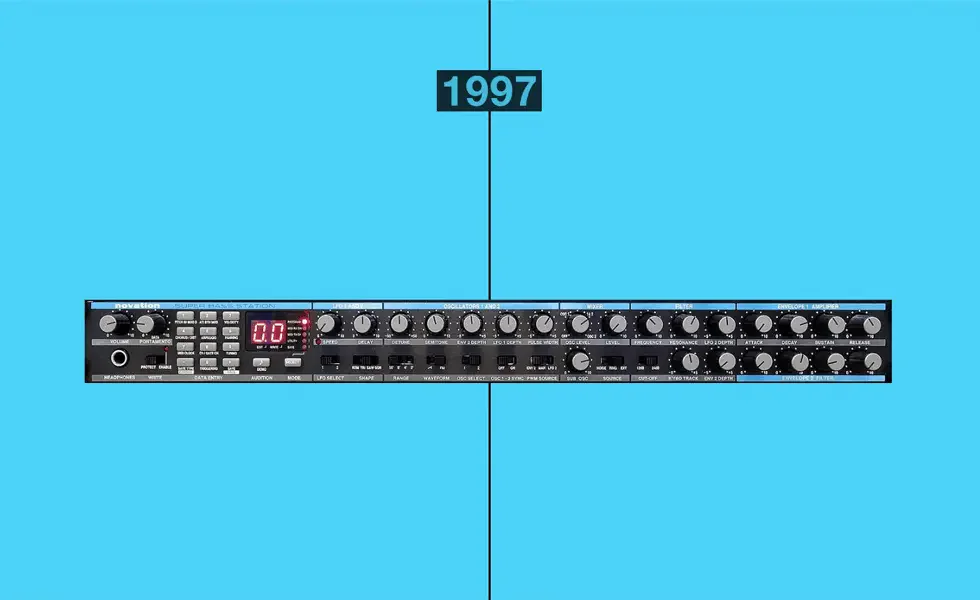
By 1997, the Super Bass Station took things further. This rack unit added a sub-oscillator, ring modulator, white noise generator, analogue distortion, and stereo chorus. A new mixer section enabled the creation of complex multitimbral sounds, while memory locations exploded from the original’s modest seven presets to 150 RAM and 50 ROM locations. The Super Bass Station represented the apex of the original line’s evolution—a powerhouse monosynth complete with Roland-esque features perfectly suited for the UK’s electronic music scene as it approached its zenith.
Then came the digital revolution. In 2003, Novation released the Virtual Bass Station plugin, signaling a seismic shift in music production. Print magazines closed, CD plants shut down, vinyl presses fell silent. Expensive hardware gave way to cheaper software. Producers went “in the box,” and for nearly a decade, hardware synthesis seemed to be fading into history.
The Resurrection: Bass Station II in 2013
After a decade of unlimited virtual power, producers began to realize what they’d been missing: the tactile experience of programming a synth, the commitment of recording decisions, the happy accidents that occur when working with physical circuits. The time was right to resurrect a ’90s icon.
Bass Station II launched in 2013, combining the best elements of the original keyboard version with the Super variant’s sub-oscillator and effects, then adding modern enhancements: enhanced memory, USB power and connectivity, a 32-step sequencer, and dual filter modes including the beloved “Acid” setting alongside a Classic mode. The interface was laid out with immediate, hands-on control—every knob visible, no menu diving required.

The instrument continued to evolve. In 2018, the v2.5 firmware update introduced Paraphonic Mode, enabling the two oscillators to be controlled independently for simultaneous two-note playing. Oscillator error brought analogue-style drift and random tuning variance. Microtuning tables, envelope retriggering, and filter tracking further expanded the sonic palette. Bass Station II wasn’t staying relevant—it was getting better with age.
Then came the collaboration that would define the instrument’s modern legacy.
The Aphex Twin Transformation: AFX Mode
In 2019, Richard D. James—better known as Aphex Twin—approached Novation with an ambitious concept: could each key on the Bass Station II be assigned its own discrete set of synthesis parameters? Could subtle variations be introduced up and down the keyboard, or could disparate sounds be assigned to different zones, effectively turning the monosynth into a polyphonic drum machine or a split-keyboard performance instrument?

The Novation engineering team delivered. Firmware v4.14 introduced AFX Mode, arguably the most radical update in Bass Station II’s history. Suddenly, any patch could be modified on a key-by-key basis. Users could create subtle timbral shifts across the keyboard, divide it into multiple zones each playing its own sound, or design entire drum kits within a single preset. The architecture also brought user control of envelope sustain length and retrigger count, sub-oscillator detuning, and divergent glide times for the two oscillators.

For many in the synth community, AFX Mode transformed Bass Station II from a very good monosynth into an essential one. As one producer noted in a Gearspace forum: “The unusually long production life is probably down to the surprising updates that Novation have implemented, expanding out the usefulness of the BS into another decade.”
Enter the Bass Station II Swifty Edition: Design as Instrument
Which brings us to the Swifty Edition. Ian Swift’s contribution goes deeper than a fresh coat of paint. His design philosophy—rooted in minimalist industrial design influences like Dieter Rams and informed by decades of creating two-color flyers that needed to pop in busy club environments—brings a functional clarity to the Bass Station II’s already well-organized interface.
“On the original Bass Station there’s a little blue bar,” Swifty explains. “But it only really took off when I put the knobs in orange. It goes back to my two-color club flyers. You picked two colors that work really well together. Blues and oranges. Blues and yellows. Opposite ends of the spectrum.”
The white-and-blue colorway, punctuated by orange knobs, subtly reorganizes how you interact with the instrument. Swifty’s arrows pull the eye from section to section in unfamiliar orders, encouraging different approaches to sound design. The panels feature custom-printed typography and graphic motifs that feel simultaneously nostalgic and fresh—a visual language that connects the Bass Station II to the same cultural moment that birthed the original: underground British music culture at its most vibrant.
A Dive Into the Feature Set
At its core, the Bass Station II Swifty Edition shares the same robust analogue architecture that’s made the standard version a studio staple. Two tunable, syncable analogue oscillators offer sine, triangle, sawtooth, and square waveforms, complemented by a sub-oscillator that can be detuned for added thickness. The oscillators can be synced, and Oscillator 2 features pulse width modulation for evolving textures.

The filter section remains one of the instrument’s defining features. The Classic filter delivers a smooth, musical response with state-variable topology offering lowpass, bandpass, and highpass modes with variable slope. The Acid filter brings the darker, more aggressive character inspired by the TB-303 and Roland SH-101 with its dedicated lowpass mode. Both filters offer resonance control that can push into self-oscillation territory. A dedicated filter overdrive sits pre-filter for driving harmonics into the filter circuit itself, while post-filter distortion adds additional grit and crunch for pushing bass sounds into aggressive territory.
Modulation options are extensive for a monosynth at this price point. Two flexible LFOs can be assigned to multiple destinations, with rates from slow sweeps to audio-rate modulation. Two ADSR envelopes—one for the filter and amplitude, plus a dedicated modulation envelope—provide precise control over how sounds evolve. Envelope retriggering, introduced in the v2.5 update, allows for LFO-style cyclical modulation, dramatically expanding rhythmic possibilities. Oscillator filter modulation enables FM-style timbres.
The step sequencer can record notes, ties, rests, and rhythms in real-time across 32 steps. Four separate sequences can be saved and recalled for use with any patch. The arpeggiator offers standard modes plus more creative options with dedicated controls and a swing function, and both can be synced to external MIDI clock.
The 25 full-size keys feature velocity sensitivity and assignable aftertouch for modulating oscillator pitch, filter frequency, or LFO speed. Portamento and glide controls enable smooth pitch transitions, essential for classic synth bass lines. The divergent glide feature added in firmware v4.14 allows the two oscillators to slide at different rates, creating interesting portamento effects.
A ring modulator processes oscillators 1 and 2 for metallic, bell-like tones. Memory includes 64 factory patches plus 64 user locations. With the Swifty Edition, those factory slots include the 60 new artist patches from Legowelt, Pecq, and Maria Chiara Argirò—an immediate upgrade that showcases the instrument’s range from driving techno bass to experimental ambient textures to jazzy, melodic leads.
Connectivity covers all the bases: 5-pin MIDI In and Out, sustain pedal input, dedicated headphone output, mono output and external input on quarter-inch jacks, and USB for bus power, patch transfer, and firmware updates. The ability to power via USB makes it genuinely portable—throw it in a backpack and take it to a friend’s studio without worrying about power adapters.
My Hands-On Experience With The Bass Station II Swifty
I’ll admit I came to the Swifty Edition with curiosity rather than familiarity. I’d heard the legends about Bass Station II—the firmware updates that kept expanding its capabilities, the AFX Mode collaboration, the longevity—but I’d never actually used one (I know, my bad!).
First impression: Swifty’s design work does something subtle but powerful. Those arrows and the color blocking actually guided my workflow in ways I didn’t expect. When I’m learning a new synth, I usually spend time hunting for controls and building muscle memory. Here, the visual design shortcuts that process. My eye follows the arrows from oscillators through the filter to the output section, and suddenly I’m thinking about signal flow rather than trying to remember where the resonance knob lives.
The build quality surprised me. At this price point, I expected corners to be cut somewhere, but the knobs have satisfying resistance, the faders move smoothly, and the keybed feels responsive. Yes, it’s plastic, and yes, it’s light, but that lightness translates to portability rather than flimsiness. I’ve been moving it between my desk and a small hardware setup in another room without worrying about damaging it.
The artist patches from Legowelt, Pecq, and Maria Chiara Argirò gave me an immediate entry point. I loaded up one of Legowelt’s bass patches and within seconds I was tweaking filter cutoff and resonance, hearing how the Acid filter responds compared to the Classic mode. Pecq’s patches pushed me into more experimental territory—heavily modulated, evolving textures that showcase what the dual LFOs can do. Maria Chiara Argirò’s contributions lean more harmonic and musical, demonstrating that this synth can do far more than aggressive bass.
Programming from scratch felt intuitive. I wanted a classic acid line, so I started with a sawtooth wave, cranked up the resonance on the Acid filter, and used the filter envelope to create that squelch. Then I engaged the pre-filter overdrive to add some harmonic grit before it hit the filter circuit. The result was immediate and satisfying—that resonant, aggressive character that makes you want to sequence a pattern and get lost in the tweaking.
The sequencer became addictive fast. I recorded a simple 16-step bass pattern in real-time, then went back and added ties and rests to create rhythmic variation. The ability to save four sequences means I can build multiple ideas within a single session, switching between them to see which works best with a drum pattern. Combined with the arpeggiator, it becomes a performance instrument rather than just a sound source.
I spent an evening exploring AFX Mode, and this is where things get wild. I loaded up a simple bass patch, entered AFX mode, and started tweaking parameters on individual keys. Suddenly I had a two-octave keyboard where each note had slightly different filter cutoff, resonance, and envelope settings. Playing up the keyboard, the sound evolved from dark and subby at the bottom to bright and aggressive at the top. Then I tried something more extreme—loading completely different sounds on different keys to create a drum kit. Kick on C, snare on D, hi-hat on E. The sequencer became a drum pattern programmer.
After a couple weeks of daily use, I keep reaching for the Bass Station II when I need immediate results. Whether I’m sketching out a bass line idea quickly or spending an hour deep in sound design, the workflow stays fast. That matters when inspiration strikes and you want to capture an idea before it evaporates.
The Honest Assessment: Pros and Cons
Nothing’s perfect, and the Bass Station II (Swifty Edition or any other version) has trade-offs worth considering.
The sound quality is excellent, with analogue circuits that deliver warmth and character without the tuning instability of vintage gear. The dual filter modes provide genuine timbral variety—the Acid and Classic filters sound distinctly different and suit different applications. The sequencer and arpeggiator are genuinely useful creative tools. AFX Mode and Paraphonic Mode, available via free firmware updates, provide functionality that goes well beyond what competitors offer at this price point. The artist patches included with the Swifty Edition offer immediate inspiration and demonstrate the instrument’s range. Build quality feels solid for regular gigging. Novation’s track record of continued firmware support means the Bass Station II keeps getting better over time.
The limitations are worth noting too. With only 25 keys, the keyboard limits players who want to cover wider ranges without transposing. It’s a monosynth at heart—while Paraphonic Mode enables two-note playing, this isn’t a replacement for a true polysynth. Like in other synths with a similar architecture, the knobs don’t reflect the current patch settings when recalling presets, which might be confusing initially, especially for beginners. The effects section is basic, so users looking for built-in reverb, delay, or modulation effects will need to use external processing.
Bass Station II Swifty – Pricing and (Limited) Availability
The Bass Station II Swifty Edition is available in a one-time-only batch at $569.99 USD (£449.99 in the UK, approximately €499 in Europe)—essentially the same as the standard Bass Station II, making the limited edition design and exclusive artist patches a value addition rather than a premium upcharge.
The “strictly limited” designation means once they’re gone, they’re gone. Novation isn’t announcing production numbers, but based on the 2019 AFX Station precedent—the previous limited edition collaboration—expect these to sell through relatively quickly and appear on the used market at premiums down the line. For collectors, that matters. For players, the question is simpler: do you want the current best version of a proven instrument?
The standard Bass Station II remains available for those who miss the Swifty Edition or prefer the classic aesthetic.
Also, this year GForce released a new, enhanced software version of the Bass Station II, highly recommended if you can’t afford the real deal – or when you are away from your studio!

Fun to Look At and Fun To Play – Final Thoughts
The collaboration with Ian Swift brings design insight that changes how users interact with the instrument. The included artist patches from respected electronic musicians provide immediate creative value. And the striking visual aesthetic connects the Bass Station II to the cultural moment that birthed its ancestor.
Strip away the white-and-blue colorway, the orange knobs, and Swifty’s arrows, and you’re left with something even more valuable: one of the best monosynths of the past decades, continuously improved through thoughtful updates, offered at a price that makes professional-quality analogue synthesis accessible.
For those new to the Bass Station line, the Swifty Edition is the obvious entry point—same price as the standard model, better design, exclusive patches. For existing Bass Station II owners, the calculation is different: the core sound engine is identical, so this is about the aesthetic upgrade and artist patches.
Here’s what struck me most after spending time with this instrument: it’s the ideal first hardware synth. The layout teaches you signal flow intuitively. The dual filter modes let you hear the difference between filter topologies. The sequencer and arpeggiator introduce you to pattern-based composition. AFX Mode opens the door to advanced programming techniques. Every knob and fader corresponds to a single function, so you learn synthesis by doing rather than by reading manuals. For someone making the leap from software to hardware, or from preset-surfing to actual sound design, the Bass Station II Swifty Edition is an educational tool that happens to sound fantastic (without being a half-assed clone of someone else’s design).
Yet it’s equally valuable for experienced producers. I keep it next to more expensive gear, and plan I reach for it frequently because the workflow is immediate. When I need a bass line that cuts through a mix, when I want to sketch out a lead melody quickly, when I’m looking for that specific acid squelch—the Bass Station II delivers fast results. That combination of accessibility and depth is rare.
Thirty-two years after the original Bass Station brought affordable analogue synthesis back to electronic musicians, the lineage continues. The Swifty Edition honors that history while looking forward, offering a fresh visual perspective on a modern classic. In a rapidly changing music technology landscape, that kind of longevity and continued relevance is worth celebrating.
The strictly limited production run means decisions need to be made quickly. Based on the Bass Station II’s track record, the quality of Novation’s ongoing support, and the genuine value this edition brings, it’s hard to argue against grabbing one while they’re available. Some collaborations feel forced or surface-level. This one feels right—two British icons, separated by decades and disciplines, coming together to create something that’s both a nod to the past and a tool for the future.
That’s what good design does. That’s what good instruments do. And that’s exactly what the Bass Station II Swifty Edition delivers.
If you got to this point, you’re a hero and you deserve a great video wrap-up of the Bass Sation’s story.
More Information
Official Product Page: novationmusic.com/products/bass-station-ii-swifty-edition


