A bit of backstory on this KRK Kreate review: despite seeing those iconic yellow cones in studios for years, I somehow never ended up with a pair of KRKs in my own room. Between the approachable price and the slightly lifestyle‑leaning look of the KRK Kreate 5 and KRK Kreate 8, I went in with modest expectations – and came out pleasantly surprised. We are not in premium, ruthlessly revealing territory here, but these monitors deliver far more than their styling and price would suggest.
TL;DR KRK Kreate Review
The KRK Kreate series is a “lifestyle-meets-studio” hybrid designed for the home-office era.
- The Vibe: They offer the classic KRK punch and warmth without being as “muddy” as the budget Rokits of yesteryear.
- The Feature: Bluetooth isn’t just a gimmick here; it’s a secondary input for quick reference checks or casual listening.
- The Choice: Get the Kreate 5 for tight desk setups and podcasters; grab the Kreate 8 if you produce electronic music or hip-hop and don’t want to buy a dedicated subwoofer yet.
- The Verdict: Exceptional value for entry-level producers, though the lack of a numbered volume scale makes precise stereo matching a bit of a chore.
A Brief KRK Origin Story
KRK Systems was founded in 1986 by film mix engineer Keith R. Klawitter, who started building his own monitors out of frustration with the accuracy of what was available at the time.

For the first decade or so, KRK lived in the high‑end, bespoke world of broadcast and commercial studios, before exploding into the project‑studio scene in the 2000s with its now‑ubiquitous black cabinets and yellow woofers. Lines like the Rokit series made “real” nearfields attainable for bedroom producers, while the V‑series and other models catered to more demanding rooms.

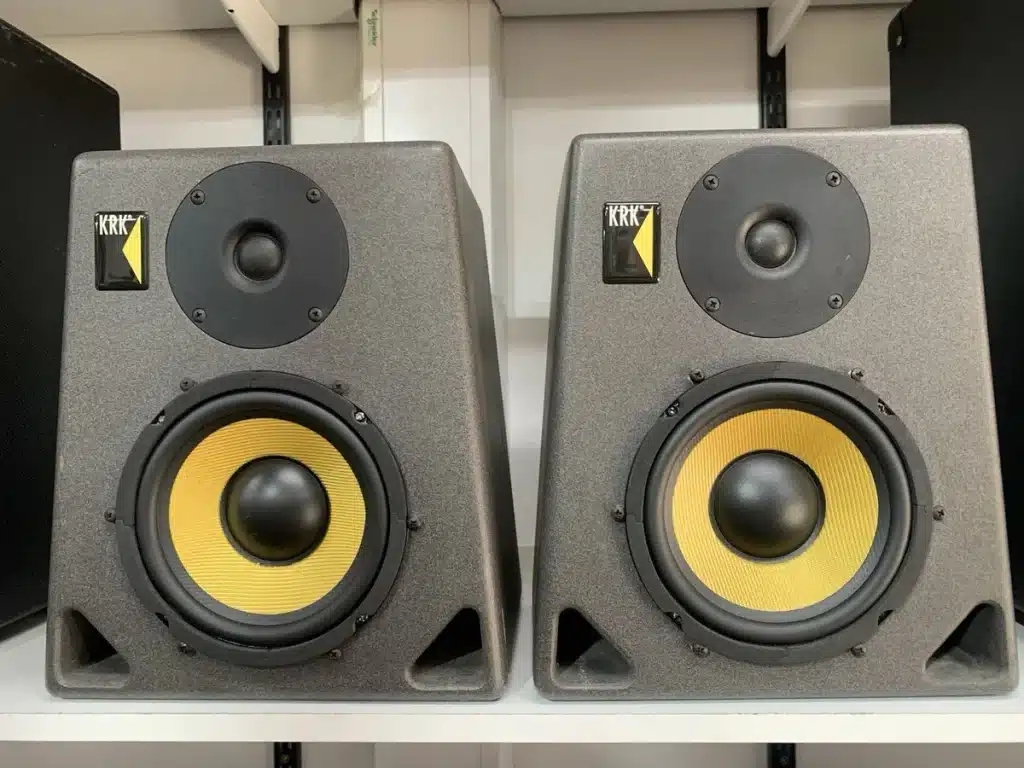
The Kreate series is the latest chapter in that story: an entry‑level line that keeps the familiar KRK character while embracing Bluetooth, creator‑oriented features and a more living‑room‑friendly aesthetic. It’s KRK saying, “Yes, these are proper monitors – but they don’t have to look or feel intimidating.”
Where The Kreate Line Fits
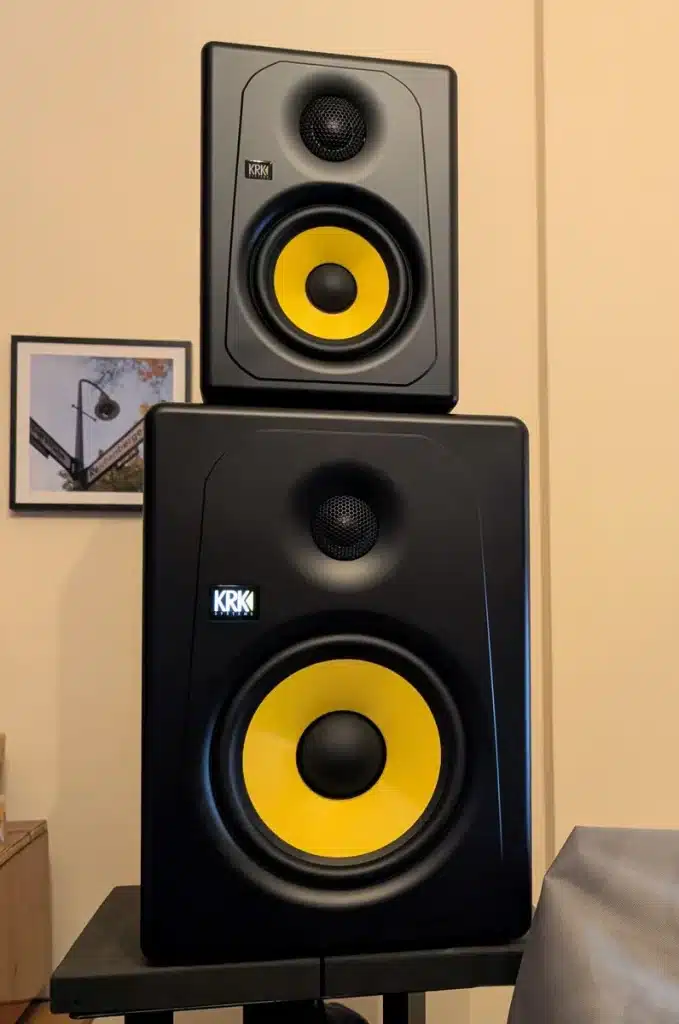
The Kreate family consists of three models: Kreate 3, Kreate 5 and Kreate 8. The Kreate 3 is a tiny active/passive pair for pure desktop use, while the Kreate 5 and Kreate 8 are fully active nearfields, each with their own amplification, inputs and controls. All three use rear‑ported MDF enclosures, woven glass‑fibre woofers and fabric‑dome tweeters, and all share KRK’s goal of offering “legendary KRK performance” to emerging musicians, producers, podcasters and content creators.
In practical terms, the Kreate 5 is the compact, small‑room all‑rounder; the Kreate 8 is the muscle – the one you pick if you need more low‑end reach, higher SPL and a bit more authority for modern, bass‑driven genres.
What they are is a very smart answer to a familiar question: “What can I buy, right now, that will let me learn, work and enjoy music without wrecking my budget?”
Perfect For: First Serious Studio (And A Solid Second Rig)
The clearest sweet spot for the Kreate 5 and Kreate 8 is that “first proper studio” moment: you’ve outgrown headphones‑only mixes and multimedia speakers, you want something you can actually learn on, but you’re not ready (or able) to drop serious money on high‑end monitors. The Kreate 5, in particular, feels purpose‑built for this situation: compact enough for a desk, with a quoted 58 Hz–40 kHz frequency response and 60 W of bi‑amped power per speaker – more than enough for nearfield work in a small room (check out our Kali Audio IN-UNF review for more desktop friendly speakers).
The Kreate 8, with its 8‑inch woofer, 100 W of power and extension down to around 48 Hz, is better suited to slightly larger spaces and genres where low‑end carries the emotional weight. It also makes an excellent “B” system in a more advanced studio – something you can turn up, enjoy and still trust when checking how your mixes feel outside a perfectly treated control room.
Design, Connectivity And Everyday Workflow
KRK has clearly tried to make the Kreate line as at‑home in a living room as it is in a studio. Both the Kreate 5 and 8 use vinyl‑wrapped MDF cabinets with sculpted front baffles and the familiar yellow cone, now protected by a perforated metal grille. The Kreate 5 even comes in a Latte finish – a mid‑century‑friendly beige/tan that visually disappears in more domestic spaces while keeping the yellow cone as a subtle accent.

Connectivity is generous for this price point. On the back of each speaker you get:
- Balanced XLR input.
- Balanced TRS input.
- Unbalanced RCA input.
- Bluetooth 5.x wireless audio input.
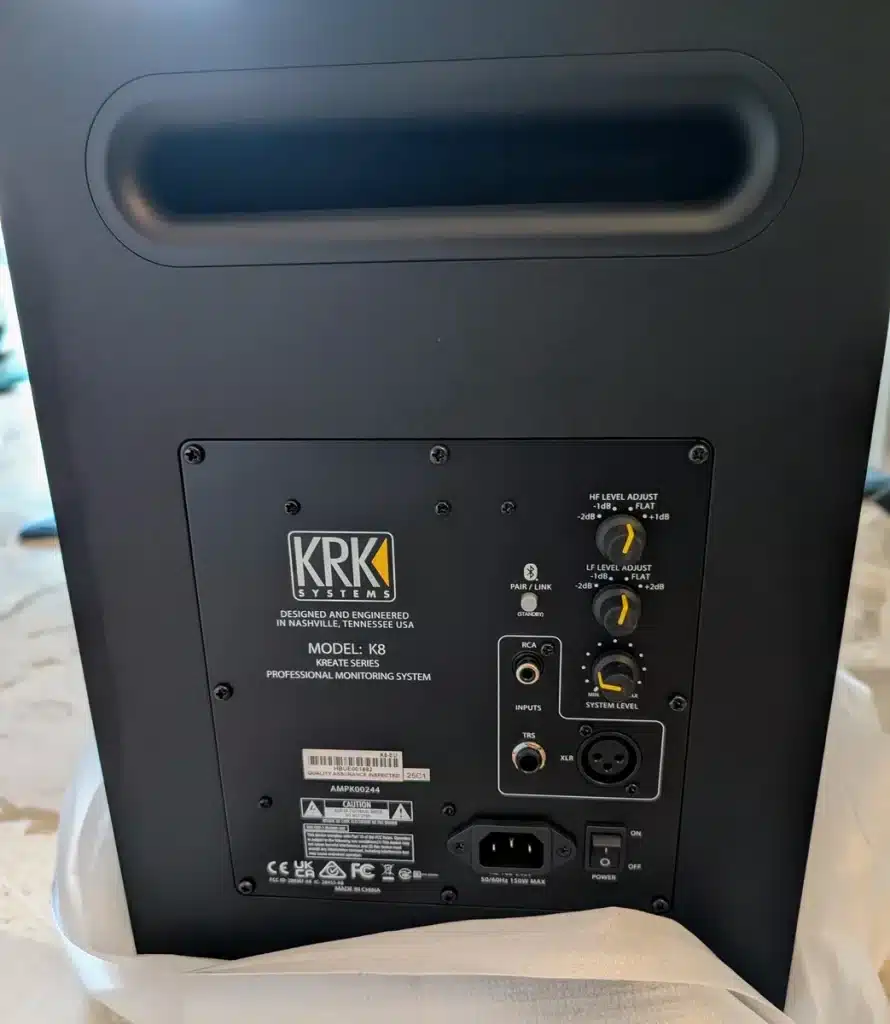
Each monitor is fully active and independent – there’s no “master/slave” arrangement – so both cabinets carry the same amplification, controls and input options. Bluetooth is implemented as a proper audio input, not a gimmicky add‑on: you can keep your DAW connected via balanced cables and still pair a phone or tablet to quickly audition references or playlists.
There’s a simple control cluster on the rear panel: System Level (gain) knob, HF and LF trim knobs, Bluetooth pair/link button, IEC power socket and power switch. No screens, no app, no menu diving – just physical controls that invite you to set and forget.

How Do The Kreate 5 And 8 Sound?
Sonically, both speakers sit in a comfortable middle ground between flattery and honesty. KRK’s own materials talk about “legendary KRK monitoring performance” with wide bandwidth and boundary‑compensation EQ; in practice, that translates to a sound that’s detailed enough to make mix decisions, but not so forensic that listening becomes a chore.
KRK Kreate 5: Compact, Punchy, Surprisingly Grown‑Up
The Kreate 5’s spec sheet tells you it reaches down to about 58 Hz and up to 40 kHz, and delivers 60 W of bi‑amped power with a 5‑inch woofer and 1‑inch tweeter. In use, that translates to more low‑end than you’d expect from the footprint, without the exaggerated bass hump that gave older budget KRKs a love‑it‑or‑hate‑it reputation.
Kicks and bass lines feel present and controlled rather than flabby, provided you give the rear port a bit of space from the wall. The midrange is slightly warm rather than icy or etched, which makes long writing and editing sessions much less fatiguing. The top end is detailed enough to show sibilance and cymbal balance, but it stops short of the harsh “cheap tweeter glare” that plagues many low‑cost monitors.
Stereo imaging is another pleasant surprise: the sweet spot is wide enough that you can lean left or right without the centre image collapsing, which is a gift when you’re moving around a small room or sharing the listening position.
KRK Kreate 8: Big‑Room Authority
The Kreate 8 steps things up in almost every respect: 8‑inch woofer, quoted extension down to roughly the high‑40 Hz region, 100 W of power and max SPL figures in the low‑110 dB range. In practice, it feels like someone extended the floor of your mix. Sub‑heavy kicks, 808s and cinematic low‑end elements finally have room to breathe, and the speaker doesn’t panic when you turn it up. Being used to the Dynaudio BM-5A, I could appreciate the extra “oomph”, if you know what I mean.
Crucially, the Kreate 8 doesn’t just throw out more bass; it keeps the low‑end reasonably tight and glued to the midrange. Vocals and mid‑forward instruments remain intelligible even when there’s a lot happening down low. The tonal balance still leans a touch warm and “musical” rather than reference‑monitor flat, but for the target audience – producers, beat‑makers, content creators – that’s often a plus.
BT, Buttons And The Joys Of Real‑World Use
Bluetooth is one of the headline features of the Kreate series, and used the right way it’s genuinely helpful. KRK pitches these monitors as suitable for everything from casual playback to serious production, and the wireless input fits that hybrid brief: you can quickly stream a reference track from a client’s phone, switch to a podcast, or just unwind with music without re‑patching anything.
Latency, of course, is still latency. Bluetooth is fine for listening, not for playing instruments or doing tight editing. Treat it as a convenience reference path rather than a replacement for cables, and it makes sense.
The auto‑standby behaviour ties neatly into this everyday workflow. Once you stop sending audio, the speakers wait a while and then quietly slip into sleep, drawing minimal power and dimming their LEDs. When you wake your computer and hit play, they pop back to life without you having to touch a single switch. During my time with the Kreate 5 and 8, I never felt the need to power them off manually – I could effectively put both my Mac mini and the speakers to bed from the Finder and get back to work instantly when inspiration returned.
For anyone who dislikes this behaviour, KRK also lets you toggle the auto‑standby feature via a button sequence on the rear panel, but for day‑to‑day studio life it’s a genuinely handy “set and forget” feature.
On the ergonomics side, there are two small but noticeable niggles:
- The System Level knob on the back has no numeric scale, only a marker. Once you move away from the default position, precisely matching the left and right speakers becomes a bit of a guessing game. You can get very close by using pink noise or a mono track and trusting your ears (or an SPL app), but a simple printed scale would have made this much easier.
- The Bluetooth pair/link button lives on the rear panel. If your speakers are on stands or pushed close to a wall, reaching back to pair or disconnect devices is awkward. It’s fine if you pair once and rarely touch it; it’s much less convenient if you imagined constantly switching between multiple Bluetooth sources.
Both of these are small, everyday annoyances rather than deal‑breakers, but they’re worth knowing about up front.
Practical Setup Tips And Suggested Settings
To get the best out of the Kreate 5 and 8, a few practical details matter more than the spec‑sheet numbers.
- Placement
- For Kreate 5: aim for roughly 0.8–1.2 m from your listening position, with at least 20–30 cm between the rear port and the wall.
- For Kreate 8: 1.0–1.6 m distance is more comfortable, and 30–50 cm from the wall helps avoid excessive low‑end buildup.
- Form an equilateral triangle between your head and the two speakers, and keep the tweeters at ear height.
- Worth Knowing (for Kreate 5): placing the speakers directly on a desk causes the MDF cabinets to vibrate the wood, “smearing” your low end.
How to fix it: Don’t just rely on the built-in foam. Invest in a set of IsoAcoustics stands or even basic high-density foam wedges. It will tighten the 100 Hz−250 Hz range significantly, making the Kreate 5 sound much “faster” and more accurate.
- HF/LF trims
- If the speakers are near walls or on a resonant desk, start with the LF trim at –1 or –2 dB to tame boom.
- In a bright, reflective room, a small HF cut (–1 dB) can help reduce splashiness.
- In a treated space, leaving both trims flat is often the most honest starting point; only adjust after you’ve lived with them for a while.
- Level‑matching workaround
- Use one speaker as your reference and set a comfortable listening level via your interface.
- Switch to the other speaker alone and gently adjust its System Level until both feel equally loud.
- If you’re fussy, use an SPL meter app; otherwise, your ears will get you surprisingly close.
- Using Bluetooth sensibly
- Keep the balanced inputs as your main path for DAW and critical listening.
- Reserve Bluetooth for reference tracks, casual playback and client demos.
- To avoid pairing chaos, agree on a “main” device for Bluetooth in shared rooms.
Little things, but they turn the Kreate from “nice budget boxes” into something you can happily work on every day.
Pros And Cons
Pros:
- Excellent price/performance ratio for both Kreate 5 and Kreate 8.
- Solid, punchy low‑end (especially on the 8) and a generally non‑fatiguing tonal balance.
- Flexible connectivity: balanced XLR/TRS, RCA and Bluetooth on each speaker.
- Simple yet useful HF/LF trims and straightforward analog controls – no menus, no apps.
- Independent active speakers (no master/slave), making each cabinet equally capable.
- Auto‑standby/sleep mode that lets the speakers power down gracefully when you stop working.
Cons:
- Rear Level knob has no numeric scale, making precise left/right matching fiddly.
- Bluetooth pair button on the back is awkward to access in many real‑world setups.
- No advanced DSP or room‑correction, which could help in very problematic rooms.
- The Kreate 5’s low‑end can only go so far; bass‑heavy producers may still prefer the Kreate 8 or a sub.
Pricing And Availability
Street prices always move, but as a rough guide (per speaker, not per pair):
- KRK Kreate 5
- Around 125–160 USD.
- Around 115–140 GBP.
- Around 129–160 EUR.
- Typical examples include listings around 139–159 EUR in mainland Europe and roughly 149 USD in the US.
- KRK Kreate 8
- Around 190–230 USD.
- Around 170–200 GBP.
- Around 199–230 EUR.
- European retailers often list them in the 199–229 EUR zone, with similar pricing bands in dollars once tax and shipping are factored in.
Official product pages and local dealers will always have the latest numbers and finish options:
Final Thoughts: Do You Need These?
If you already own premium monitors in a treated room, the KRK Kreate 5 and 8 probably aren’t here to dethrone them. What they are is a very smart answer to a familiar question: “What can I buy, right now, that will let me learn, work and enjoy music without wrecking my budget?”
All I can tell you is that, given their price, feature set and real‑world behaviour, the KRK Kreate 5 and KRK Kreate 8 absolutely deserve to be on that shortlist. They are efficient, honest‑enough tools with just enough personality to be fun, and just enough restraint to be trusted. If you’re at the “first serious monitors” stage – or you’re looking for a reliable Plan B that doesn’t feel like a toy – do yourself a favour and at least audition them before you write them off as “just another budget box”.