


There’s already a free plugin that does extreme time-stretching. It’s called PaulXStretch, it works in your DAW, and it’s been around since 2018. So when William, the solo developer behind Parallel Minds Studio, built Reverie around Paulstretch as just one of 38 processing modules, the interesting question isn’t what the tool does in isolation — it’s what gets added around it.
The answer, as it turns out, is quite a lot.

What Reverie Actually Is
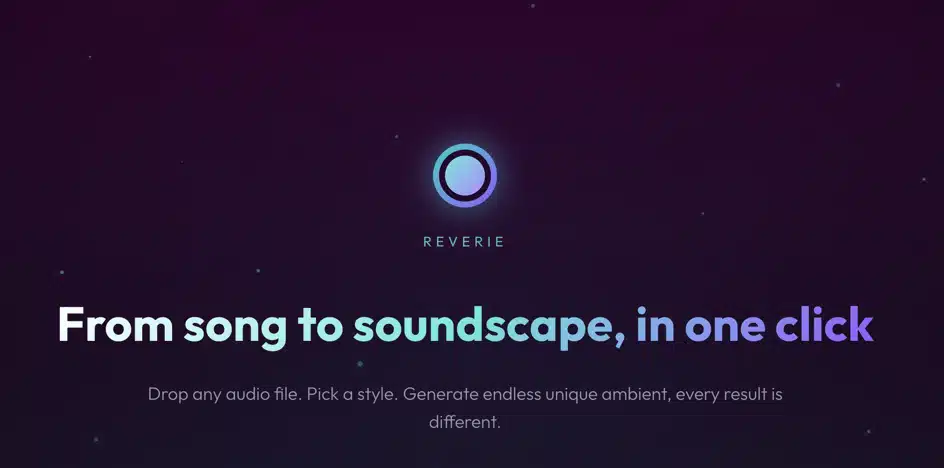
Reverie is a standalone desktop application — no DAW, no plugin format — that takes any audio file and outputs up to 30 minutes of evolving ambient music. Drop a WAV, MP3, FLAC, M4A, OGG, or AIFF file, pick one of 19 styles, adjust four sliders (variation, brightness, stretch intensity, duration), and click generate. The app builds a complete processing chain automatically and renders the result offline, no internet required.
The developer documented the build process in a post on dev.to: the app runs on Python and Electron, and the processing engine chains modules in sequence based on the chosen style. This is genuinely a solo project — one person’s attempt to make a category of sound design that usually requires specialist knowledge require nothing of the sort.
38 Modules, Not Just One
The press release leans on Paulstretch as the headline feature, which is slightly misleading. Paulstretch handles extreme time-stretching (up to 100x), but looking at the actual effect chains on the product page, not every style even uses it. The Spectral style, for instance, chains Lowpass → Spectral Freeze → Spectral Blur → Shimmer Reverb → Stereo Width — no Paulstretch involved.

The more technically interesting modules are:
- Phase-vocoder time-stretching — based on Nasca Octavian Paul’s phase-locking research, preserving spectral coherence during extreme expansion
- Stochastic synthesis with Markov chains — probability-driven generation rooted in Iannis Xenakis’s Formalized Music (1992), which treated composition as a mathematical probability problem long before generative audio became a product category
- Spectral Freeze and Spectral Blur — FFT-based transformations in the frequency domain, referencing Laroche and Dolson’s 1999 research
- Temporal Evolution — the module specifically designed to prevent 30 minutes of output from becoming sonically static
The seed system is worth flagging: every generation is tied to a reproducible seed, so you can return to a result you liked and render it again identically. For generative tools this is basic hygiene, but it’s still skipped more often than it should be.

The PaulXStretch Problem — and Why It Doesn’t Kill Reverie
If you own a DAW and have used PaulXStretch (free, by Sonosaurus), Reverie’s value proposition needs some unpacking. PaulXStretch can generate hours of drone material from a five-second sample. It has spectral shaping. It has live input. It’s free.
What it doesn’t do is sequence those transformations over time, layer them with additional modules, or manage the arc of a 30-minute piece. Reverie is closer in spirit to Sampleson Scaper, which we covered in October 2024 — another tool built around the idea of “any audio in, hours of ambient out” — but with a broader processing palette and a more explicit focus on temporal structure.
The question Reverie is answering isn’t “can I mangle audio?” It’s “can I get a finished, usable ambient piece from my material without learning how to mangle audio?” That’s a different product for a different person, and at €19 one-time, the pricing reflects it.
Stochastic Synthesis Is Not a New Idea
The Markov chain reference in the feature list will mean nothing to most of Reverie’s target audience — and everything to the small subset who recognize it as Xenakis’s compositional method from the 1950s. Iannis Xenakis applied stochastic probability theory to orchestral composition in works like Metastaseis (1955) before codifying the approach in Formalized Music. Using Markov chains to manage variation in a generative ambient system is a direct lineage from that work, even if the use case here is background music for a Zoom call.
That’s not a criticism — it’s context. The underlying science in Reverie is serious. Whether the outputs justify the technical pedigree is something only extended listening will answer. How about you — have you experimented with PaulXStretch or similar tools before? What stopped you from sticking with them?
Pricing and Availability
Parallel Minds Studio Reverie is available now for macOS (Apple Silicon and Intel, macOS 11+) and Windows (10+, 64-bit). Both versions require 4GB RAM.
- Free version: Up to 3 minutes, 5 styles, no account required
- Pro version: €19 one-time — up to 30 minutes, 19 styles, 15 artistic presets, all 38 modules, no subscription
A 30% introductory discount is currently available with code APG30 until April 30, 2026, bringing the Pro version to €13.30.
Download and full details at reverie.parallel-minds.studio.


