KOMA Elektronik has never shown much interest in building conventional synthesizers or predictable grooveboxes. For well over a decade, the Berlin shop has treated sound design as an electro-acoustic science experiment, preferring exposed motors, contact microphones, and raw control voltage over clinical digital menus. Their ongoing partnership with sound-art duo Passepartout Duo continues that streak. Following their touchless instrument debut with the original Chromaplane, the team has introduced the KOMA Elektronik Haloplane, an electromagnetic micro-loop sampler and wavetable instrument that replaces keys and buttons with physical coils and handheld pickups.
Instead of tapping velocity pads or dragging automation curves on a screen, you sculpt sound by physically moving two stereo pickups through space. It’s an intriguing tactile setup, but it demands an entirely different performance mindset than your average desktop sampler.

Seven Playable Fields and the Four-Second Rule
The surface of the KOMA Elektronik Haloplane houses seven independent electromagnetic fields. Each field generates its own short looping sample or wavetable, equipped with a dedicated LFO and dedicated parameter set. You can capture audio directly onto the device using either the built-in microphone or an 1/8-inch line input.
However, anyone expecting a phrase sampler or multi-bar loop recorder will hit a wall quickly. Each field caps recorded audio at four seconds. The Haloplane chops incoming audio into micro-loops, slicing the waveform based on your length setting and smoothly morphing across slices with the position dial. You can scrub through grains, invert playback direction, and detune pitch across the surface. Wavetable mode shrinks this architecture down into single-cycle oscillations. Each wavetable holds six distinct waveforms that morph via the position control, while the length parameter adjusts pulse width in forward playback or sync effects in reverse.

Field Rotation, Dynamic CV, and the Complete Omission of MIDI
One of the more clever concepts on the Haloplane is field rotation. Rather than keeping each sound stationary on the physical panel, field rotation continuously shifts the active fields across the instrument’s surface. A melodic figure or granular texture can cycle beneath your hands while your pickups stay fixed in place. Because rotation is fully voltage-controllable with modes for triggers, continuous rotation, and phase reset, you can synchronize this physical layout shift to external analog gear.

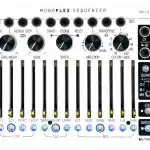
The back panel leans hard into modular integration. The onboard multi-mode state-variable filter and selectable effects engine (reverb, delay, flanger, chorus, and bit-crusher) both provide dedicated CV inputs. Furthermore, the pickups output an envelope follower signal alongside a dynamic modulation CV that shifts continuously based on physical pickup activity. Much like KOMA Elektronik’s Monoplex, the machine prioritizes kinetic voltage modulation over static patch recall.
Then comes the catch: the Haloplane contains zero MIDI connectivity. There is no 5-pin DIN, no 3.5mm TRS jack, and no USB-MIDI protocol. If your production setup relies on MIDI clock, start/stop messages, or external keyboard tracking, you won’t find help here. To pull external audio through the device in a DAW environment, you must boot the machine into its dedicated USB audio mode. In this mode, the Haloplane shows up on macOS, Windows, and Linux as a 7-channel audio interface, letting you route individual stems directly into each electromagnetic field from your DAW.
Browser Control for a Screenless Machine
KOMA designed the hardware to function entirely standalone, avoiding tiny OLED screens that clutter the performance panel. Standalone play handles immediate recording, playback, filtering, and preset loading smoothly. When you want to edit wavetables, organize your 100 preset slots, load custom scales, or set specific micro-tuning increments down to a single cent, you must turn to the companion app.
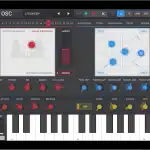
Instead of requiring an internet connection or clunky driver installations, the Haloplane broadcasts its own local Wi-Fi hotspot. You connect any phone, tablet, or computer browser directly to the instrument to access visual waveform slicing, drag-and-drop sample imports, and wavetable design tools. Everything saves directly to an internal SD card. It’s a clean way to keep the hardware chassis distraction-free, though sound designers doing deep sample curation will still need a laptop or tablet propped up next to the box.
Pricing and Availability
Pre-sales for the KOMA Elektronik Haloplane open on November 12, 2026, at 16:00 CET (10:00 AM NYC / 7:00 AM LA / 3:00 PM London) directly through the KOMA Elektronik webshop.
KOMA is using a tiered pricing structure across four pre-order batches that reward early buyers before hitting full retail:
- Batch 01: €486 (limited to 30 units)
- Batch 02: €505 (limited to 50 units)
- Batch 03: €532 (limited to 100 units)
- Batch 04: €550 (limited to 200 units)
Once those 380 pre-order units sell out across the tiers, the instrument will move to its standard retail price of €648. When an instrument enters your cart, the price locks for 15 minutes to complete checkout. Orders are capped at two units per customer. Buyers should prepare for a wait, as initial production batches will begin shipping in early 2027 as units are assembled.