

Viiri Audio Aava looks like the sort of plug-in that starts as a “hmm, interesting” demo and ends up sitting on your template because normal convolution suddenly feels too static. The big deal here is not just that Aava does convolution; it is that it treats impulse responses like living material, letting you reshape them in real time instead of waiting for the processor to settle into a polite, frozen state.
Why Aava Stands Out
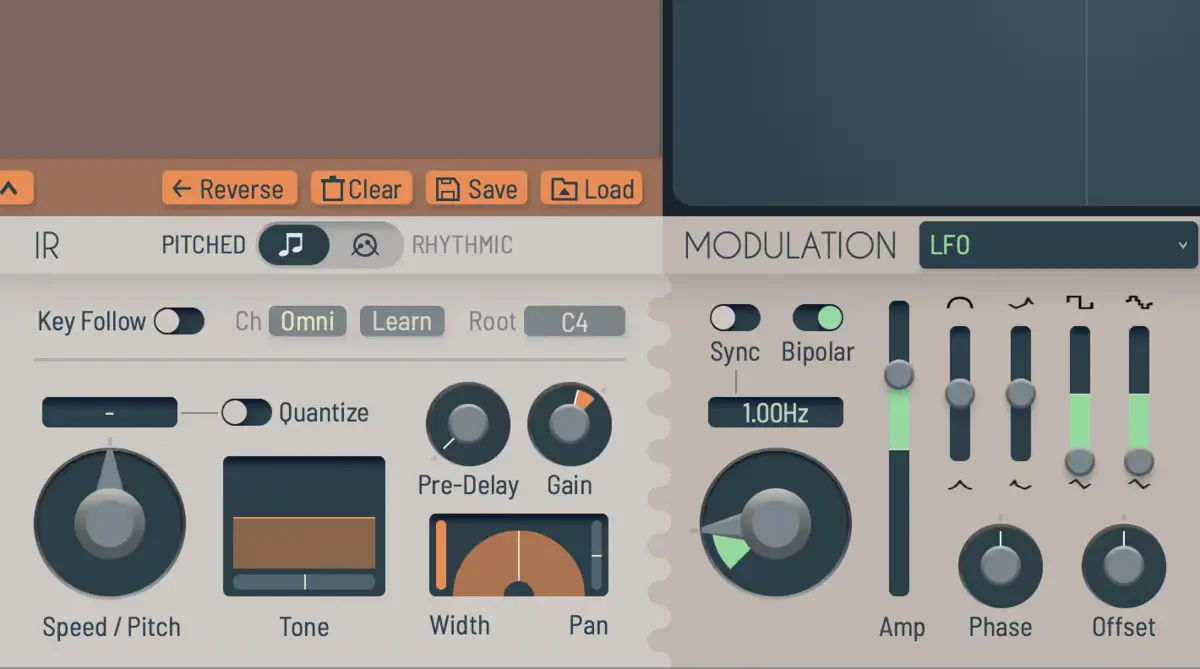
Aava’s headline trick is real-time modulation of impulse-response parameters without the usual glitches, fades, or transport-killing interruptions. You can alter start time, length, pitch, and timing while playback is running, and the company says this can happen even at audio rates. That alone pushes the plug-in beyond the usual reverb-and-go mindset and into more experimental territory, where the IR becomes something you perform rather than simply load.

The other thing that makes Aava feel more like an instrument than a utility is the four-layer approach. You can load up to four impulse responses, blend them, and give each one its own behavior — which opens the door to stacked textures, hybrid resonances, and movement that a single IR rarely delivers. The pitched and rhythmic modes matter too: pitched IRs can be key tracked, while rhythmic IRs can lock to host tempo, so the same engine can function as a tuned resonator or a grid-friendly rhythmic effect depending on what you feed it.

The Explore Map
The Explore Map is the feature that really gives Aava its own identity. Instead of treating presets as fixed snapshots, it stores full plugin states as nodes and lets you interpolate between them on an X/Y plane — meaning you can move from one sound world to another continuously, without stepping through preset names and hoping one lands close enough.

It is also the kind of workflow that makes sound design feel hands-on in a useful way. Rather than automating every control individually, you shape a larger trajectory and refine the details inside it. That distinction matters particularly if you build textures for film cues, ambient pieces, or experimental electronica, where motion carries more weight than any single static effect.
Convolution, The Time Is Now
Convolution has spent years being treated as a specialist tool for spaces, cabinets, and realism, but the direction of travel in creative processing keeps pulling it toward more expressive roles. BT’s Phobos explored that idea from the sampler side back in 2017; Aava takes a more focused, processor-first approach and pushes it further with modulation that Phobos never attempted. The difference is that Aava centres the concept on motion inside the impulse response itself, which is a more radical proposition than dressing convolution up with extra preset banks.
That timing is relevant because producers are increasingly reaching for tools that respond musically, morph cleanly, and stay interesting over long arrangements — the same appetite that made tools like Lese Smear worth covering. Aava addresses the same problem from a different angle: instead of spectral manipulation, it gives you a modulation-first approach to one of the oldest processing techniques in the book.
Pricing and Availability
Viiri Audio Aava (I hear you, not the most memorable name!) is available now in AU, CLAP and VST3 formats for Linux, macOS, and Windows. The intro price is 79 € / $79 / £69 until June 15, 2026, after which it settles at 99 € / $99 / £89. A fully functional 30-day trial is available directly from the Viiri Audio website.