

Antares invented pitch correction in 1997. Nearly three decades on, the company that defined the sound of modern pop — intentionally and accidentally — is carving a new tier into its flagship lineup. AutoTune Advanced launches today at $450 perpetual, slotting above the streamlined AutoTune and alongside the manual-editing workhorse Auto-Tune Pro 11. The pitch is a rebuilt algorithm, a patent-pending vibrato engine, and sub-millisecond live latency. The catch — and there is one — comes at the end.
DVA™: The Vibrato Story Worth Actually Reading
The headline feature is DVA™, a patent-pending vibrato engine Antares is calling a first for automatic pitch correction. The problem it targets is real: standard pitch correctors flatten vibrato indiscriminately. Correct a singer with natural vibrato and you get a result that sounds tuned rather than sung, because the algorithm can’t tell the difference between a pitch error and an expressive pitch modulation. DVA™ claims to make that distinction — detecting the vibrato the singer intended, leaving it intact, and correcting everything around it.
“Since 1997, the complaint about pitch correction has been the same: it takes the singer out of the singing,” said Jeff Wright, CEO of Antares Audio Technologies. “That’s the problem DVA was built to solve. It can tell the difference between a pitch error and a decision the vocalist made, and it leaves the decision alone.”

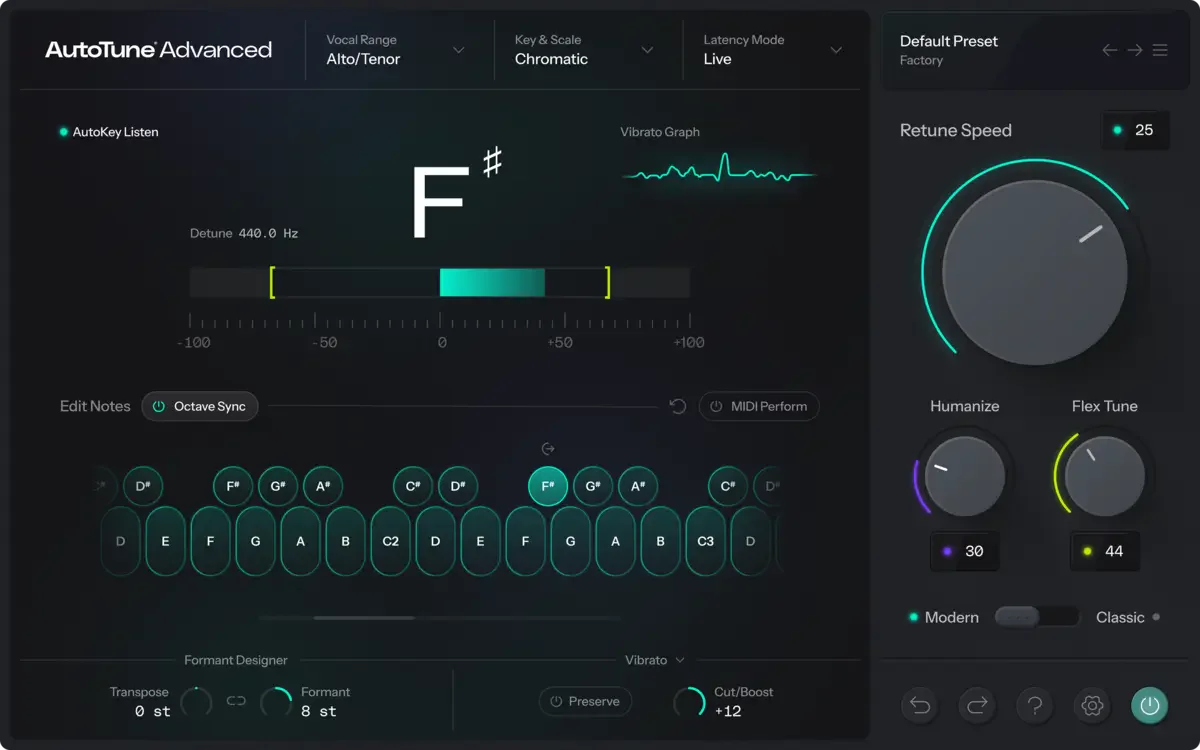
From there you get a full set of controls. Preserve the detected vibrato, reduce it, boost it, or generate synthetic vibrato where there was none — sine, square, saw, or triangle shapes. A real-time visualiser shows what the engine is hearing as it hears it, which matters both for dialling in the right amount and for explaining a processing decision to a vocalist who’s not sure why their voice sounds different through cans.
The obvious comparison is Melodyne, which can isolate individual pitch components including vibrato modulation via its DNA (Direct Note Access) technology. But Melodyne’s DNA works in a region-based editor — you’re working with transferred audio inside the plugin. DVA™ operates in Auto Mode, in real time, with the vocalist in the room. Different workflow, different use case, and whether the detection is as precise as Melodyne’s is a question that studio use will answer, not a spec sheet.
The Algorithm Rebuild and Live Latency Mode
Underneath DVA™, Antares describes this as the largest engineering investment in the AutoTune algorithm since its introduction. Modern Mode delivers what Antares claims is the most accurate and transparent automatic tuning they’ve shipped — pitch moves toward the note without the processed edge that reveals heavy correction. Classic Mode is also on board for the hard-tuned vocal sound that has shaped popular music since 1997, when that’s the goal. Flex Tune preserves expressive pitch movement between notes rather than locking every glide. Humanize stops sustained notes from sounding mechanically static.

The three latency modes are where engineers tracking live vocalists will focus. Live mode reports plugin latency of 0.84 ms at 44.1 kHz — meaning the session’s sample rate never costs you feel during tracking. Low Latency covers general studio work. High Quality is reserved for final mixes and bounces, where latency doesn’t matter and audio fidelity does.

One clarification: that 0.84 ms figure is the plugin’s processing latency, not your total monitoring chain latency. Buffer size, driver round-trip, and interface all contribute separately. In a hardware monitoring setup where the vocalist hears dry signal, this is a non-issue. Running IEM monitoring through the DAW, it makes a real difference — and that’s the use case where the Live mode spec earns its weight.
What You’re Getting — and What You’re Not
The scale and key workflow has been redesigned around a single panel covering all twelve keys and modes simultaneously, replacing the previous menu-based approach. A 78-note Visual Keyboard gives you note-level control — include or exclude individual pitches from the scale, bypass what should stay untouched, or retune specific notes by hand while leaving intentional bends and runs exactly as sung. AutoKey 2 compatibility means key and scale detected from any track syncs instantly across every Advanced instance in the session.
The Formant Designer shapes vocal timbre with precision across pitch and formant independently. MIDI Perform is a new addition worth flagging for live and hybrid setups: it maps a MIDI controller directly to AutoTune Advanced’s main tuning controls and Vibrato FX, letting you ride them in real time or write automation straight into the session without touching a mouse.
The plugin ships with signature presets from GRAMMY-winning engineers and producers including Ann Mincieli (Alicia Keys, Beyoncé, Jay-Z), Julian Marley, Tom Norris, and Benjamin Thomas (Pharrell Williams, Lil Uzi Vert, Future). “The vibrato mode on AutoTune Advanced gives you the perfect opportunity to both push the AutoTune hard, but also keep that natural vibrato that is essential to a singer’s performance and realism,” said Thomas.
No Graph Mode. That’s the line. Note-by-note pitch editing with a drawn automation curve still lives in Auto-Tune Pro 11 exclusively, and Antares is explicit about it in their own materials. If your sessions involve forensic repair — fixing one word without touching the phrase around it — AutoTune Advanced doesn’t do that. The Harmony Player from Pro 11 is also out of scope.
At $450 perpetual, AutoTune Advanced sits between two existing products and replaces neither of them for every job. For engineers who live in Auto Mode and want the most vibrato-aware, algorithm-fresh version of that workflow, the case is solid. For anyone who reaches for Graph Mode regularly, Pro 11 is still the ceiling — and now costs you an extra product purchase to get there.
This is a launch piece. We haven’t put AutoTune Advanced through its paces in a session yet, and the claims around DVA™ detection quality and the rebuilt algorithm are exactly the kind of thing that only real tracking time can validate. We’ll be back with a full review.
Pricing and Availability
AutoTune Advanced is available today, September 24, priced at $450 as a perpetual license. VST3, AU, and AAX on macOS and Windows. Compatible with Pro Tools, Logic Pro, Ableton Live, FL Studio, and all major DAWs supporting those formats. AutoKey 2 compatible.
AutoTune Advanced is included in Auto-Tune Unlimited at no extra cost from launch — existing subscribers get it on day one. A free trial of Auto-Tune Unlimited is also available to everyone via the Antares website.
More information at https://antarestech.com/products/pitch-correction/advanced.