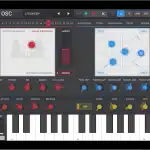
PEACH is a polymetric arpeggiator plugin from boutique developer 510k Arts that breaks free from the tired up/down patterns that have defined arpeggiation for years. Priced at $49 and available in AU, VST, VST3, and AAX formats, it brings independent lane lengths to each parameter, creating evolving, meter-shifting sequences that sound organic rather than mechanical.
Breaking the Loop
The core concept here is refreshingly simple yet powerful. Instead of forcing every lane to march to the same step count, PEACH lets you set different lengths for Gate, Hold, Octave, Velocity, and three assignable MIDI CC lanes. This polymetric approach means your patterns don’t just loop predictably, they shift and evolve, creating musical phrases that feel alive.
After spending time with it, I found the workflow genuinely intuitive. You’re not wrestling with complex menus or buried parameters. The clever interface, designed by Resonant Design, puts everything where you’d expect it. Each lane has its own step count control, and you can set individual play modes: forward, backward, pendulum, or random. Mix these up across lanes and suddenly simple three-note chords spawn intricate, constantly evolving arpeggios that would take ages to program manually.

Seven Lanes of Independence
The five core lanes handle the fundamentals. Gate controls note duration at each step. Hold determines whether notes sustain or retrigger. The Octave lane shifts notes up or down across a range you define globally. Velocity adds dynamic expression, so patterns breathe rather than pound at a static level.
What really grabbed my attention are those three MIDI CC lanes. You can route these to any synth parameter: filter cutoff, resonance, decay, whatever strikes your fancy. This turns PEACH into more than an arpeggiator, it becomes a modulation sequencer running alongside your note patterns. Having these lanes operate at their own independent lengths means your timbral movement drifts in and out of phase with the rhythmic content, creating exactly the kind of organic complexity that makes electronic music feel less programmed.
The Big Picture Controls
The global panel handles note order (up, down, order played, random), latch mode, octave range limits, and swing. The scale quantization proved particularly useful in my testing. You can snap everything to factory scales or create custom ones. Play anything on your keyboard and it stays musical, locked to the scale you’ve chosen. For sketching ideas quickly, this removes a lot of friction.
There are also two advance modes: Arp Advance and Step Advance. These control how the arpeggiator moves through your held notes and through each lane’s steps. Similar to the creative features found in Arturia’s KeyLab MK3 controllers, it’s the kind of detail that seems minor until you realize how much control it gives you over timing and feel.

Controlled Chaos
PEACH includes dice buttons for instant randomization, but crucially, you can lock individual steps before rolling the dice. This means you can preserve the backbone of a pattern while randomizing everything else. It’s a smart middle ground between total control and happy accidents, the kind of feature that actually gets used rather than just looking good in a spec sheet.
You can store up to 12 patterns per preset and switch between them instantly via MIDI. For live performance or even just A/B testing ideas in the studio, this makes the plugin feel performance-ready rather than just a sound design tool.

Here’s a video walkthrough:
How It Holds Up
In practice, PEACH works exactly as advertised. Feed it a simple triad and within seconds you’re getting complex, shifting patterns that would be tedious to program step-by-step in a piano roll. The polymetric interaction between lanes creates natural variation without sounding random or chaotic.
The undo/redo functionality is there when you need it, and the interface scales well across different screen sizes. As a MIDI effect plugin, it requires a software or hardware instrument downstream to generate sound, but that’s standard for this type of tool. It plays nicely with all major DAWs: Ableton Live, Logic Pro, Bitwig, Cubase, Studio One, FL Studio, Reaper, Pro Tools.
Community response has been enthusiastic. Users on Reddit’s AudioProductionDeals forum praised its playability, with one commenter saying they tested the demo and immediately decided to purchase. Another endorsed it strongly, calling it “incredibly enjoyable.” The consensus seems to be that PEACH delivers on its promise without unnecessary complexity.
Pricing and Availability
At $49, PEACH sits in affordable territory for a specialized MIDI tool. A demo version with limited features is available from the 510k website, so you can test it in your workflow before committing. You can also purchase it from Plugin Boutique. The plugin received an update to version 1.0.2 in October that added AAX support for Pro Tools users, showing ongoing development attention.
PEACH is designed by Alexkid, coded by Tadashi Suginomori of HY-Plugins, and shares design philosophy with 510k’s other sequencers, SEQUND and POLYLLOP. The company positions these tools as complementary, and users who enjoy polymetric sequencing will likely find value in the full ecosystem.
Other Options Worth Considering
The arpeggiator plugin space isn’t exactly crowded with polymetric options, but there are a few worth checking out. BLEASS Arpeggiator (around $29-39) takes a different approach, wrapping complex pattern generation in a synth-like interface with built-in modulators and even its own FM synth engine. It’s polyphonic and can trigger up to four notes per step, which makes it more of a pattern sequencer hybrid than a traditional arpeggiator.
Kirnu Cream (€35) is an older but capable step-based MIDI arpeggiator and sequencer that offers extensive performance features. The interface feels dated compared to modern plugins, but it’s got depth if you’re willing to dig into it.
For macOS users specifically, there’s XiiixxiQ, a free Euclidean-based polymetric sequencer that’s genuinely impressive – although I haven’t seen any updates for quite some time, and it might be abandonware FYI). It uses summed Euclidean generators to create evolving patterns and includes 2D/3D sequence morphing. The catch is it’s macOS-only and works best as a Logic Pro MIDI FX plugin, but at zero cost it’s worth exploring if you’re on Mac.
Within 510k’s own ecosystem, SEQUND and POLYLLOP offer complementary approaches to polymetric sequencing. SEQUND focuses on probability-based pattern generation, while POLYLLOP handles polyphonic polymeter sequencing. If you find yourself drawn to PEACH’s polymetric workflow, the other 510k tools might be worth investigating as they’re designed to work together.
The Ups and Downs
PEACH excels at generating evolving patterns quickly. The polymetric lane approach is genuinely musical, not just a gimmick. The interface is clean and performance-friendly. Scale quantization removes wrong notes from the equation. Randomization with step-locking strikes a good balance between control and experimentation.
Worth knowing: PEACH is specifically designed for polymetric arpeggiation. If you want traditional up/down/random arp patterns with no fuss, you probably don’t need this. And if you’re looking for a full-blown generative sequencer with extensive probability lanes and complex conditional logic, 510k’s own SEQUND might be a better fit. PEACH does one thing well rather than trying to be everything.
Worth Your Time?
PEACH delivers polymetric arpeggiation in a package that’s both immediate and deep. It’s priced fairly, works reliably across platforms, and most importantly, it generates patterns with real character. The sequences it produces have a liveliness and unpredictability that static loops lack, and that’s ultimately what makes it worthwhile. For producers working in electronic music, ambient, or anything that benefits from evolving textures, PEACH is a solid addition to the toolkit that I’d recommend exploring.