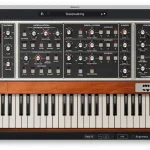
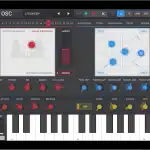
Celebrating its 25th anniversary, Arturia has just unveiled its latest innovation: the AstroLab stage keyboard. According to the French company, this 61-key powerhouse combines sleek design, intuitive controls, and an expansive ecosystem of sounds.
A Universe of Sounds at Your Fingertips
At the heart of AstroLab lies an awe-inspiring library of over 1,300 presets, meticulously crafted using 10 types of synthesis and 35 engines. From intimate keys and vintage synths to acoustic instruments and modern textures, this stage keyboard offers a constellation of sounds that cater to every musical style and creative vision.
Arturia’s Phi/TAE technology is seamlessly integrated into AstroLab, granting access to 33 iconic instruments from their acclaimed Analog Lab software. With a simple turn of the navigation wheel, you can effortlessly explore this vast sonic universe and find the perfect sound for your performance.

Arturia AstroLab’s Integration with Your Studio
One of AstroLab’s standout features is its ability to bridge the gap between your studio and the stage. Thanks to the included Analog Lab software, you can effortlessly transfer your carefully crafted sounds from your DAW to AstroLab, eliminating the need for a computer and streamlining your live setup.
The AstroLab Connect app takes this integration even further, allowing you to control, customize, and organize your sounds on the go. And with Analog Lab Pro, you can access Arturia’s entire sound library, dive into in-depth sound design, and unlock an additional 2,000 presets from their renowned V Collection.
Designed for Expressive Performances
AstroLab’s thoughtfully designed controls and features are tailored to empower live musicians. The navigation wheel and screen make preset browsing a breeze, while the four macro controls enable quick sound editing. The dedicated chord, scale, and arpeggiator modes allow you to embellish your performance with ease, and the loop and record functionality lets you capture MIDI phrases up to 32 bars long.

For your Kraftwerk or Daft Punk moments, AstroLab offers a handy feature: a dedicated vocoder engine that can be accessed by simply plugging in an external microphone.

Built to Withstand the Rigors of the Stage
Arturia has spared no effort in ensuring that AstroLab is a reliable companion for your live performances. The integrated design eliminates latency, cable clutter, and unwanted dropouts, giving you the confidence to focus on what matters most: your music.

The robust aluminum and bakelite construction strikes the perfect balance between durability and portability, making AstroLab an ideal choice for musicians on the move.
Pricing and Availability
€/$1599. Currently available only from Arturia’s website and major stores like Thomann.

Arturia AstroLab – Hit Or Miss?
At ANR, we have always been enthusiastic supporters of Arturia’s V Collection (can you believe we created some audio demos for the v.1 of their Minimoog V and CS-80 V?), and Analog Lab has proven to be an indispensable tool in our songwriting and music production workflows.
With the introduction of AstroLab, Arturia aims to provide the best of both worlds by integrating the power of Analog Lab into a stage-friendly keyboard, offering a vast library of sounds, intuitive controls, and seamless integration with their software ecosystem.
It’s worth pointing out that, like Analog Lab, AstroLab doesn’t offer tons of hands-on controls. The focus is on performance more than sound design, and having the most important parameters of each preset under your fingers is, in Arturia’s vision, the most effective way to achieve this goal. It’s up to the user to decide if this approach suits their needs.
As someone who has been in the industry long enough to remember Arturia’s previous attempt at a “VST in a box” concept with the Origin (launched in 2009), I can’t help but draw comparisons. Perhaps the Origin was ahead of its time, or maybe Arturia’s marketing efforts weren’t as strong back then, but despite receiving some positive reviews, it never quite achieved the success the company had hoped for.
However, given Arturia’s impressive track record with hardware products over the past 10 years or so (MatrixBrute and MicroFreak, anyone?) and the brand’s current popularity, AstroLab might just succeed where Origin fell short. Only time will tell, but at a glance, the AstroLab appears to be a powerful stage keyboard with the potential to make a significant impact on the market. The pricing is in line with the professional stage keyboard market and is fair, considering the instrument’s features and flexibility.
I’ll be honest with you. If I were still a live music performer, I would put the AstroLab at the top of my shopping list. If it works as promised, it would save me so much time – no computer to carry around anymore, no extra cables, audio interface, etc.
That being said, I do have some reservations about the timing of this release, considering the recent decline in live music performances across several countries. It will be interesting to see how the AstroLab fares in the current climate.