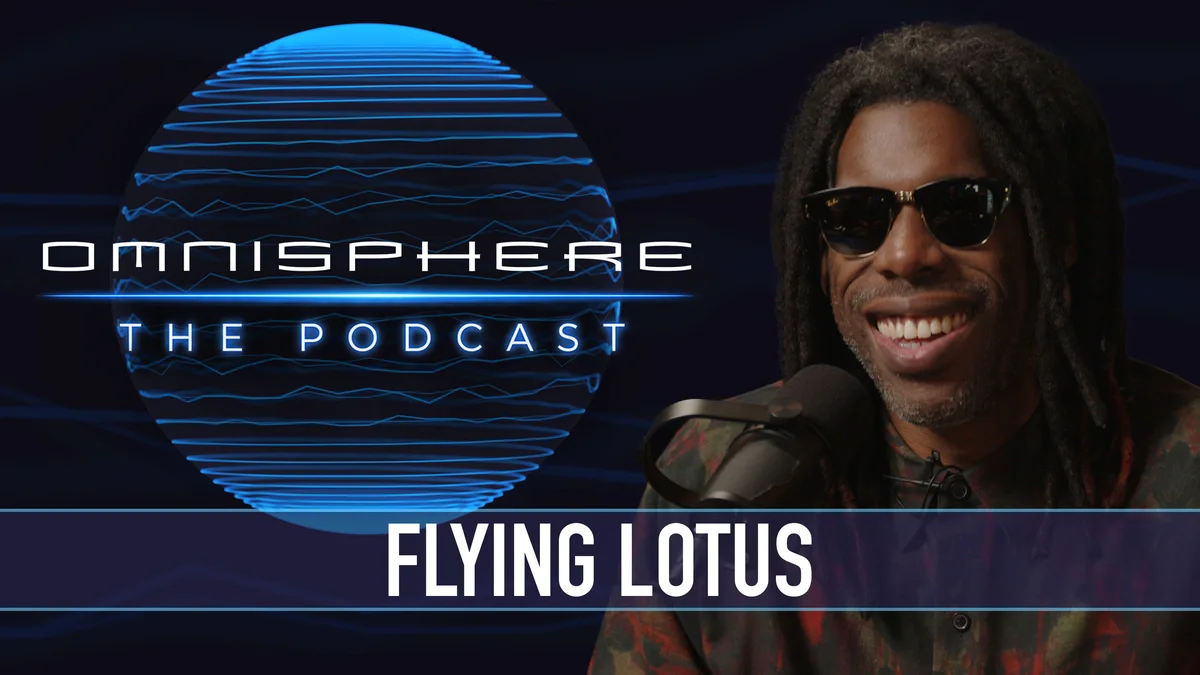


Spectrasonics has launched a podcast, and the first guest is Flying Lotus. A company talking to one of its own best-known users is not a neutral setup, so I went in expecting a long commercial. It is partly that. It is also a better watch than that, because the Omnisphere segments are specific and the conversation has real texture.
Who Is Flying Lotus Talking To?
Omnisphere the Podcast is a Spectrasonics production, and the first episode is a sit-down with Flying Lotus, hosted by James Bernard. The conversation covers his creative background, his family, running the Brainfeeder label, how he handles distraction and creative lulls, and what he wants to do next. He says he has never really had writer’s block, only days when he feels terrible and days when he just needs to sit in the chair. His rule is that there is always something to work on: chords to learn, sounds to build, craft to improve even when no tune comes out of it.
It is also not shy about its own product. The host closes with a desert-island quick-pick round, and the whole thing is clearly designed to put Omnisphere in front of Flying Lotus’s audience. Fair enough. The interesting question is what gets shown on screen.

A 1969 Tape of Sun Ra Meeting the Minimoog
The conversation drifts to Afrofuturism, and Flying Lotus says he really wants to make a sequel to Sun Ra’s Space Is the Place (a title that names two things: Sun Ra’s 1973 album, and the 1974 cult film directed by John Coney that stars Sun Ra and his Arkestra. In the film, Ra lands a music-powered spaceship in Oakland and offers to relocate Black Americans to a new planet, after settling their fate in a card game with a devilish figure called the Overseer. Both are the best entry points into Sun Ra’s cosmology). He never says which one he means, but his talk of “more to tell with that story” and the host’s joke about teleporting the whole planet through music suggest the film, which would fit a man who has just directed his second feature. The host then plays something he clearly saved for the right moment: tape from 1969 of Sun Ra and his bandmates checking out Bob Moog’s first Minimoog prototype and talking to him about it.
The audio is a good listen. Moog describes working with tone colour instead of pure pitch, with a synthesizer letting you move continuously from pure pitch to noise, bright to mellow. The Sun Ra side of the exchange pushes back on where music ends and noise begins, asking how you would even measure it if a musician is the one using it. Flying Lotus’s reaction is about how clear the vision already was, even though it took years for musicians to catch up. If you care about the history of the Minimoog, this clip alone justifies the runtime.

How Flying Lotus Actually Uses Omnisphere
This is where the episode earns its place. Flying Lotus says he has used Omnisphere since roughly 2017 or 2018, starting with version 2, and that it sits in his template every time. His description of it is that it does everything, with a warmth and analog feel that can still turn very clean, and that you can stack layer on layer.

The live setup is the highlight, and the context matters. Flying Lotus is talking about his recent short tour with a live band, with extra musicians on stage. For the first iteration of that show he ran 127 Omnisphere instances, so that he could build beats on the spot while the band played. He admits it was risky to have it all on one computer, though he reports no problems. A 16-pad controller handled patch selection, with each pad jumping to a different sound through an instrument rack chain selector in Ableton. Not every patch in the rack was Omnisphere, which is a refreshingly honest detail.
The host then shows a trick for exactly this kind of use. Live Mode in Omnisphere holds up to eight patches ready to go, selected by notes, which Flying Lotus has effectively already mapped to pads. Stack Mode adds splits, and the Stack Mode Note Regions option applies those splits only to the patches you bring in. The result is leads up high and bass down low, with a loop latched at the top of the keyboard, and you decide which layers are audible by touching pads. Flying Lotus admits he had only used Stack Mode as a split. Seeing him react to it as a real new option is more convincing than any product page.
The old standalone pitch from Spectrasonics always argued that these instruments could leave the DAW. Here, ironically, the best live trick happens inside Ableton.
Omnisphere 3 Effects, Applied to Everything
The last long segment is about the effects added in Omnisphere 3. Flying Lotus admits he has not used them as much as he should. So the host builds a demonstration around a stock sample from the Heart of Africa library, which is a raw sound source and not a patch, tied to the Sun Ra theme.
Half Speeder and Flip Backward capture the incoming audio and replay it at different note values, which turns a single horn sample into a rhythmic, brooding phrase. Warp Shifter adds a swishy movement, and some of the presets are, in the host’s words, “horror movie soundtrack all day”. The point is that these are tools for transformation, not polish.
Then comes the part I found more useful. The Omnisphere FX rack can also be loaded as a plugin on any audio track in Ableton. The host runs a clip of one of Flying Lotus’s own earlier tracks through a chain that includes Pumpamatic, Half Speeder, Refraction, Inner Space, Drifter and Pulsar Split, then peels the effects away one at a time until Flying Lotus recognises it. Pulsar Split, a two-band splitter with shaped, rate-based volume movement, is pitched as sidechain-style motion for a mix bus. Fun, and I would have liked to see more than one example, but it makes the case that Omnisphere 3’s effects can live outside the synth.
I have not tried the standalone effects against dedicated alternatives, so I would not read this as a verdict on any of them. What I can say is that the demonstrations are real and audible, which is more than most promotional videos manage. For more on the instrument itself, our Omnisphere 3 review covers the library and engine in depth.
Moog or Oberheim?
The quick-pick round at the end is mostly for fun. Flying Lotus picks Oberheim over Moog, which surprised the host, citing a juicy sound behind a lot of hits. Madlib versus Dilla is declined, he chooses Shogun Assassin over Seven Samurai and Mad Hatter over Headhunters, and he goes with John Carpenter over John Williams. Vangelis beats Tomita, because Vangelis was improvising much of it. It is pure personality, and it makes the episode feel like a conversation instead of a demo reel.
Where to Watch and Listen
Omnisphere the Podcast is free. The first episode with Flying Lotus is on YouTube, Apple Podcasts and Spotify. Spectrasonics promises more Omnisphere tricks in future episodes.