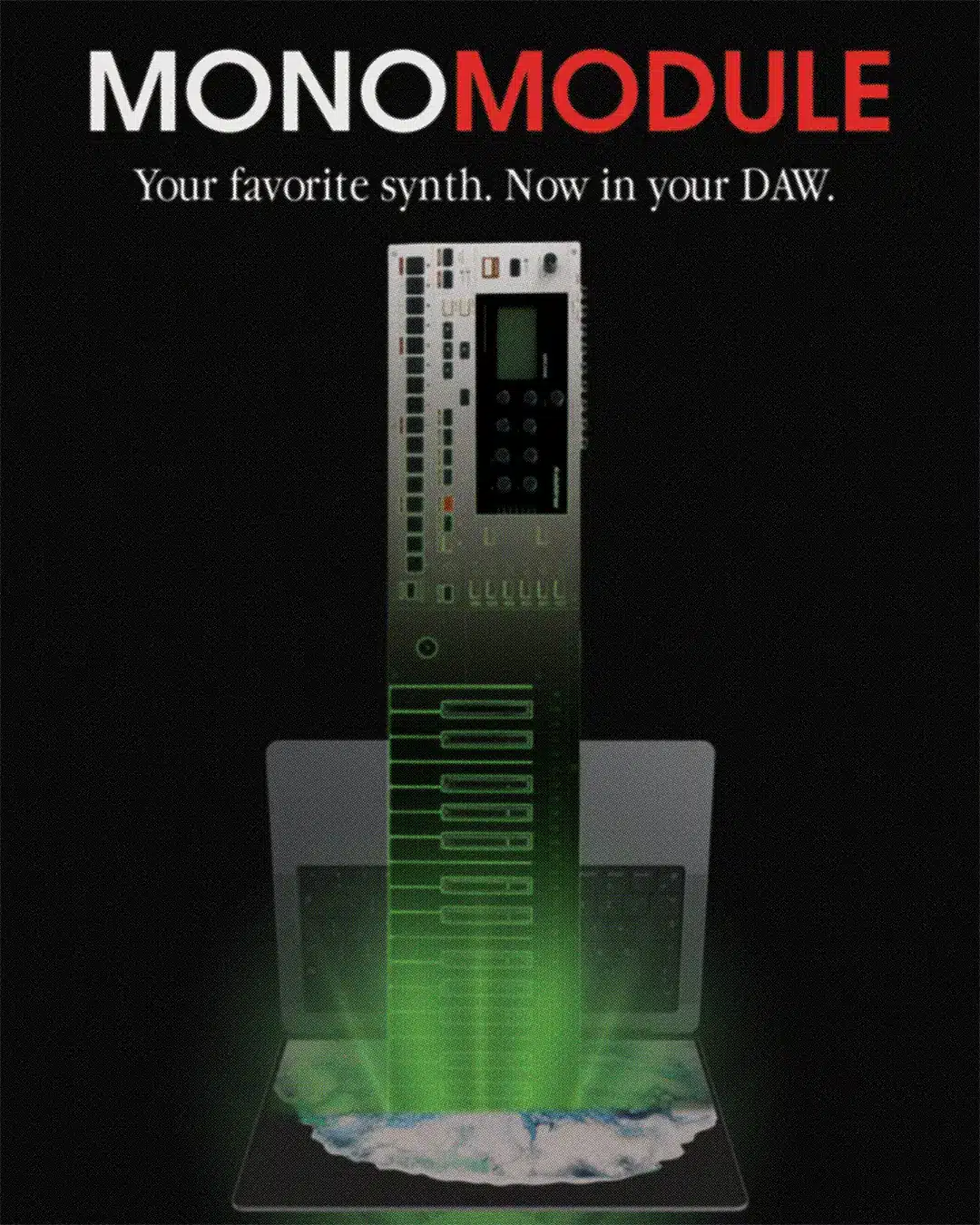


There’s a thought experiment that every gear romantic eventually has to run: if you stripped the interface, the panel, and the physical ritual from your favourite cult instrument—what would actually be left? For the Elektron Monomachine, a machine that has commanded four-figure prices on the used market for the better part of a decade and shaped the studio DNA of Sophie, Autechre, and The Knife—the answer just arrived as a free plugin. It’s called Monomodule. It dropped on September 24th. And it is both a technical marvel and an unwitting philosophical provocation.
The DSP, Liberated from Its Chassis
Developed by Shnoll DSP and released as free, open-source software under the GNU AGPLv3, Monomodule takes a different path from the emulator projects that preceded it. The DSP preservation lineage ANR covered previously—Osirus, Vavra, Xenia—generally required users to source proprietary ROM dumps through channels that occupied a legal and ethical grey zone. Monomodule found a cleaner door. Elektron has kept the Monomachine OS 1.32B firmware available as a free `.syx` update file on their legacy support archive. The plugin unpacks it on first boot, extracting the DSP program, compressed algorithmic data, and native LCD font graphics from the container—without ever redistributing the copyrighted binary. No ROM hunting. No forum whisper networks. You download it from Elektron directly.

Hardware manufacturers have long distributed monolithic firmware updaters to support legacy servicing, long after a product line ends. Monomodule is the sharpest demonstration yet that those same updaters quietly contain everything needed to run a machine’s brain in perpetuity. The legal pathway was sitting there the whole time.
The technical execution matches the ambition. In the original SFX-60 hardware, the Monomachine’s firmware divided responsibilities clearly: one layer managed envelopes, LFOs, and pitch tracking, passing a 52-word parameter block to the DSP engine every 16 samples and collecting 16 stereo frames of audio in return. Monomodule replicates that host role in C++/JUCE, with a JIT recompiler executing the DSP’s binary instructions directly—not approximating them, not modelling the circuit, but running the actual code, instruction for instruction, in real time. All 22 synthesis engines across the machine’s seven architecture families are operational. GND. SWAVE. SID. DPRO. FM+. VO-6. FX. Every one of them.

Four Plugins, One Download
The software arrives as a suite of four distinct tools. Monomodule One is the single-track monophonic voice—SYN, AMP, FILT, EFX, and all three assignable LFOs collapsed onto a single panel, no page-flipping. Monomodule Six is the full six-track multitimbral architecture in a single instance, responding across MIDI channels 1–6 with neighbor track routing intact.


Monomodule FX pulls out the Monomachine’s processing bus—Gated Reverb, Chorus, Dynamix Compressor, Ring Mod, Phaser, Flanger, Filter, and Delay—as a standalone DAW insert, usable on any audio you route through it. Monomodule Library is a standalone SysEx management app for auditioning hardware kit dumps through the live emulated DSP and dragging sounds directly into a session.

The CPU footprint is borderline absurd compared to what hardware owners were working with. Because the JIT backend compiles DSP instructions into native machine code, users on Apple Silicon are reporting they can run multiple simultaneous Monomodule instances with negligible system impact—a stark contrast to the six-track ceiling baked into the hardware by design.

What the Community Is Actually Discovering
Five days in, Elektronauts and r/Elektron are generating more friction than celebration—and that’s what makes this interesting. Acoustic fidelity is not the debate. Listeners confirm the fingerprint is exact: the harsh digital transients, the brittle 6581 SID rasps, the narrow resonant bandpass character, the specific way the delay collapses at low feedback settings. The hardware is in there.
Monomodule reveals something subtler. Several early testers report that the raw engines feel unexpectedly vulnerable once you isolate them in a DAW and strip away the sequencer chassis. The FM operators feature two and four-op configurations. Effective, but basic. The SID emulation highlights the 6581 chip’s digital edge, which always stood out because it was a technical limitation rather than a design goal. The GND machines produce clean sine tones and bit-reduced noise. These synthesis architectures do not exist merely to impress a plugin-browser window. Instead, they demand you drive them hard through the friction of a physical step-sequencer, parameter locks, and slide trigs working together across time.
The Monomachine sounded the way it did partly because of how you had to interact with it
The “demystification” effect, a phrase users on Elektronauts employed without prompting, is real. The Monomachine sounded the way it did partly because of how you had to interact with it. Hold a trig, turn an encoder, hear the p-lock reshape a pattern in real time. That workflow generated the kind of productive accidents that became career-defining sounds for a generation of electronic producers. Monomodule maps every parameter to standard MIDI CC and host automation. The control is total. The accidents have to be engineered deliberately.
The Cold Start
Monomodule v1.0 ships with zero presets. It boots to silence. You’re either importing SysEx dumps from actual Monomachine hardware, kits, patterns, sound bank. Or you’re starting from a blank INIT voice with 22 machines to choose from and no signposts.
To be fair, the original hardware’s out-of-the-box experience wasn’t entirely different. While Elektron did ship the unit with factory patterns and sounds, they were notoriously clinical. The real Monomachine workflow always required starting from a blank kit to sculpt sounds from scratch. But for hardware owners, the Library app handles this missing content well: drag your `.syx` archives in, audition everything through the live DSP, pull what you want into the session. For everyone else—the bedroom producers who wanted Monomachine access without the used-market price—the entry point is genuinely steep. The synthesis vocabulary here was learned on hardware. Without that muscle memory, or without the willingness to treat the machine’s historical constraints as the curriculum, version 1.0 is a cold room.
Monomodule Monomachine Emulator – What This Actually Proves
The Monomachine’s mythology rested on two pillars: the DSP code, and the physical interface that mediated your relationship with it. Monomodule has now cleanly separated them. The code is free, legal, and running on laptops across three platforms.
What the community’s early sessions are collectively finding is that both pillars mattered. The DSP is intact and genuinely distinctive. But the evidence is mounting that the instrument’s most generative quality was the productive friction of its hardware workflow—the sequencer, the trig buttons, the specific cognitive overhead of working within its constraints. Monomodule doesn’t diminish that insight. It proves it.
Pricing and Availability
Monomodule is free and open-source (GNU AGPLv3). The full suite—Monomodule One, Six, FX, and Library—is available now via monomodule.com for macOS 12+ (AU/VST3, Apple Silicon and Intel native), Windows 10+ x64 (VST3/Standalone), and Linux x64 (VST3/Standalone). Requires the Elektron Monomachine OS 1.32B `.syx` firmware file, available as a free download from Elektron’s legacy support archive.