In 1986, the Ensoniq ESQ-1 arrived at a price point — around $1,295 — that made polyphonic synthesis accessible to musicians who couldn’t afford a Prophet or a Juno-106. Its hybrid architecture, pairing digital oscillator waveforms with a genuine Curtis CEM3379 analog filter, produced a sound that sat between the clinical precision of early FM synthesis and the warmth of all-analog polys. Forty years on, Cherry Audio has rebuilt it in software — officially licensed from Creative Technology, who own the Ensoniq IP — and the result is more than a faithful port. It’s a considerably more powerful instrument than the original ever was, which raises a question worth sitting with: at what point does “faithful emulation” become a different synthesizer altogether?
What Cherry Audio Rebuilt
The foundation is solid. Cherry Audio worked directly from the original 32 ESQ-1 waveforms — licensed from Creative Technology — and modeled the CEM3379 analog low-pass filter in software, along with the four DCAs, four multistage envelopes, and three LFOs that defined the hardware’s character. For existing ESQ-1 owners — and there are still plenty of them — drag-and-drop import of SysEx patch files and direct MIDI patch transfers from the hardware are supported, as is export back to SysEx format. That bidirectional compatibility is a genuine differentiator. It means decades-old patch libraries slot straight into the plugin without any conversion headaches.

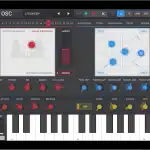
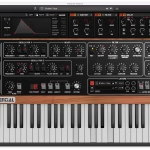
The original hardware had a notoriously awkward programming experience. A small LCD display and a data slider meant you navigated menus to edit almost everything. Cherry Audio’s response is to surface every control simultaneously across five tabbed sections — Play, Edit, Modulation, Envelopes, and Sequencer. That’s a reasonable design call, though it does explain early community feedback noting that the interface reads as dense. Compared to, say, the clean single-page layout of Arturia’s instruments or Cherry Audio’s own CR-78, the five-tab architecture has a learning curve. It’s faithful to the source material’s complexity, but it requires time investment.
Where It Goes Beyond the Original
Here’s the honest description of what’s actually on offer: a dual-layer engine with up to 32 polyphonic voices per layer, a four-slot modulation matrix with 41 sources and 85 destinations, channel aftertouch, polyphonic aftertouch, and full MPE support. The original ESQ-1 had eight-voice polyphony and a basic modulation architecture. Cherry Audio Ensoniq ESQ-1 is effectively a different instrument wearing the same clothes — which is not a criticism, but it does need saying.

The modulation matrix is the standout addition. Click-to-assign routing with that range of sources and destinations turns the ESQ-1’s already expressive signal path into something that can handle generative sequencing, complex evolving pads, and MPE-driven expressive performance. Stack two layers with independent controls in split or unison mode, and you have a polyphonic engine with a depth that the 1986 hardware could never approach. For producers who loved the ESQ-1’s sound but were limited by its architecture, that’s a meaningful upgrade. For strict emulation purists, it complicates the claim.

The Sequencer and Effects
The 16×4 polyphonic step sequencer — syncable, transposable, with humanise options and per-step note or modulation assignment — is a useful inclusion. It’s more capable than the hardware’s sequencer and integrates with the dual-layer architecture in ways the original couldn’t. The built-in arpeggiator works alongside it cleanly.
Three customisable effect chains with 20 effects cover the standard studio toolkit: reverb, delay, chorus, modulation, saturation. Nothing about the effects section is particularly unusual for a 2026 plugin release, but the arrangement, save, and recall system is tidy. Over 400 presets ship with the plugin, including the original ESQ-1 factory patches — a useful reference point for anyone wanting to hear how closely the emulation tracks the hardware.
The IP Story
The Creative Technology partnership is worth a paragraph. Creative Technology — best known for Sound Blaster, which gave PC audio its first mainstream platform — acquired the Ensoniq assets following Ensoniq’s dissolution into E-mu Systems and eventually into Creative itself. So when Cherry Audio says they’re “officially licensed,” they mean they cleared it with the same company that owns the Sound Blaster trademark. That’s an unusual ownership lineage for a synthesizer’s intellectual property, and it partly explains why this kind of licensed release hadn’t happened before for the ESQ-1.
The Soniq Odysseys Preset Pack by sound designer James Dyson ($9.99) offers 100+ presets and 25 MPE-specific presets for performers who want to exploit the new expression architecture immediately. At that price it’s a reasonable add-on rather than an essential, but the MPE content is genuinely differentiated — most factory packs don’t prioritise MPE performance specifically.
Pricing and Availability
Cherry Audio Ensoniq ESQ-1 is available now at $69 — stated as a permanent price, not an introductory offer. A free 30-day demo is available. Formats covered: AU, VST, VST3, AAX, and standalone for macOS 10.13+ and Windows 7+.
The real tactical dilemma here is the math. At $69 standalone, the ESQ-1 removes any typical introductory discount urgency. But if you look at Cherry Audio’s current ‘Build Your Own Bundle’ deal running through June 30, the math changes completely. Picking it up in a bundle drops the per-plugin price to roughly $25—making a standalone purchase right now a tough sell if you’ve been sitting on an active wishlist