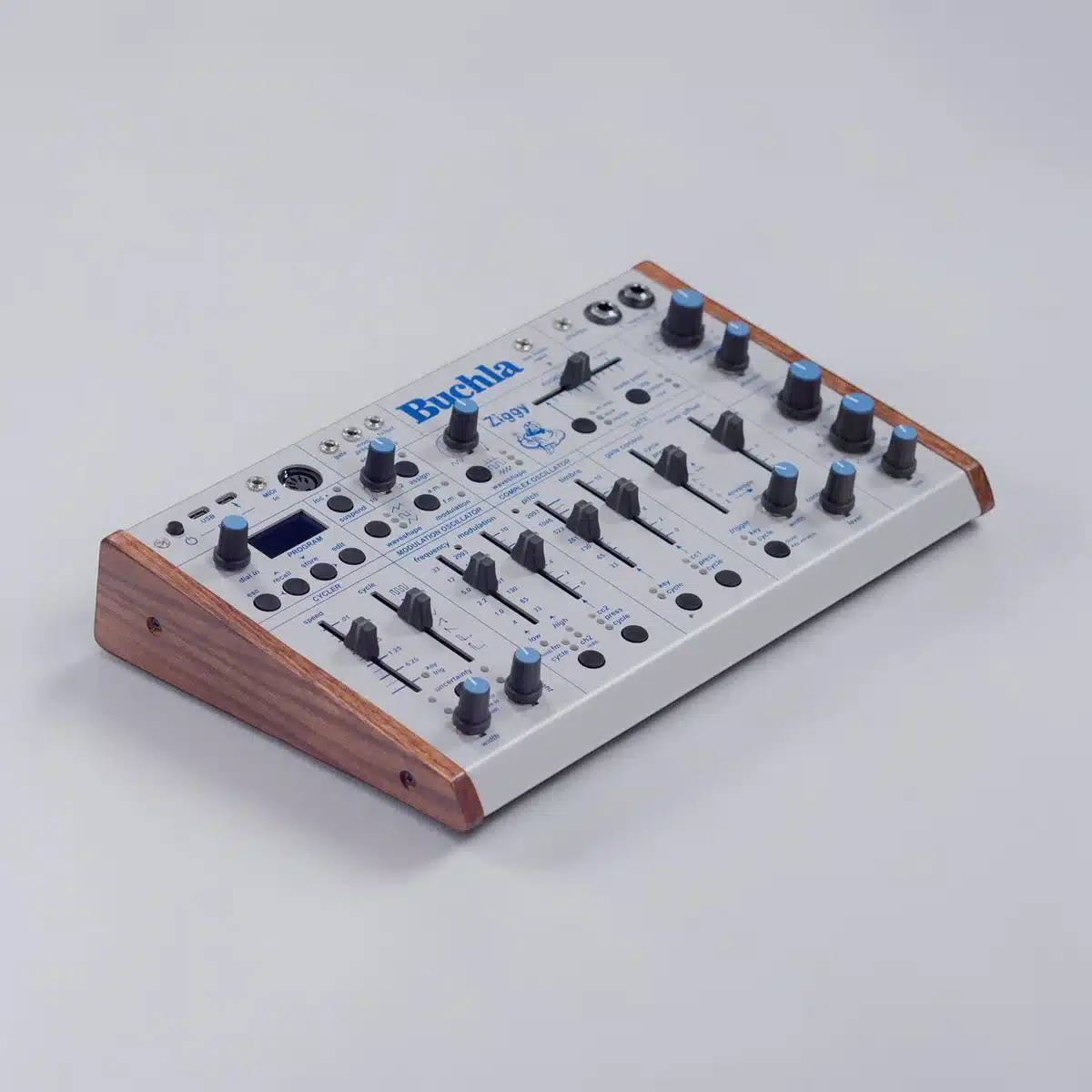


For decades, owning a real Buchla meant either serious money or serious luck. Ziggy changes that equation — a self-contained, analog desktop synthesizer built around the legendary Buchla complex oscillator, launching via Kickstarter at $899 for early backers and $999 at standard pricing.
The Long Road to Accessible Buchla
Buchla’s influence has always outrun its distribution. Over the past few years, the company worked with Arturia on Easel V software, Softube on Modules, and Tip-Top Audio on Eurorack versions of the 200 series — all collaborations that widened the audience without requiring a second mortgage. Ziggy is the first fully internal answer to that same problem: a complete instrument at a price that doesn’t need an apology.

Other attempts existed. Pittsburgh Modular’s West Pest took a crack at West Coast desktop synthesis, and the Make Noise 0-COAST leaned into patching and hybrid techniques. But as Peter Kirn noted at CDM on launch day: “What we haven’t gotten is a compact, portable Buchla that retains not just some elements of the signal architecture, but the signature Buchla interface and its hands-on approach.” That’s the gap Ziggy is specifically designed to close.
From the 208 to a Clean Slate
Designer Joel Davel — working with Don Buchla since the early nineties, with credits on the Lightning, Marimba Lumina, and the 200e series — drew direct inspiration from the recent 208 Programmed Sound Source update, the LEM218 Touch Activated Voltage Source, and the latest Music Easel revival. The difference with Ziggy was the freedom to start from scratch: presets, effects, a compact enclosure, and a completely rethought approach to interaction.

Firmware and software come from Dan McAnulty, who spent years at Keith McMillen Instruments before joining Buchla. The physical enclosure was designed by David Phipps, who fits Buchla work around his role as keyboardist for Sound Tribe Sector 9 — which probably explains why the layout reads as a performance instrument first and a sound design tool second.

The Complex Oscillator, Unpatched
The analog Complex Oscillator at Ziggy’s core starts from a sine wave and opens outward. It can be frequency or amplitude modulated by the onboard Modulation Oscillator, distorted through the Timbre wavefolder, and blended into spike, square, or sawtooth shapes — all the characteristic Buchla territory from glassy FM sidebands to woody percussives, free of digital aliasing.
What Ziggy removes is the patch cable. Modulation assignment works through a hold-and-move gesture: hold a button, move the target slider or knob, and the range is set. Color-coded LEDs along the sliders pulse in real time to show active modulations — a small design detail that makes the signal flow readable without a diagram. This approach traces back philosophically to the original 1973 Music Easel’s stored programs, which used physical resistors in the analog chain; Ziggy’s 127 preset slots do the same job with considerably less soldering.
The Modulation Architecture
The Cycler sits at the center of Ziggy’s modulation world — functioning simultaneously as envelope, clock, and LFO with mutatable waveshapes, variable width and height parameters, and a built-in Uncertainty control that introduces randomness in adjustable amounts. An additional XLFO with triangle shape runs alongside the Modulation Oscillator and Cycler for further movement.
The Low Pass Gate (Sallen-Key analog filter architecture) operates as VCA, filter, or both, with blended envelope shapes rather than a standard ADSR — nudging you toward sounds you didn’t plan rather than ones you precisely specified. The Games section routes Breakout, Pong, and Asteroid-style physics simulations as generative modulation sources. And the Suspend Local button lets you stage all parameter changes silently before releasing them at once — a genuine performance tool with no real equivalent on East Coast instruments.
Connectivity and Effects
CV modulation, gate, and 1V/oct pitch cover Eurorack integration. MIDI runs over USB-C, five-pin DIN, and Type-A mini. A mono 3.5mm external audio input feeds into the LPG, and stereo output exits through 3.5mm headphones and two quarter-inch jacks. Power is USB-C, with a second USB-C input for power-only use when adapting from older connections. Stereo digital effects — reverb, delay, chorus, flanger, pitch shift, and distortion variants — are each controlled by a wet/dry knob and a single macro “size” parameter. A WebMIDI browser-based editor handles patch storage and firmware updates.
Pricing and Availability
The Buchla Ziggy is available to preorder now. Kickstarter early backer pricing is $899, with standard retail at $999 (€1,039 / £915). A bundle with the Buchla LEM218 V3 touch keyboard is available at $1,999. First shipments are estimated for August/September 2026. Buchla is presenting Ziggy at Superbooth 2026, Stand B045.
- Buchla Ziggy — official product page
- Buchla Ziggy — Kickstarter campaign
- Order via Thomann (€1,039 incl. VAT)
Dimensions: 12.1″ × 7.7″ × 2.8″ (307 × 196 × 71 mm) — 5.1 lbs (2.31 kg), USB-C bus powered.