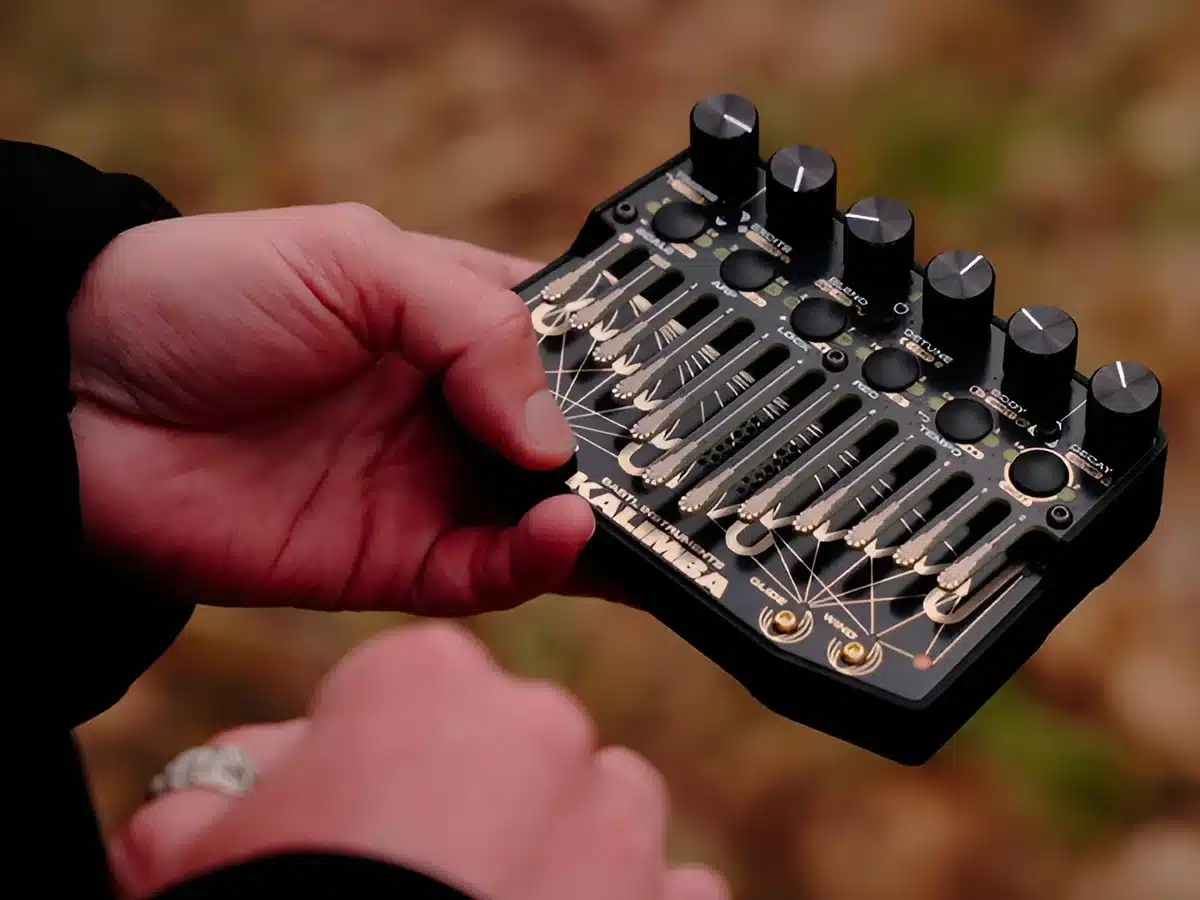


Bastl Instruments have spent three years on the Bastl Kalimba. Today, May 7th 2026 — the same week as Superbooth — they’re taking it to Kickstarter. The result is a 6-voice desktop synthesizer whose entire interface revolves around the tines of a thumb piano: pluck them, and you’re playing FM synthesis and physical modelling simultaneously.
The timing lands in an interesting moment for tine-based instruments. Earlier this year, Korg shipped the phase8 — an electromechanical acoustic synthesizer that uses electromagnetic drivers to vibrate real steel resonators. ANR first flagged the Korg phase8 concept back at Superbooth 2024, describing it as “a sort of Kalimba meets electronic synthesis and sequencer.” The Bastl Kalimba takes a different route entirely: digital synthesis engines excited by acoustic input, rather than electromagnetically driven physical resonators. Two different philosophies; the same family tree.

How the Sound Engine Works
Plucking the 12 touch-and-velocity-sensitive tines sends signals from internal stereo microphones and capacitive sensors into two synthesis engines running in parallel: FM synthesis and a physical modelling engine with stereo digital resonators. The harder the pluck, the more aggressively both engines respond. Knock or strum directly on the casing and the same thing happens — the microphones pick up the impact and use it as an exciter.
Six bipolar macro knobs handle parameter control across both engines simultaneously. There’s no separate FM patch page or physical modelling submenu for standard operation — one knob turn shapes the whole timbre. Bastl call this interactive macro mapping. It’s a practical way to keep a dual-engine instrument accessible without dumbing it down.
Motion as a Performance Tool
The internal accelerometer filters the left and right output channels of the FM engine independently as you tilt or rotate the device. This is genuinely spatial — it’s not a mod wheel substitute, it’s a stereo shaping tool tied to your body’s position in space. The accelerometer also doubles as an alternative exciter for the physical modelling engine, which means shaking or tapping the body of the unit is a legitimate playing technique, not an accident.

Four named touch zones on the front panel add further expression: Pad (manual volume fade), Glide (pitch slides between tines), SOIL and WIND (timbral modulation and resonator excitation). Two fully assignable touch points on the rear can be mapped to any knob, effect, pitch bend (±1 or 7 semitones), transpose, tempo, sustain, or arpeggiator parameters.

What’s Built In
The arpeggiator runs five modes — up/down/up-down/order/random — with velocity set by touch pressure rather than a fixed value. The internal looper runs free or tempo-synced and supports destructive looping: re-recording directly through the on-board effects chain, which includes a RAT-style distortion/bit crusher, chorus/flanger/tape emulation, a soft high/low filter, and reverb and delay (each with daytime and nighttime character models, adjustable decay and send level).
Twelve scales function as tuning presets, each with per-tine micro-pitch adjustment. Sixteen presets store all sound and arpeggiator settings. Six sensitivity levels compensate for different playing environments and hand sizes — a detail that matters more than it might seem for a touch-sensitive instrument.
Build and Connectivity
The Bastl Kalimba measures 144 × 95 × 50 mm and weighs 310g. It ships with a hardshell carry case. The internal microphones are calibrated to avoid feedback on stage. Battery charges via USB-C; there’s a built-in speaker for practice or outdoor use.
Connectivity covers: stereo 3.5mm output (150mW per channel), TRS MIDI in and out (Type A), analog clock in and out, and USB-C MIDI. That’s enough to sync to a DAW clock, integrate with a modular rig, or trigger external MIDI instruments from the on-board sequencer.
Pricing and Availability
The Bastl Kalimba Kickstarter runs 7 May to 6 June 2026. Tier breakdown:
- Super Early Bird — €389 (500 units)
- Early Bird — €420 (800 units)
- Kickstarter Special — €489 (1,000 units)
- Special Edition (includes neck strap) — €500 (500 units)
Optional add-ons include a custom strap, shirt, cap, USB-C wrist strap, stickers, and a Keitai charm. The first batch of 1,500 units is expected to ship December 2026. A second batch of up to 750 units may follow in early 2027. Post-campaign retail pricing will start at a minimum of €550, with units expected in stores by the first half of 2027.
Back the Bastl Kalimba on Kickstarter or visit the official product page. Bastl will be demonstrating the instrument live at Superbooth 2026, booth O385.