Introduction to Slate + Ash Primaries
Slate + Ash are industry leaders when it comes to the innovative use of sampling organic instruments and controlling sounds in the Kontakt sample engine. Primaries is their new sample library. If you’re already familiar with their previous releases we reviewed, like Auras and Cycles, you know they have a knack for pushing the envelope. Primaries is another inspiring release. It’s all about blending traditional orchestral sounds with cutting-edge electronic textures, making it a dream tool for anyone who loves to experiment.
For more details, check out the Slate + Ash Primaries product page.
I don’t know how long they spent recording and editing these sounds—to my mind it took a LONG time.
What’s the Big Idea?
Rather than focusing on the more typical purpose for organic instruments of melody and rhythm, Primaries is built around the concept of tonality and timbre. Slate + Ash put it thusly:

“Primaries explores solo strings as a fundamental colour in the orchestral spectrum. Notes behave like vibrant rays of light, merging together into abstract expressions of colour and texture.”
Primaries is going to be a future series of libraries (I’m assuming of separate orchestral instrumental sections), and this one is focusing on strings.
The library is a massive 65GB set of string samples, divided initially into three separate menus:
1. Individual Articulations
Each member of the string family has its own sub-menu of roughly 25 articulations. And these are not your usual bowing techniques. Slate + Ash outline how they worked with the string players to get performances of extended techniques and recorded them in great detail. The emphasis is on capturing as much of the timbral tone and colour of stringed instruments, moving away from typical bow patterns and into harmonics, taps, fumbles, ripples, bumps, and shakes. You can see Slate + Ash’s experience as working composers, getting as much dynamic and timbral quality from the players as possible. The ensuing tones are just gorgeous—rich, airy, scratchy, with loads of movement and organic evolution. Right in line with the contemporary focus on sound design in scoring.

2. Expressions
These are again subdivided by the stringed instrument. They’re more focused on performance and evolution of sound, and they’re made by morphing between two pre-selected articulations with the mod wheel, enabling you as you record to morph from quiet bowing to string taps in a smooth fashion. The editing and coding are excellent here, as you can’t really hear where one articulation stops and the other starts.
3. Sound Design
This is the meat of the library. Primaries is designed to veer off into experimental yet usable territory very quickly, blurring the lines between organic and digital—and here is where you’ll hear some of its potential. This section is subdivided into seven categories such as Texture, Atmosphere, Motion, Arp, Keys, and Pads. They contain presets that utilize the depth of modulation and effect capabilities of the engine with the natural, beautifully recorded string articulations.

Main Window
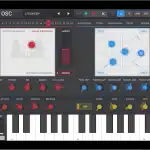
The main window is both the performance control—where you decide what articulations you’re going to use, how to layer them, adjust envelopes—and spatial control (more on that in a moment). A click of a button takes you into the effects window, which features 15 unique and excellent effects to completely alter the sound you began with.
Notable effects include:
- Buffer Effect: A stutter-type effect that can be very subtle and incredible for experimenting with an organic string library.
- Pulse Effect: Morphs from a gated sound to a gentler throb, adding nice movement to the original sound.
Using Space as Timbre
This is an unusual one. As mentioned above, the main window has a ‘Perspective’ XY window right in the middle. The samples have been re-amped in four different spaces—some real (Funkhaus Berlin and Realworld Studios) and some algorithmic (Bricasti M7). Each reamp signal is included in the library, with several options for positioning these four wet signals along with the dry signal within the Perspective XY window.
The signal, represented by a dot, can be effectively morphed between all reamp signals in real time—either to set sounds in a particular space or create timbral evolution using various modulation sources (LFOs, recorded movement, CC performance, or physics-style motion with bounce, magnetism, instability, etc.). It’s a really fun element of this machine—creating evolving color just by morphing source sounds between different places (real or algorithmic).
Input Modules & Output Effects
Input Modules
The two pink vertical bars open up powerful tools for shaping sound sources:
- A generative arpeggiator.
- A harmonics generator based on your chosen scale.
- A tape sound effect, introducing warmth and warble.
- A random generator, adding octave shifts, panning randomness, or tuning variation.
Output Effects
On the right side is the Master Effects bar for additional sound-shaping possibilities:
- EQ
- Lo-fi processing
- Compression
- Delay
- Reverb
Each effect opens deeper editing parameters upon clicking. The convolution reverbs go beyond what’s already in Kontakt’s engine—just gorgeous sounding.
The Sound
I don’t know how long they spent recording and editing these sounds—to my mind it took a LONG time. The quality of these recorded sounds is impeccable—absolutely beautiful. The emphasis is on slow-evolving, gently modulating sounds that can suit different atmospheres—from gentle beauty to quiet fright.
When you utilize input modules, run sounds through some of the 15 effects alongside spatial controls like Perspective XY Window or Master Effects bar—the results are breathtaking examples of blending organic and digital elements.
Here’s a video walkthrough from Slate + Ash:
Conclusion
Once again Slate + Ash have created an eminently usable library with incredible attention to detail where it’s needed most. If you’re looking for a string texture and ambience library suitable for scoring projects or experimental sound design work—this library would be hard to beat. I can’t wait to hear more libraries in this series!
For more information or to purchase Slate + Ash Primaries (currently priced at $249), visit Slate + Ash’s website. It’s also available via Native Access.