

Hardware giant Focusrite and Swedish boutique developer Klevgrand have maintained a software bundling relationship for years, shipping lite plugins with Scarlett interfaces. With Altitude Harmony, that partnership yields an actual co-branded commercial product. Derived directly from the full Altitude vocal workstation launched earlier this spring, this streamlined spin-off cuts out deep modulation envelopes and multi-voice MIDI routing in favor of an immediate, two-knob vocal tracking tool.
The premise addresses an enduring session problem: dialing in tight vocal doubles and harmonies during tracking usually stalls writing momentum. While flagships like Antares AutoTune Advanced continue pushing complex neural vibrato engines and premium subscription bundles, Altitude Harmony strips the vocal workflow back to basics. You set a scale, dial correction character, and push a single knob to generate stacked interval voices.

Two Knobs, Four Buttons, Zero Menus
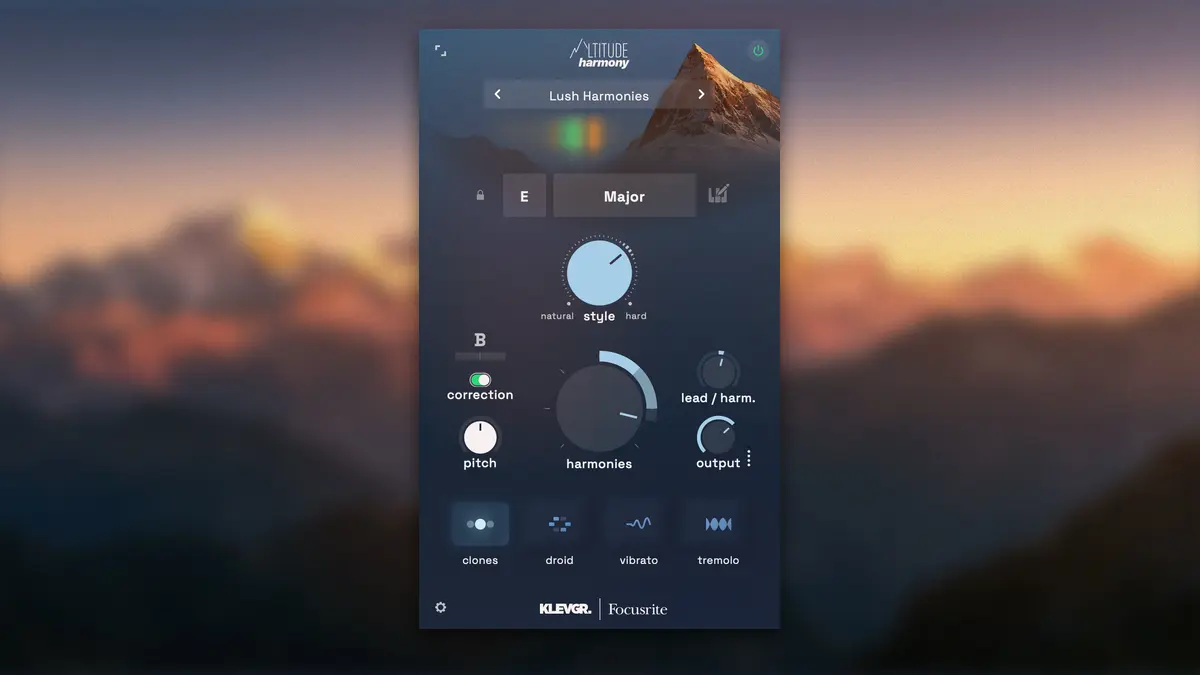
The core interface centers on two primary dials: Style and Harmonies. The Style control dictates pitch correction intensity, sweeping continuously from transparent pitch assistance to aggressive, hard-tuned clamping. Formant correction runs active throughout the algorithm, preventing artificial voice thinning or nasal drift as the correction speed tightens.
Directly below, the Harmonies knob handles intelligent vocal layering. Rather than forcing you to map intervals or configure MIDI chords, turning the dial clockwise or counter-clockwise adds up to three additional harmony voices stacked either above or below the lead vocal. The musical intervals are calculated automatically from the active scale. A scale strip provides 15 scale presets—covering Major, Minor, Pentatonic, and Dorian modes—alongside a custom note matrix for manual pitch grids.


Underneath the main dials sit four fixed-state character processors: Droid (robotic ring-modulation style tone), Clones (voice doubling and stereo widening), Vibrato (natural pitch oscillation), and Tremolo (tempo-synced amplitude modulation). In classic Klevgrand fashion, these buttons omit secondary parameters entirely. You toggle them on or off, and the selected processing applies uniformly across both the lead voice and the generated harmony stack.
Studio Realities and The Tradeoff
Stripping away menu depth delivers genuine speed during tracking sessions, but that simplicity carries compromises. The single-knob harmony engine decides voice voicings and octave distributions on its own. If a bridge demands a minor third instead of a fifth, or if you need to pan individual harmony voices independently across the stereo field, Altitude Harmony offers no manual overrides. You either accept the algorithmic voicing or print the track and edit manually.
Similarly, the four character effects provide zero adjustments for depth, rate, or tonal color. While the inclusion of a dedicated low-latency tracking switch and selectable vocal pitch registers makes the plugin viable for real-time monitoring through a desktop interface, the DSP executes entirely on the host CPU rather than onboard Focusrite interface chips.
At an introductory price of $29.99, Altitude Harmony serves as an accessible entry point for songwriters and quick session sketching, with an upgrade path available toward the deeper Altitude suite for those who eventually require granular voice design.
Pricing and Availability
Focusrite & Klevgrand Altitude Harmony is available now for macOS (10.13 or later, native Apple Silicon and Intel) and Windows 10+ (64-bit) in VST3, AU, and AAX formats. Introductory pricing is set at $29.99 (rising to a regular price of $49.99).
For full technical specifications and sound demos, head over to the Altitude Harmony product page on Klevgrand.