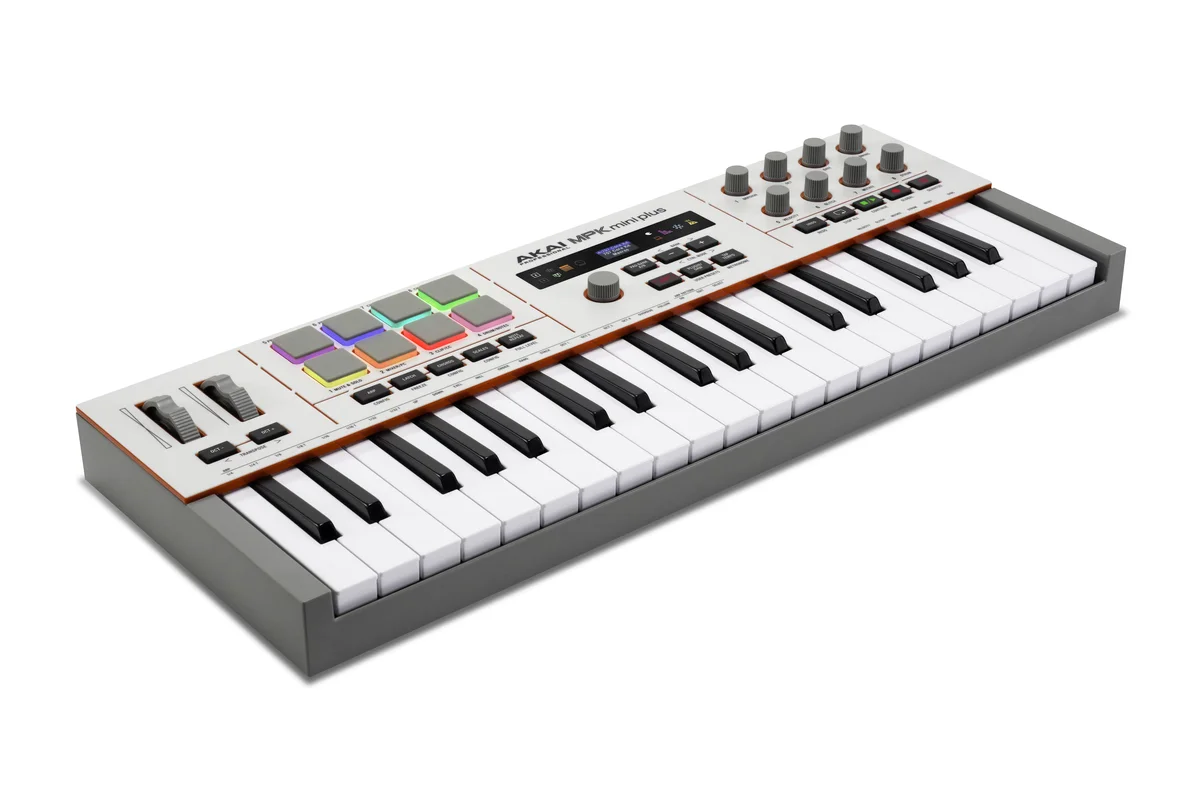


Akai’s MPK Mini series has occupied bedroom desks and backpack rigs for over a decade. While the standard 25-key slab handled quick drum programming and basic basslines, serious chord exploration always felt suffocated by the two-octave limit. The Akai Professional MPK Mini Plus II addresses that bottleneck directly, stretching the footprint to a three-octave, 37-key mini keybed while injecting hardware connectivity, algorithmic sketchpad tools, and a full-color screen.
At $169, it aims squarely at producers caught between cheap plastic keyboards and dedicated hardware production centers. Rather than merely adding keys, Akai has loaded the unit with genuine modular and analog hardware credentials alongside direct hooks into standalone MPC workflows.

Expanded Keys, Hardware CV, and MPC Integration
The physical interface balances compact portability with tactile command. Alongside the upgraded 37-key mini keybed, the controller packs eight velocity- and pressure-sensitive RGB MPC pads with dual-bank switching, dedicated pitch and modulation wheels, eight endless 360-degree rotary encoders, and a push encoder.
Hardware connectivity sets the Akai Professional MPK Mini Plus II apart from typical entry-level controllers. Around back, USB-C handles bus power and computer MIDI, joined by a full-size five-pin DIN MIDI output and three 3.5mm CV/Gate outputs (Pitch, Gate, and Mod). This allows the controller to drive Eurorack rigs and semi-modular synthesizers without an intervening computer interface.

Integration goes beyond basic class-compliant MIDI. The hardware communicates directly with MPC Desktop and MPC Standalone environments, giving producers hands-on access to Q-Links, track navigation, pad banks, mixer channels, and clip launching. It serves as an accessible satellite controller, bridging the gap for beatmakers who want tight hardware sequencing without stepping up to dedicated standalone instruments like the MPC Key 37 G2.

Color Display, Generative Tools, and DAW Scripting
A 160×80 full-color LCD screen replaces the utilitarian monochrome readout of older iterations. The screen serves up dynamic parameter feedback, preset names, and control assignments, drastically cutting down the reflex to glance back at a laptop monitor during sound design.
On the creative side, Akai expands the internal performance engine with Chord Creator, Note Repeat, and advanced Arpeggiator workflows, including user chord progressions. A suite of real-time transformation modes—Glitch, Mutate, Strum, Freeze, and Follow—lets performers bend melodic phrases and rhythmic sequences into unexpected directions directly from the hardware. These tools push the controller into creative sketchpad territory, matching the algorithmic sequencing tricks found on the Novation Launchkey Mini 37 Mk4.
For computer-centric setups, scripted DAW integration covers Ableton Live, Logic Pro, Cubase, and FL Studio. Full NKS compatibility maps plugin parameters straight to the eight encoders and color screen. That Native Instruments integration is hardly an accident; following inMusic’s acquisition of Native Instruments, the hardware ships with Komplete Select (Akai Edition), joining MPC Beats and the AIR Studio Instrument Collection with over 1,000 sounds from AIR, Moog Music, and Akai.
Pricing and Availability
The Akai Professional MPK Mini Plus II is available immediately through authorized dealers and global retailers for $169 USD / 159.99 € / £134.99.
For full specifications and details, visit Akai Professional.