

Room correction has always had one awkward habit: you need the computer to fix the room, and then you need to remember the computer is in the way. IK Multimedia ARC Studio+ addresses that directly with hardware that measures, corrects and keeps running without a DAW anywhere in sight.
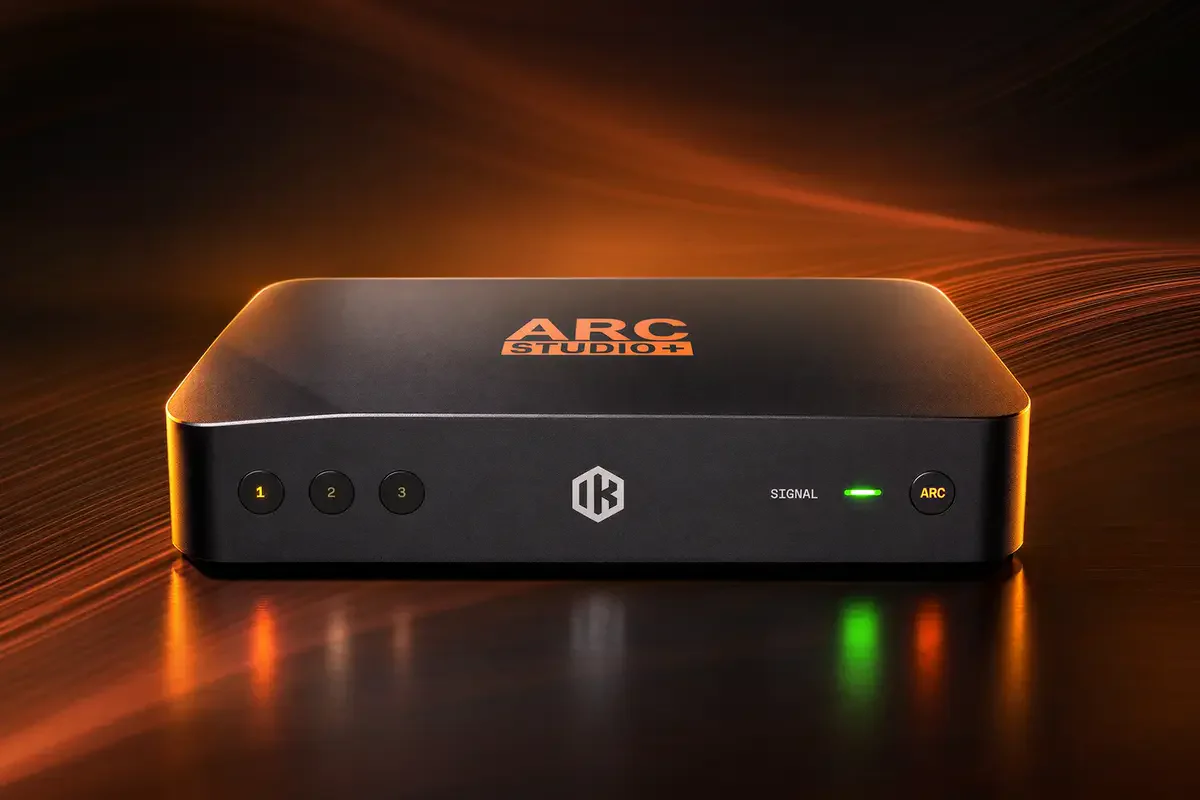
The original ARC Studio stays in the lineup as the entry point. ARC Studio+ sits above it, adding standalone calibration, three onboard scenes, automatic subwoofer management and a fully digital signal path.
Calibration Without Booting a Laptop
The headline addition is Standalone Calibration. Plug the included ARC measurement microphone into the dedicated ARC MIC port and the unit runs a 1-point or 3-point quick calibration at the press of a button, then applies the correction onboard without touching a computer.

IK has explored computer-free calibration before. Its iLoud monitors, including the MTM and Precision lines, carry onboard ARC DSP and can calibrate directly with their supplied microphone. ARC Studio+ brings that standalone convenience to any monitoring setup.
Quick 1- or 3-point passes are well suited for fast checks, temporary spaces, or re-calibrating after repositioning a speaker. When deeper fine-tuning is required, connecting ARC X unlocks 7- and 21-point 3D room measurement, target-curve editing and profile management. Once uploaded, the profile lives in hardware memory and runs with the software closed, making the computer a tool for detailed calibration rather than an everyday necessity.
Smart Subwoofer Management
Anyone who has tried to blend a sub with a pair of monitors knows the ritual: crossover guesses, level tweaks, then a phase flip that may or may not solve the problem. ARC Studio+ adds a dedicated sub output and detects a connected subwoofer automatically, aligning gain, crossover, phase and delay as part of calibration. IK notes that the integration works with any monitor and subwoofer pairing, leveraging technology developed for its iLoud Sub.
Subwoofer integration is notoriously tricky in untreated or compact rooms where room modes and boundary loading complicate the low end. Automating these alignment parameters removes significant trial and error, giving engineers a coherent low-frequency baseline in minutes rather than hours of manual sweeps.

Pure Digital, Near Zero Latency
Connectivity is well tailored to modern setups. You get balanced combo XLR/TRS inputs, balanced XLR monitor outputs, a dedicated sub output, USB-C digital audio input, and optical S/PDIF in and out. Feeding digital-input monitors or an external D/A converter allows the signal to stay digital end-to-end, skipping superfluous conversion stages.
Correction runs on dedicated internal DSP, keeping host CPU loads unaffected. Latency behavior aligns with workflow needs: Natural Phase mode delivers a swift 1.4 ms—virtually imperceptible during tracking and live monitoring—while Linear Phase mode uses 42 ms for phase-linear precision during mixing and mastering.

Three physical SCENE buttons recall full configurations: calibration profile, speaker routing, sub on/off and input selection. It is easy to assign one scene to the mix position, one to a couch listening position for clients, and one to an alternate curve for translation checks. A selectable relay-based hard bypass enables instant A/B comparison against uncorrected audio while protecting speakers against power pops.
Under the hood, the converter specifications are robust: 120 dB(A) dynamic range, 0.00023% THD+N at 1 kHz, and 32-bit conversion supporting sample rates up to 192 kHz.
What’s Different From the Original ARC Studio
Set the two product pages side by side and the changes fall into a few clear buckets:
- Calibration: The original ARC Studio relies on a computer running ARC X and requires an audio interface with a phantom-powered XLR mic input. ARC Studio+ adds a dedicated ARC MIC port and front-panel standalone calibration.
- Measurement depth: Both units work with ARC X for multi-point profiles. On ARC Studio+, IK specifies higher-resolution 7- and 21-point 3D measurement options.
- Subwoofer integration: While the original calibrates the system as a combined stereo pair, ARC Studio+ features a dedicated hardware sub output with automatic detection and discrete alignment of gain, crossover, phase and delay.
- Connectivity: The original offers analog I/O and USB-C management. ARC Studio+ introduces USB-C digital audio playback alongside optical S/PDIF in and out.
- Instant recall: ARC Studio allows switching monitor emulations via software. ARC Studio+ adds three physical front-panel Scene buttons that recall routing, calibration profiles, and sub status instantly.
- Conversion specs: The original employs AKM Velvet Sound converters at 96 kHz with 24-bit conversion. ARC Studio+ bumps conversion to 32-bit with sample rates up to 192 kHz.
- Hardware footprint: ARC Studio+ is slightly larger and heavier (19.7 x 12.2 x 4.4 cm, 625 g compared to 14.4 x 12 x 4.5 cm, 465 g).
- Microphone packaging: The original offered configurations with or without the mic. ARC Studio+ bundles the ARC measurement microphone in the standard box.
Both units maintain the same 120 dB(A) dynamic range rating and low-latency DSP foundation (1.4 ms Natural Phase, 42 ms Linear Phase). The enhancements center around hardware autonomy, subwoofer control, and digital connectivity.
For studios with dedicated subs, secondary listening spots, or digital monitor paths, ARC Studio+ ($/€399.99 intro) offers a substantial functional step up. For standard stereo setups with a computer always active, the original ARC Studio ($/€299.99) remains a capable, cost-effective option.
How It Stacks Up
IK positions ARC Studio+ against solutions that require third-party licenses or complex manual setups. Compared to software-only workflows like Sonarworks SoundID Reference, having correction hosted on outboard hardware eliminates master-bus plugin management and accidental print errors entirely.
That hardware convenience was among the most praised aspects of the original ARC Studio across user forums and Reddit communities. Producers regularly highlighted the benefit of zero plugin maintenance and noticeable clarity gains in untreated rooms, particularly around muddy 100–200 Hz room resonances.
The most common hurdle with the first generation was the initial measurement setup, which required a phantom-powered interface input. ARC Studio+ addresses that directly with its onboard mic preamp. Experienced engineers rightly observe that digital correction is most effective when paired with baseline acoustic treatment, serving as the final polish for room translation rather than a substitute for physical absorption.
For existing ARC Studio owners looking to upgrade, IK offers a dedicated upgrade path at $/€299.99 intro ($/€349.99 regular). For users expanding into 2.1 monitoring or seeking digital integration, the additional hardware flexibility makes it a sensible evolution.
Pricing and Availability
ARC Studio+ is shipping now from the IK Multimedia online store and authorized dealers worldwide. For a limited time, all three versions carry introductory pricing, $/€50 off the regular price. Prices exclude taxes.
- ARC STUDIO+: $/€399.99 intro (regular $/€449.99). Includes the hardware processor, ARC X software, power supply and ARC measurement microphone.
- ARC STUDIO+ Upgrade for ARC Microphone Owners: $/€349.99 intro (regular $/€399.99). Includes the hardware processor, ARC X software and power supply.
- ARC STUDIO+ Upgrade for ARC Studio Owners: $/€299.99 intro (regular $/€349.99). Includes the hardware processor, ARC X software and power supply.
- ARC Studio (original): $/€299.99, upgrade price $/€249.99.
More details are on the IK Multimedia ARC Studio+ page.