

Elastic OSC, Oliver Greschke’s Plaits-based polysynth, landed on Mac and Windows on May 6, 2026 — roughly a year after its iOS debut, where it earned a spot on multiple “Best of 2025” lists and built a dedicated following among mobile synthesis enthusiasts. The desktop version ships with everything the iOS release kept behind in-app purchases, unlocked from the start.
The Plaits Legacy, Extended
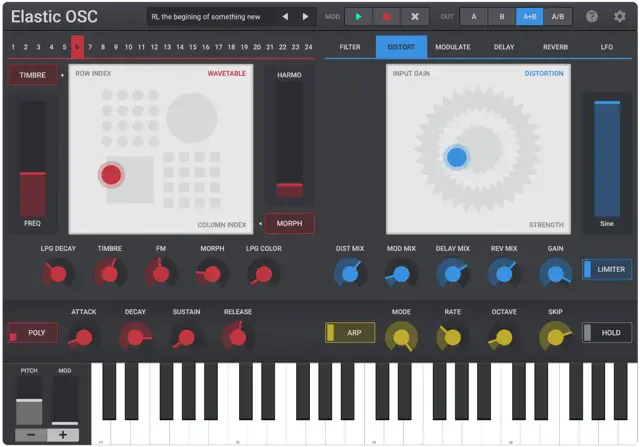
Mutable Instruments Plaits was a macro-oscillator — 24 synthesis engines packed into a 12HP Eurorack module, controlled by four parameters: Frequency, Harmonics, Timbre, and Morph. Émilie Gillet open-sourced the firmware under the MIT license, and the code has been ported and cloned dozens of times since. What Greschke built on top of it is the part that matters: 8-voice polyphony (hardware Plaits is strictly monophonic), a dual XY-pad interface that maps those four parameters to direct touch performance, and the “Elastic” loop-automation system that records and stores modulation directly within presets.

As we covered in our Elastic OSC iOS review earlier this year, the XY pads are genuine performance tools — not just a prettier way to reach sliders. You can record modulation on almost any parameter in 1-, 2-, or 4-bar loops and loop them in tempo sync. That same system carries through to the desktop version, with the added desktop-only features on top.
24 Engines, One Interface
Switching oscillator models in Elastic OSC keeps your modulation state and effects chain intact — which sounds minor until you realize it means you can apply an aggressive FM patch setup to a physical modelling engine mid-session without losing anything. The 24 engines span virtual analog and waveshaping, 2-op and 6-op FM (with DX7 bank import supported since the v1.1 update), wavetable and granular, physical modelling, speech synthesis, chiptune, and six percussive drum engines. Each engine also has a secondary “B” output — a variant, sub-oscillator, or by-product signal depending on the mode — that can be blended or hard-panned against the main output for a pseudo-stereo or hybrid effect.

The effects chain covers drive/distortion (six modes: sine, bitcrusher, downsampler, asymmetric, pow2, tanh2, coded by Lucie Gosset), a high/low-pass filter with resonance, chorus/flanger, delay, and reverb — all automatable, all stored in presets. The second XY pad controls this chain directly.

The LFO Mixer: Modular Logic, Without the Rack
Rather than a conventional LFO-to-destination matrix, Elastic OSC offers four LFOs and a visual blend mixer. You set speeds, shapes, and intensities independently, then dial in how strongly each LFO affects six destinations — Frequency, Timbre, Morph, Harmonics, Filter, and Pan — by moving each target’s position relative to each LFO source in the mix view. The result is a summed modulation signal where slow and fast LFOs at different phases interact in ways that drift and evolve rather than loop predictably. LFO speed and shape are themselves automatable via the Elastic loop system, so the modulation itself can change over time.
On iOS, three of the four LFOs were a $3.99 in-app purchase. On desktop, all four are included.
MPE: Polyphonic Expression, Properly Implemented
MPE support assigns Glide (X), Slide (Y), and Pressure (Z) to up to eight synthesis parameters simultaneously, with each mapping working polyphonically. Every note you hold carries its own independent timbre, filter response, pitch movement, and dynamics — not a global response averaged across the keyboard. Combined with the 8-voice polyphony and the LFO mixer, this makes the desktop version a meaningfully expressive instrument for MPE controller users (Osmose CE owners, I’m looking at you).
Pricing and Availability
MOM Instruments Elastic OSC for Desktop is available now from mominstruments.com at an introductory price of €39 (regular price: €45). A free trial is available on the same page.
- Formats: VST3 / AU (no standalone version, unlike previously reported)
- macOS: 10.14 or later
- Windows: 10 or later
- Tested in: Ableton Live, Bitwig Studio, Reaper, Cubase, FL Studio, Logic Pro
- Mobile: iOS ($14.99) and Android ($9.99) versions remain available separately