

Walk the NAB Show floor long enough and you develop a filter for the word “revolutionary.” Most booths use it. Few earn it. RØDE has shown up to Las Vegas this year with six announcements spanning a co-engineered German semiconductor platform, a UHF wireless system a decade in the making, two new studio arms, a microphone branding accessory, an AI podcast editing app, and an Android expansion for their mobile recording app. That’s not a product refresh. That’s a company redefining the width of its own lane.
The thread connecting all of it is a simple idea: that the limits of audio capture — in size, durability, sound quality, and workflow — are limits RØDE intends to push past. Whether every product here delivers on that promise is something we’ll learn over the coming months. But there’s enough here to take seriously.
Watch the full NAB 2026 RØDE announcements:

Sonaura: The One to Watch
The headline announcement is Sonaura, a proprietary MEMS (micro-electro-mechanical systems) microphone platform built in partnership with Infineon Technologies, manufactured at Infineon’s semiconductor facility in Germany. If you’ve spent time trying to fit a half-decent capsule into a lavalier housing — the kind that ends up clipped to a shirt collar two inches from someone’s throat — you’ll know what the actual problem is: size and fragility fight quality at every step.
Sonaura is RØDE’s answer to that problem. The capsule measures 4mm × 5mm. It delivers an SNR of 83dB and a self-noise of 11dBA — specs that sit alongside studio condensers, not the MEMS chips you’d normally find in earbuds or phone microphones. The design uses what RØDE calls a Sealed Dual Membrane, which increases resistance to physical shock and environmental exposure compared to open-capsule traditional designs. It’s built on a custom low-noise ASIC developed for the platform.
I’m cautious about MEMS claims. The technology has been “almost there” for professional audio for years — good enough for consumer products, rarely convincing in critical listening. What’s different here is the Infineon partnership: this isn’t a consumer-grade MEMS chip repurposed for audio. It’s a co-engineered platform designed from the start to hit broadcast-grade performance targets. Whether it actually sounds like a studio condenser in practice, we’ll need independent testing to confirm. The specs say yes. The specs always say yes.

Sonaura debuts first in the Lectrosonics L1 lavalier — Lectrosonics being the professional wireless company also under the Freedman Group umbrella. Further integrations across the RØDE lineup are coming, though no specific product names or dates were given. More at rode.com/about/sonaura.
Watch the official Sonaura introduction:

RØDELink II: UHF, 32-Bit Float, Timecode
The original RØDELink was a 2.4GHz system — brave timing for 2014, when that frequency band was still relatively clean. A decade later, 2.4GHz is a war zone in live production environments. RØDELink II moves to proprietary UHF and draws on engineering from Lectrosonics, which has been building UHF systems for broadcast and film production for several decades.
The kit ships as a two-transmitter, single-receiver system for dual-channel operation. Each transmitter pairs with a broadcast-grade lavalier featuring locking connectors. The headline spec for location sound work is 32-bit float onboard recording to microSD — so even if the RF transmission drops or clips, you have a clean backup capture on the transmitter itself. A dedicated timecode I/O port eliminates the need for manual sync in post. The body is machined metal, three removable lithium-ion batteries are included, and the whole system ships in a premium travel case.
Alongside the system, RØDE is launching a range of cables: 3.5mm TRS to 5-Pin and 3.5mm TRS to BNC timecode options with locking connectors, plus XLRM and XLRM Splitter audio cables for connecting to professional recorders. No pricing has been announced.
LPA1 and DS3: Two Arms, Two Problems
The LPA1 is a low-profile desk arm designed specifically for on-camera setups — it sits below the camera’s sightline, keeping the microphone in position without appearing in frame. It offers 750mm of horizontal reach, 360° silent rotation, a 2kg load capacity, and integrated cable management for both XLR and USB. Mounts via standard desk clamp.
The DS3 takes the opposite approach: no clamp, no desk edge required. A weighted base keeps it planted on any flat surface. A ball head handles positioning, a natural cork base inlay handles slip resistance, and available finishes are black or white. Universal mount compatibility via included 5/8″ and 1/4″ thread adaptors, 1.5kg load capacity. Both arms were designed at RØDE’s Sydney headquarters and are listed as coming soon.
PodMic Flag: Honest About What It Is
The PodMic Flag is a branded sticker wrap for the PodMic’s WS14 pop filter. Creators design their own artwork, download a template, print it, and apply it. That’s the product. It won’t change how anything sounds, but for video podcasters who care about what their setup looks like on screen, it’s a clean solution that doesn’t require buying a new microphone. Coming soon, no pricing announced.
RØDECaster Studio: Beta Available Now
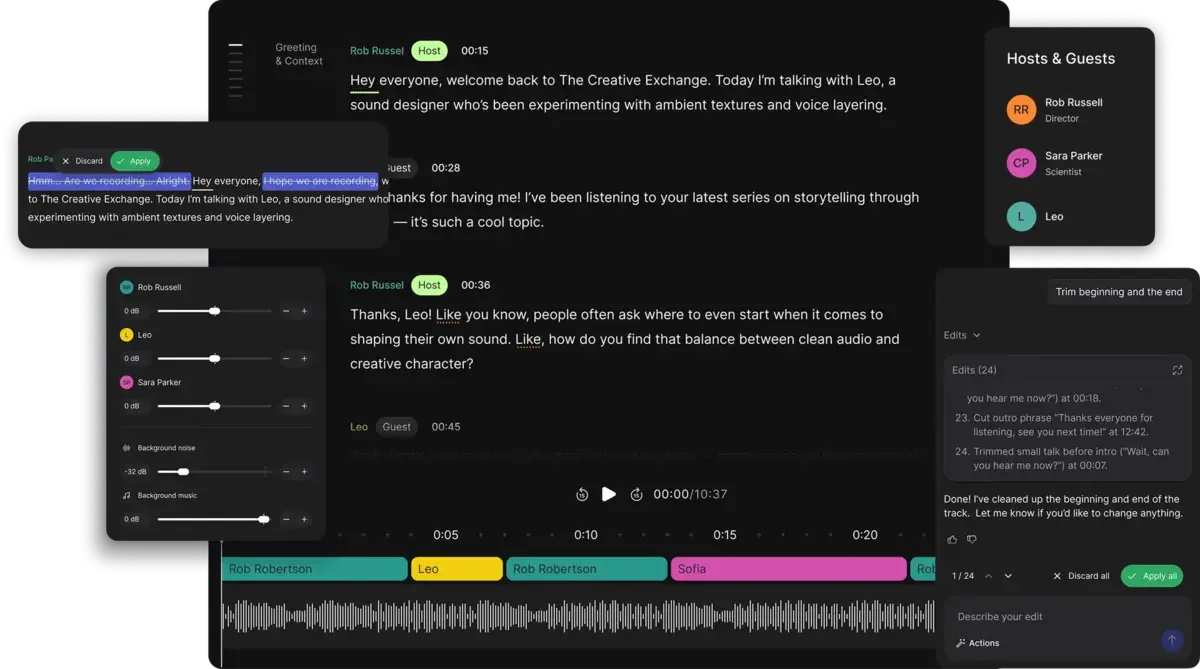
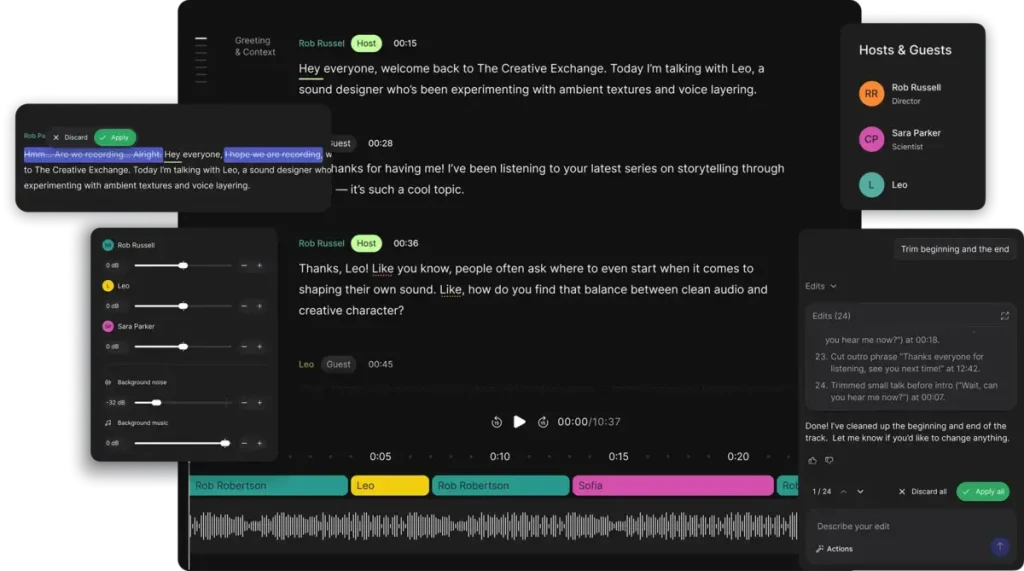
RØDE’s UK AI Lab has built a desktop podcast editing application for Mac and Windows called RØDECaster Studio. It imports directly from RØDECaster Pro II and RØDECaster Duo hardware, syncs projects via RØDE Cloud, and centres the editing workflow on a transcript rather than a waveform.
The transcript engine generates word-level timestamps with automatic speaker identification — so you can edit by reading rather than scrubbing audio. An AI in-painting tool can replace or correct individual words without re-recording, preserving the original speaker’s tone and cadence. A built-in RØDE Assistant handles higher-level edits via plain-language instructions: remove filler words, trim the top, apply censorship. One-click export handles loudness normalisation for Spotify, Apple Podcasts, and YouTube.
Transcript-based editing has been available in tools like Descript for several years, so this isn’t a new concept. What’s notable is that it’s now integrated directly into a hardware ecosystem — record on a RØDECaster, sync to cloud, open in Studio, export for publishing, all without leaving RØDE’s own software stack. How well the AI tools perform outside of demos is something beta testers will find out first. Sign up for the beta at rode.com.
RØDE Capture Arrives on Android
RØDE Capture, the brand’s video and audio recording app, is coming to Android after being iOS-only since launch. The Android version includes Direct Connect, which lets Wireless Micro, Wireless GO Gen 3 and Wireless PRO transmitters pair directly to a smartphone via Bluetooth — no receiver needed. Dual-camera recording modes and in-app microphone control carry over from iOS. Timeline for the Google Play release is listed as “soon.”
Pricing and Availability
No pricing has been confirmed for any of the new hardware. All physical products — RØDELink II, LPA1, DS3, and PodMic Flag — are listed as coming soon. RØDECaster Studio beta is open now. RØDE Capture for Android is coming to Google Play soon.
- RØDE booth at NAB Show: Central Hall, Booth C9316 (April 18–22, 2026)
- Sonaura overview: rode.com/about/sonaura
- All products: rode.com