
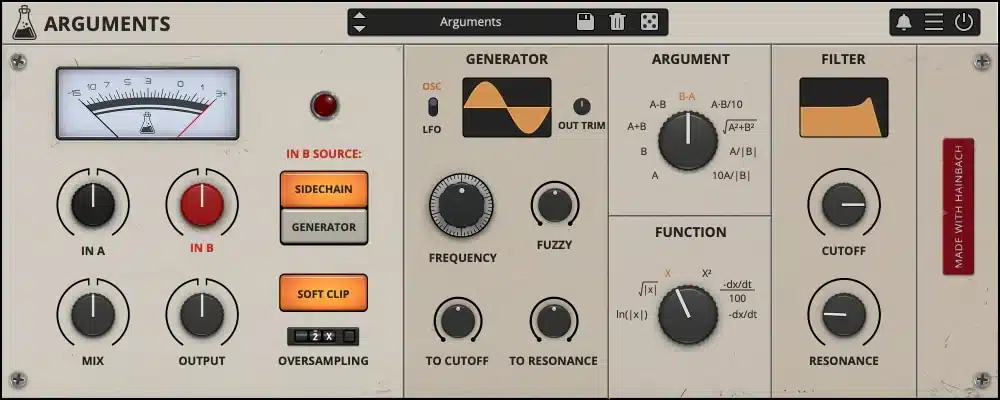


AudioThing and experimental musician Hainbach have unveiled Arguments, their latest collaboration that transforms vintage nuclear research concepts into an innovative audio processor. This unique plugin continues their successful partnership in bringing rare test equipment-inspired tools to modern music production.
From Nuclear Research to Sound Design
The inspiration behind Arguments comes from Nuclear Instrumentation Module (NIM) systems, standardized modular electronic equipment originally designed for nuclear physics research in the 1960s. These sophisticated rack-mounted devices were used in nuclear physics laboratories to process and analyze experimental data, measuring properties of subatomic particles and radiation.

Hainbach, known for his exploration of scientific equipment in musical contexts, discovered that these precise measuring instruments could create fascinating sonic textures when pushed beyond their intended use. Arguments captures the essence of these mathematical processing modules, particularly drawing from specialized NIM BIN components that performed complex calculations on measurement signals.
The plugin recreates these mathematical operations in the digital domain, allowing users to process audio signals using methods originally developed for particle physics research. This unconventional approach to signal processing results in unique timbral possibilities that would be difficult to achieve through traditional audio effects.
Core Processing Features
Arguments operates by combining two input signals – either two audio sources or one audio source with its internal generator. The plugin offers:

Signal Processing

- Nine different argument modes for signal combination
- Six function blocks for further signal manipulation
- Multi-mode filter section
- Internal oscillator with various waveforms
- Comprehensive modulation options
Sweet Spot Territory
The most interesting sonic territories emerge when pushing the mathematical operations to their limits. By carefully adjusting the gain staging of inputs A and B, users can achieve rich textures reminiscent of rare vintage equipment like the “Radioactive Box” PAR CR4-A.
Early Impressions
After spending some time with Arguments, I’m particularly impressed by its ability to generate unexpected textures and evolving soundscapes. While the interface might seem intimidating at first, the mathematical operations behind it create a surprisingly musical workflow.
The plugin really shines in ambient and experimental contexts, but it’s equally capable of adding subtle harmonic enhancement to more conventional material.
What’s particularly noteworthy is how efficiently it runs despite its complex processing architecture. Even when pushing multiple instances with heavy modulation, CPU usage remains remarkably reasonable. The presets provide an excellent starting point for understanding the plugin’s capabilities, though the real magic happens when you start experimenting with the various argument modes and function blocks.

Pricing and Availability
AudioThing Arguments launches with an introductory price of €39 (regular price €69) for the desktop version. The plugin is available for immediate download from AudioThing’s website and other retailers such as Plugin Boutique.
Licensing
Each desktop license allows activation on up to three computers, with flexible online and offline authorization options – no iLok dongle required. The desktop version runs as a 64-bit plugin in VST2, VST3, AU, AAX, and CLAP formats on:
- macOS 10.13 or newer (Universal Binary)
- Windows 7-11
- Linux (Ubuntu 20.04 or newer)
iOS Version
For mobile music producers, Arguments is also available on the iOS App Store for €14.99, supporting both iPhone and iPad. The iOS version comes as both a standalone app with Inter-App Audio (IAA) support and an AUv3 plugin for use within compatible iOS DAWs.


