
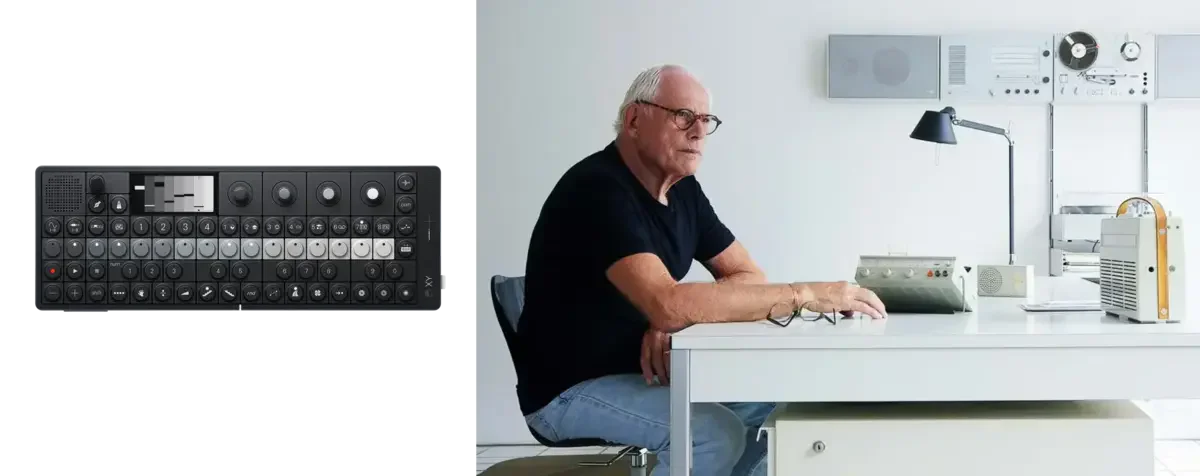


Yesterday, when Teenage Engineering unveiled their latest creation, the OP-XY, the design community immediately noticed its strong ties to classic industrial design principles (those words in German on the TE’s website are there for a reason).
The Swedish manufacturer, whose OP-1 Field made waves last year, has never hidden its admiration for the pioneers of functionalist design, particularly the work of Dieter Rams during his legendary tenure at Braun. From the minimalist interface to the thoughtful use of materials, the OP-XY seems to whisper “weniger, aber besser” (less, but better) – Rams’ famous motto that shaped decades of consumer electronics design.
Given these evident influences, we thought: what if we could summon the master himself to review this instrument? How would the 92-year-old German design pioneer, known for his “Ten Principles of Good Design”, assess this modern musical device that so clearly draws inspiration from his philosophy?
What follows is an imaginative exercise: Dieter Rams’ hypothetical review of the OP-XY, written in his voice and following his celebrated design principles.

Innovation Through Restraint
In an era of excessive features and superficial innovations, the OP-XY demonstrates that true innovation develops in tandem with technology, never as an end in itself. The dual CPU architecture serves a clear purpose: enabling 24-voice polyphony and sophisticated processing while maintaining simplicity in operation.
The Essence of Usefulness
The anodized aluminum chassis, finished in matte black, speaks to my long-held belief that good design makes a product useful while disregarding anything that could detract from it. The streamlined interface, with its precisely arranged 64-step sequencer and minimalist controls, emphasizes usefulness over decoration.

Aesthetic Integrity
The aesthetic quality is integral to its usefulness – a principle I’ve always championed. The grayscale OLED display and monochromatic control scheme create visual harmony without sacrificing functionality. This is design that affects our well-being through daily use.

Musical Architecture
The OP-XY’s musical workflow demonstrates the same principles we applied to modular furniture systems at Braun – systematic, logical, and infinitely adaptable. The approach of stacking musical ideas like architectural elements shows deep understanding of creative processes.

Sequencing Intelligence
The sequencing capabilities, particularly the “brain chord progression” function, demonstrate how good design should make complex technology accessible and natural to use. The 64-step sequencer with LED-equipped buttons provides immediate visual feedback – a hallmark of thoughtful interface design.
Sound Design Architecture
The implementation of punch-in effects and gyroscope functionality for track control shows innovation in performance design. The dual-engine system enables simultaneous sample manipulation while maintaining processing efficiency – technology serving creativity, present but invisible.
Environmental Consciousness
With its durable construction and 16-hour battery life, the OP-XY adheres to my belief that good design must be environmentally friendly. The USB-C charging and robust build quality suggest longevity – crucial in our throwaway society.
Technical Specifications
- Dual CPU architecture
- 24-voice polyphony
- 8GB storage
- 512MB RAM
- 16-hour battery life
- High-resolution grayscale OLED display
- Multi-output port (MIDI, CV, gate, sync)
- USB-C connectivity
- Gyroscope for motion control
- Price: €2,299
Comparison with Siblings
Similarities with OP-Z
- Step components approach
- Performance and generative-oriented sequencing
- Motion control capabilities
Similarities with OP-1 Field
- Premium build quality
- High-resolution display
- Multiple synthesis engines
- Advanced sampling capabilities
Key Innovations
- Dual CPU architecture
- Enhanced polyphony
- Expanded sequencing capabilities
- Improved connectivity options
- More sophisticated effects processing
Final Assessment
While the price point of €2,299 may seem substantial, it reflects the true cost of thoughtful design and engineering. The OP-XY represents my maxim “weniger, aber besser” (less, but better) – achieving more through reduction than addition. It stands as a testament to how electronic musical instruments can balance innovation and restraint, a rare achievement in today’s market of excessive consumer electronics.
Editor’s Note: We hope you enjoyed this article, an imaginative tribute to Dieter Rams’ design philosophy and its enduring influence on modern electronic instruments. While the review is fictional, the principles and observations are based on Rams’ documented design philosophy and the actual specifications of the OP-XY.
Photo copyright: Gary Hustwit (Dieter Rams) and Teenage Engineering (OP-XY)


