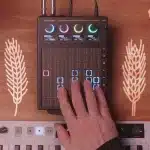
Three years into the Tempera’s life, Beetlecrab Audio keeps doing the thing that nobody expects small hardware developers to do: releasing massive, free firmware updates that fundamentally expand the instrument. The v2.3 firmware—described by founder André as “our biggest firmware update yet”—arrives after six months of development, Discord-driven beta testing, and apparently another round of finding headroom in a DSP that was, by all accounts, already full.
If you’ve been watching this instrument’s evolution, you’ll remember the pattern. The Tempera launched as a capable hardware granular synthesizer in a compact 20×14.6cm footprint. Then v2.1 introduced live granular processing, turning it into a real-time effects processor. v2.2 piled on reverse grains, a step LFO sequencer, Euclidean grain sequencing, and patina effects. Each time, Beetlecrab declared the DSP ceiling reached. Each time, they found more ceiling. v2.3 continues that tradition with enough new features to justify a separate product line at most other companies.

Cross-Modulation Changes the Modular Calculus
The headline addition in v2.3 is cross-modulation. Speed, size, and phase of any modulator are now routable as modulation targets—meaning you can set modulators to control other modulators. On paper that sounds abstract. In practice, it means the Tempera’s internal modulation system now behaves more like a semi-modular routing matrix than a fixed-destination LFO section. Complex, evolving, self-interfering textures that previously required external CV patching or careful sequencer programming can now be built entirely within the box.
Pair that with the new envelope follower modulator—which converts internal or external audio into a modulation source—and you have something genuinely interesting for live performance. Run a guitar or drum machine into the audio input, and its dynamics become a control signal capable of driving grain density, playback speed, or pitch. The Tempera was already a capable audio processor; this makes it a responsive one that reacts to what’s happening around it in real time.

Quad-Macro and the Performance Angle
The new quad-macro control lets a single knob drive four parameters simultaneously, with macro states that can be stored and recalled for instant changes mid-performance. It’s the kind of feature that looks like a convenience addition on paper and turns out to be something you reach for constantly on stage. Store a macro for your slow, wide ambient state; store another for a tight, percussive one; flip between them in a single gesture while your hands stay on the grid.

The Tempera’s accumulated depth—grain shape tilt, grain skip probability, per-emitter grain pitch now added on top of two years of prior feature additions—raises the obvious question: does more capability mean more menu-diving? Community feedback says largely no. Sound on Sound, MusicTech, Elektronauts, and Reddit users who’ve owned the instrument across multiple firmware generations consistently report that the 8×8 multitouch grid keeps parameter access physical rather than navigational. Screens on the Tempera display encoder values; they don’t gate features behind sub-menus in the way that haunts menu-heavy boxes like certain Elektron devices. There’s a learning curve, everyone agrees on that—but users describe it as the curve of learning an instrument, not the curve of learning a UI. That’s a meaningful distinction.
Grain Sparkles Is a Smarter Visual Feedback Tool Than It Sounds
The waveform display now marks each grain emission in real time—what Beetlecrab calls “Grain Sparkles.” This sounds like a cosmetic flourish. It isn’t. On a granular instrument, understanding density and position by ear alone is demanding, especially when you’re navigating a complex sample with varied transients. Visual confirmation of where grains are actually firing, and how densely, gives you a genuine monitoring reference without forcing you to count clicks or rely purely on feel. It’s the kind of small design decision that experienced granular users will actually use, rather than just acknowledge.
Similarly, cell marker nudging addresses a real workflow friction point: live recordings don’t always land on the grid cleanly. Being able to push markers to align precisely with transients or natural phrasing—rather than accepting whatever the auto-marker decided—saves time that used to disappear into workarounds.
Free. No Asterisk.
Beetlecrab Tempera v2.3 is a free firmware update for all existing users. No tier, no upgrade fee, no feature gating. In an industry where post-launch monetisation through paid expansion packs, subscription tiers, and “Pro” unlock keys has become increasingly normalised, that remains genuinely unusual for a hardware product at this price point. The community on Discord and r/synthesizers has been consistently positive—users describe the instrument as one that “keeps getting better” in ways that reflect actual feedback loops between the developer and the people using it. André is reportedly active on the Discord himself. That’s not common at larger companies, and it shows in which features actually landed in v2.3.
The full new feature set includes: quad-macro control with recallable states; cross-modulation across modulators; grain shape tilt for asymmetric envelope articulation; grain sparkles visual feedback; envelope follower modulator (internal or external audio); cell marker nudging; per-emitter grain pitch; waveform zoom fit; grain skip probability; a built-in SD card and USB flash drive formatter; increased link slots; and additional polish across the interface.
Pricing and Availability
The Beetlecrab Tempera retails at €699. The v2.3 firmware is a free download for all existing Tempera owners, available now from the official Beetlecrab Audio Tempera page. The instrument measures 20×14.6cm—compact enough to live permanently on a desk without rearranging anything else.