

Back in 2022, iZotope quietly released Audiolens — a free desktop app that could capture tonal fingerprints from Spotify, YouTube, or any streaming source and pipe them into Ozone 10. It was genuinely useful, but it lived outside Tonal Balance Control in its own separate lane, and getting the two to work together required more steps than it should. iZotope Tonal Balance Control 3 is, in many ways, the version that closes that gap.
TL;DR: The Bottom Line
iZotope Tonal Balance Control 3 is no longer just a “look-but-don’t-touch” meter. By absorbing Audiolens technology, it allows you to capture tonal “fingerprints” from Spotify, YouTube or any other sources, and match them in real-time using a new built-in Hybrid EQ.

- Verdict: A must-have for power users of Ozone and Neutron; a “nice-to-have” luxury for those happy with the free Audiolens workflow.
Capturing References From Anywhere
The core new feature is an audio capture flow built into a companion desktop app. Play a track on Spotify, Apple Music, YouTube — anything your computer outputs — and TBC3 grabs its tonal fingerprint. That target lands directly in your plugin’s library, ready to pull up mid-session. No downloading files, no routing audio through auxiliary channels, no switching windows to cross-reference an analysis.
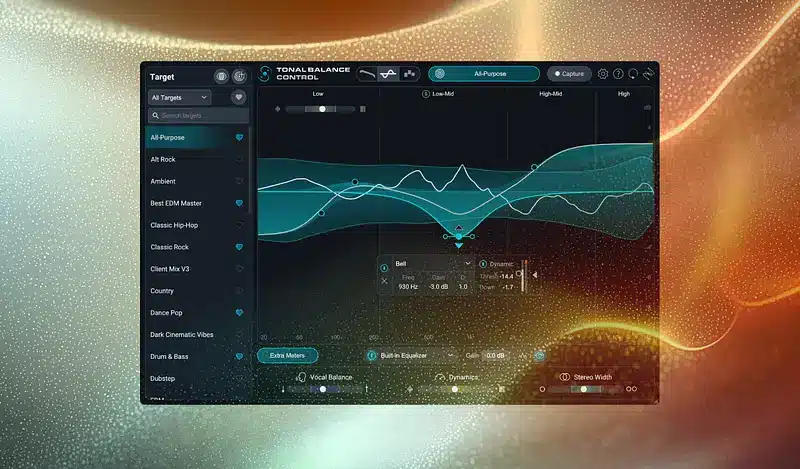
Previous versions of Tonal Balance Control shipped with 12 genre targets built from thousands of professional masters — a reasonable starting point, but producers working outside those genre buckets were often stretching the closest preset to fit. TBC3 expands the target library substantially, with dozens of new genre profiles and proper search and favorites organization so you can actually find the target you saved three projects ago.
Four New Meters Worth Noting
The metering section has been extended beyond the existing frequency spectrum view. Three additions — vocal balance, dynamics, and stereo width — let you compare specific dimensions of your mix against a reference rather than just overall spectral shape. A low-end crest factor meter rounds things out for checking bass density and transient character – crucial for ensuring your sub-bass doesn’t eat up your master’s headroom.

These aren’t decorative. Matching a vocal balance to a reference requires a different read than matching low-end energy, and having those readings presented as discrete comparisons rather than folded into a single spectrum view is more actionable. The dynamics meter in particular addresses something broad-spectrum referencing tools tend to skip: you can have a tonally accurate mix that still feels wrong because of how compressed or open it is compared to the source.
Hybrid EQ and Plugin Connectivity
TBC3 adds a built-in hybrid EQ with dynamic nodes drawn directly on the spectrum display. It’s not meant to replace your channel strip — it’s more of a quick-response tool for nudging problem areas while you’re looking at the reference comparison. For heavier work, the integration with Ozone’s Master Assistant and Neutron’s Mix Assistant lets you feed captured reference targets into their AI-driven processing, or connect directly to Ozone and Neutron EQs from inside TBC via Inter-Plugin Communication.

iZotope has been building out that IPC framework since Neutron 3, and TBC3 fits logically into it. Whether you’re mastering in Ozone or balancing individual tracks with Neutron, the same reference target can inform processing at both stages without any copy-paste.
A Paid Successor to a Free Tool
There’s a practical question worth raising: Audiolens has been free since 2022. TBC3 absorbs its central function — streaming capture — into a $129 product. That’s a real shift in value proposition, and it’s worth naming.
What TBC3 adds on top of what Audiolens offered is a significantly tighter integration: the capture feeds directly into a properly organized library, those targets interact with the new meters, and the hybrid EQ gives you a correction surface right inside the same view. For producers already inside the iZotope ecosystem — especially those on Ozone or Music Production Suite — the argument for the upgrade is fairly concrete. For someone who only ever used Audiolens for quick checks, it’s a less obvious call.
Existing TBC2 users can import saved targets directly, which removes at least one friction point from upgrading.
TBC2 vs. TBC3: Is the Upgrade Worth It?
| Feature | Tonal Balance Control 2 | Tonal Balance Control 3 |
| Reference Sources | Manual File Uploads | Direct Streaming Capture (via Desktop App) |
| Target Curves | 12 Genre Presets | 30+ Presets + Target Blender |
| Correction | Remote Control (Ozone/Neutron) | Internal Hybrid EQ + Remote Control |
| Metering | Spectrum & Crest Factor | Vocal Balance, Dynamics, & Width |
| Workflow | Static Views | Leveled View (Focuses on deviations) |
| Format | VST2, VST3, AU, AAX | VST3, AU, AAX (Drops VST2 support) |
Pricing and Availability
iZotope Tonal Balance Control 3 is available now from the iZotope website.
- New: $129 / €139 / £119
- Upgrade from any previous version: $99 / €109 / £95
- iZotope Pro subscription: Included
The Mix & Master Spotlight runs through April 15, 2026, with up to 30% off Ozone 12, Neutron 5, and Music Production Suite 8 — worth a look if you’re considering a broader upgrade.
👉 Get iZotope Tonal Balance Control 3
👉 Browse iZotope at Plugin Boutique
A Few Shopping Tips:
- Check the “Loyalty” Tab: Plugin Boutique usually lists the $99 Upgrade under a separate “Upgrade” or “Crossgrade” product tile. You should log in to your PB account to see if you qualify for the lower price.
- The “Everything Bundle” Update: iZotope also just updated the Everything Bundle and Music Production Suite (now v8.5) to include TBC3. If you are looking for the best value, those bundles often provide a much deeper discount per plugin than buying TBC3 standalone.
- V12 Integration: TBC3 is designed to pair natively with the new Ozone 12 and Neutron 5 (which also recently hit the store).