
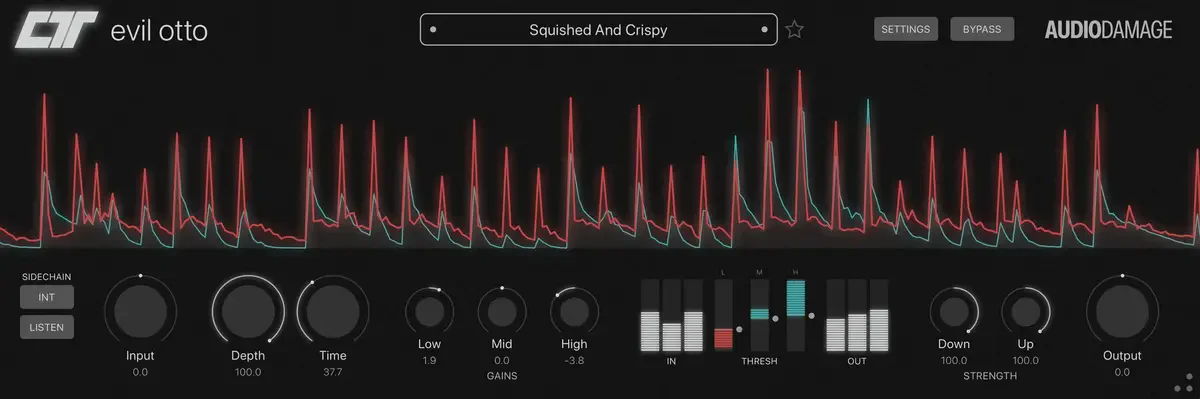


If you’ve spent any time in the EDM, hip-hop, or pop production world, you already know that sound — hyper-present, dense, nothing hiding in the shadows. OTT compression didn’t start as a plugin. It started as a preset baked into Ableton Live’s Multiband Dynamics, became a standalone freeware sensation when Steve Duda of Xfer Records released his free OTT plugin back in 2012, and essentially defined a generation of production aesthetics. Now Audio Damage — the folks behind the recent Descent granular delay — have entered the OTT compression ring with their own take: Evil Otto.
I can’t help thinking: why did it take this long for a company with such deep compression heritage to tackle OTT? Whatever the reason, they’ve arrived, and they’ve done it on their own terms.
Not a Clone — A Proper Tool
Evil Otto is not a recreation of the Xfer OTT or any specific implementation. Audio Damage started from the core concept — simultaneous upward and downward compression across three independent frequency bands — and built something with genuinely more useful controls without burying you in menus. That balance is harder to pull off than it sounds.

The architecture is straightforward: your signal hits an Input Gain stage (which, importantly, isn’t just a volume trim — driving it harder pushes more signal into the compressor and increases the effect), then gets split into Low, Mid, and High bands, each receiving its own OTT treatment. After that, optional sidechain ducking shapes the output before the final Output Gain stage. Clean, logical, musical.
The Controls That Actually Matter
The two most impactful global controls are Depth and Time. Depth is essentially a wet/dry control for the compression behavior itself — dial it from 0% (nothing happening) to 100% (full aggression). Time controls attack and release simultaneously: faster settings add punch and pumping artifacts, slower settings produce a more transparent, leveling behavior. If you’re hearing distortion on low-frequency material, slowing Time down is usually the first fix.
Beyond that, Down Amount and Up Amount give you independent control over the two sides of the OTT equation:

- Down Amount — the peak-taming side; higher values mean more aggressive peak reduction
- Up Amount — the detail-boosting side; push this while keeping Down Amount low and you bring up reverb tails, room tone, and subtle performance nuances (and yes, noise too — that’s the deal)
Per-band Threshold controls appear as draggable regions on the center meter display, letting you set independently where the compressor engages in each frequency band. Per-band Level trims (±12 dB) let you rebalance the tonal output after compression. It’s a small set of controls with a large range of possible sounds.

The Sidechain and Monitoring Features
Evil Otto includes an external sidechain input for classic ducking effects — feed a kick drum into the sidechain and a compressed pad will breathe rhythmically around it. What’s particularly thoughtful here is the Sidechain Listen mode: it solos the sidechain signal so you can confirm your routing is correct before committing to the sound. Audio Damage explicitly made this non-automatable, because it’s a setup tool, not a performance control. That kind of considered design decision says a lot about their intent.
The Interface
The UI features a scrolling waveform display (when animation is enabled) that overlays the pre- and post-compression signals in real time — a genuinely useful visual for understanding how hard the plugin is working. Nine vertical meters cover input, gain reduction/expansion, and output per band. Two color schemes are available: the default, and an Outrun scheme for when you need your compressor to look like a 1984 arcade cabinet. The interface is resizable, and animation and glow effects can be disabled for older systems.
Evil Otto is available as VST3, AU, CLAP, and AAX on macOS (10.13+, Intel and Apple Silicon); VST3, CLAP, and AAX on Windows 10+; VST3, CLAP, and LV2 on Linux; and as AUv3 and Standalone on iOS 12+. Standalone is available on all platforms.
Sound Design Starting Points
The manual offers some solid entry points worth highlighting:
- Drum bus: Depth at 60–70%, fast Time; upward compression brings out ghost notes and room tone, downward tames peaks
- Parallel drums: Run Evil Otto on a send at 100% Depth and blend under dry drums for density without transient destruction
- Bass/synths: Depth at 70–80% with Down Amount higher than Up Amount for aggressive peak control with moderate fill-in
- Synth pads: Push both Amounts high and embrace the density — OTT on pads turns a simple chord into a harmonically rich, constantly evolving texture
- Mix bus: Start at 10–20% Depth; be cautious with Up Amount on full mixes, as it will bring up bleed and noise floor
- Creative abuse: Try upward compression only (Down at 0%, Up at 100%) on a room mic for impossibly dense ambient textures, or automate Depth from 0–100% for dramatic builds
The Bigger Picture
FYI: this is Audio Damage acknowledging where the industry is. OTT-style processing has been a staple of electronic music production for over a decade — Steve Duda’s Xfer Records OTT became a near-ubiquitous utility that entire genres leaned on. What Evil Otto brings is a grown-up version of that concept: more articulate controls, proper per-band threshold visualization, sidechain routing, and a design philosophy that respects your intelligence. The fact that it’s free on desktop is Audio Damage continuing a tradition of community-oriented releases — give the community tools that build goodwill, and some of those users will follow you to the paid stuff.
Perhaps I’m wrong, but I think the iOS pricing model here is an elegant solution: desktop is free, iOS costs money because deployment on Apple’s platform costs money. That’s a straightforward arrangement and I respect it.
Pricing and Availability
Audio Damage Evil Otto is free for desktop (macOS, Windows, Linux) — no demo limits, no time bomb, no license code required. The iOS version (AUv3/Standalone) is available on the App Store at a paid price to cover Apple platform costs ($2.99).
Download and full details: audiodamage.com/pages/evil-otto


