I’ve been sitting with this topic for a few weeks, and I still can’t decide if it’s closer to science fiction or the next logical step in how we think about musical expression. Brain-computer interfaces for live music performance were flagged as a major emerging trend at NAMM last year. They’re not in the mainstream, but they’re no longer exclusively in labs either — and the gap is closing faster than most producers realise.
What the Brain Is Actually Doing
Let’s be clear about what brain-controlled music isn’t: it’s not thinking of a chord and hearing it play. The EEG signals a cap picks up are electrical noise generated by millions of neurons firing at once. Getting a usable musical command out of that is less like reading a message and more like identifying a specific conversation in a stadium crowd.
Researchers have landed on three methods that produce reliable enough results to be worth pursuing. The first is called SSVEP — Steady-State Visually Evoked Potentials. You focus on a light flickering at a specific frequency, your brain starts producing electrical activity at that same frequency, and the system detects it. Several flickering lights, each mapped to a different command: increase reverb, change synth attack, open a filter. A PhD thesis out of the University of Plymouth reported around 96% accuracy with this method. The catch is that you’re controlling music by staring at blinking lights, which creates obvious complications for live performance.

The second approach is affective state detection — the system reads your EEG to infer your emotional state, something like arousal or calm, and maps it to musical parameters. If you’re deep in a passage and your focus spikes, the delay gets wetter. The mix responds to what’s happening internally, not what your hands are doing. The third is motor imagery: you imagine a physical movement — tapping a finger, clenching a fist — without doing it. The Encephalophone, developed at the University of Washington’s DXARTS program, uses exactly this. A 2025 clinical pilot study published in Frontiers in Human Neuroscience found that users with moderate to severe motor disabilities improved their pitch-matching accuracy by 15.6 percentage points with training. They weren’t just using a tool — they were learning to play one.
Your Body as Instrument
Not everything in this space requires an EEG cap or a neuroscience department. Some of the more interesting recent work bypasses brainwaves entirely and works with the body’s other rhythms. A system called Breath uses millimeter-wave radar — no contact, no wristband — to capture heart and breathing rates, then feeds that data to an AI agent that interprets it into musical descriptors like tempo and mood. A project called Synthetic Bio Music does something more literal: your heart rate becomes the kick drum tempo, and your breathing drives a breathy synth layer.

Then there’s Instruo’s Pocket Scion, which takes this in a stranger direction. It’s a handheld synth with sensor clips that you can attach to your skin — or a plant, or a piece of fruit — and converts the biofeedback it receives into MIDI and internal modulation. It’s not a BCI in the strict sense, but it represents the same underlying impulse: dissolving the boundary between performer and instrument at the level of biology. This instinct toward direct physical expression also runs through the emerging world of adaptive composition, which we explored in a related piece on how game music is changing the composer’s role.

A live show called Feedback Performance takes this further into performance art territory: audience members wear heart rate and skin conductivity sensors, and the musicians on stage improvise entirely based on that collective biometric data. The art is literally reacting to the room’s physiology.
BCHJam and the Stage-Ready Question
The most complete attempt at a stage-ready BCI music system right now is BCHJam, developed at the University of Trento’s Department of Information Engineering and Computer Science by researcher Luca Turchet and colleagues. A musician wears a BCI that controls audio effects in their DAW. Simultaneously, audience members see visual effects through mixed reality headsets — effects also driven by the performer’s EEG. The performer’s brainwaves are shaping the sound and the visual world in real time. It has been tested in actual live concert conditions, not just a lab setting, using a combination of passive EEG signals (alpha and beta waves) and active mental commands.

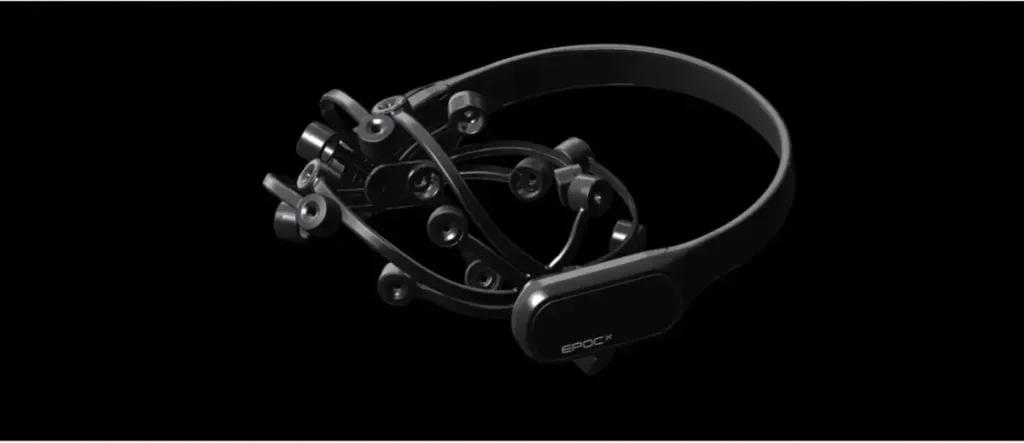
Another direction: a project called Duet, which won Cal Hacks 2024, uses the Emotiv EPOC X EEG headset to translate emotional states into AI-generated music in real time, with a focus on therapeutic applications for children and people with disabilities. The EPOC X now offers 14 channels, a 9-hour battery life, and Bluetooth 5.0 — making portable BCI experimentation genuinely accessible for the first time.
Where It Still Falls Short
Would a professional musician stake a festival headline on a BCI right now? Almost certainly not, and the reasons are specific. Latency is the biggest one: live music runs on millisecond precision, and the signal chain from brain signal to decoded command to audio parameter carries inherent delays. EEG is also extremely sensitive to noise — muscle movement, stage lighting interference, even blinking can contaminate the signal. Getting a reliable read night after night, tour after tour, is a different engineering problem from getting it to work in a controlled research environment.
The deeper artistic limitation is resolution. Music isn’t a series of binary commands. It lives in the space between notes — in subtle dynamics, articulation, the difference between a phrase played with conviction and one played with hesitation. Mapping arousal to volume is straightforward. Mapping whatever a player feels in bar 32 of a live improvisation to a specific, nuanced timbral shift is something current systems can only approximate. There’s also a phenomenon researchers call “BCI illiteracy” — roughly 15–20% of users simply can’t achieve reliable accuracy with motor imagery-based interfaces, for reasons that aren’t yet fully understood. Deep learning approaches are being actively developed to close that gap.
Invasive BCIs — surgically implanted electrodes, the kind associated with Neuralink-type research — offer dramatically higher signal fidelity, recording from thousands of individual neurons rather than averaging across a whole scalp. For music performance, that path is a non-starter for almost anyone, which means we’re working with the noisier, less precise, but wearable non-invasive option.
The Data Question Nobody Is Asking Loudly Enough
Here is the part of this conversation that feels genuinely underexplored. EEG used in a live performance context means broadcasting neurodata — arguably the most personal category of information a human being generates. Sharing your heart rate is one thing. Sharing the electrical patterns of your brain activity, potentially recorded, archived, or sold, is another. As BCHJam and similar systems move toward commercial or public applications, questions of data ownership, consent, and the possibility of neural profiling don’t have clear legal or ethical frameworks yet. The music industry has a long history of being late to these conversations, and then being surprised by the consequences.
The UKBCIC’s recent NeuroVision Music–BCI hackathon is actively trying to build a community around exactly these questions — not just the technical ones, but the ethical and creative ones. That feels like the right instinct.
A New Instrument, Not a Replacement
The analogy that keeps coming back to me is the early days of MIDI. When a headband with a single electrode was first mapped to pitch and velocity in a 1998 Wired article — using what the researchers called “brain fingers” — it looked like a curiosity. The signal chain was crude: brain signal to digital command to MIDI event. But it established the basic idea that the body could be an instrument without touching anything. BCHJam, the Encephalophone, Synthetic Bio Music — these are that idea, grown up.
What BCI and biometric music control are opening is a new expressive channel, one that operates below the level of conscious technical gesture and reaches into internal states that previously had no direct musical output. For now, it’s a pioneer space, requiring significant personalised calibration and training. But so was synthesizer programming in the 1970s, and sampling in the 1980s, before either became an assumed skill in a producer’s vocabulary. The instruments of tomorrow rarely announce themselves clearly when they first arrive.
Common Questions About Mind-Controlled Music
Not yet. Current BCI technology doesn’t “read thoughts.” Instead, it detects electrical noise from neurons (EEG) or physiological signals like heart rate. These signals are then mapped to specific commands, such as opening a filter, changing a synth’s attack, or triggering MIDI notes through focused attention or imagined movement.
The primary hurdles are latency and signal noise. Live performance requires millisecond precision, but the signal chain—from the brain to the DAW—carries inherent delays. Additionally, EEG signals are highly sensitive to interference from muscle movements (like blinking) and stage lighting, which can contaminate the data.
This is an emerging ethical concern. Using BCI in public or commercial settings involves broadcasting neurodata—the most personal data a human generates. Currently, there are few legal frameworks protecting this information, making data ownership and consent a critical conversation for the future of the industry.