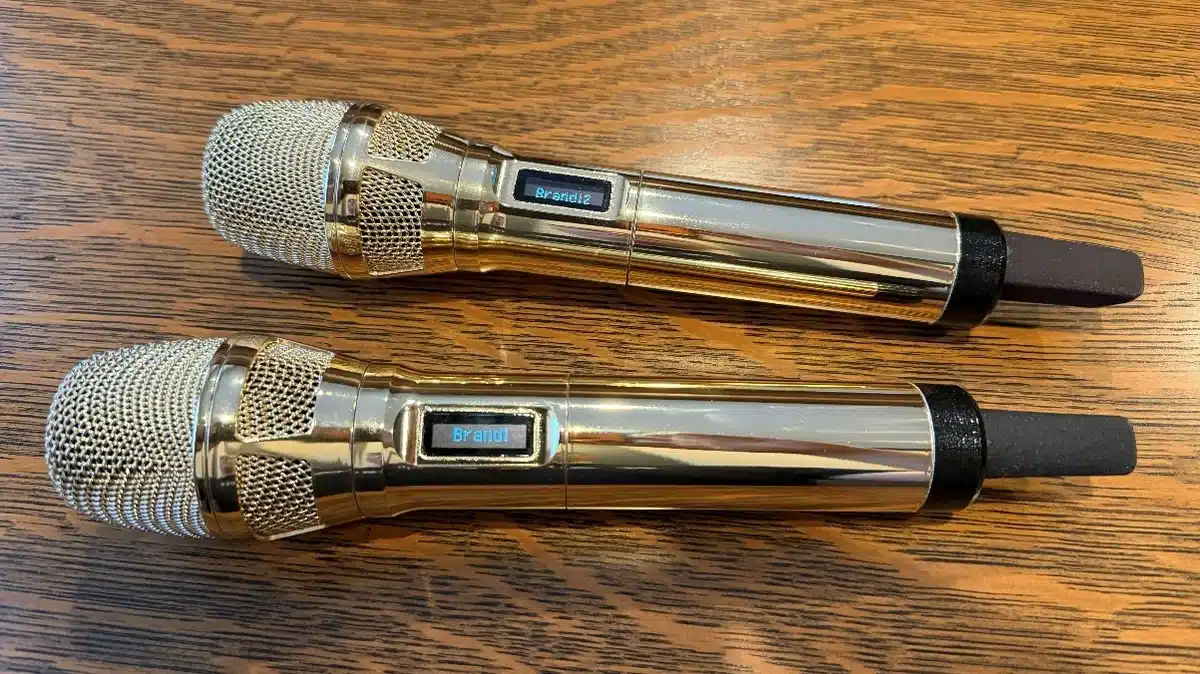


When you’re singing the national anthem at the Super Bowl, wireless failure isn’t an option. Brandi Carlile knew this when she stepped onto the field February 8 holding a custom gold prototype microphone that had never appeared on a live broadcast before. The Sennheiser Spectera SKM handheld transmitter paired with a Neumann KK 205 capsule delivered 1 millisecond latency and 96 kHz audio resolution to millions of viewers—while sharing just 6 MHz of RF spectrum with six other wireless mics and nine in-ear systems across the entire production.
The halftime show, headlined by Bad Bunny with guest appearances by Lady Gaga and Ricky Martin, relied on the proven Sennheiser Digital 6000 wireless system—custom white handhelds for Gaga, silver for Martin. But Carlile’s pre-game performance marked the moment Spectera moved from theater productions and controlled environments into the most RF-hostile, high-stakes live broadcast environment imaginable.

From Broadway to the Big Game
Lead RF coordinator Cameron Stuckey had deployed early Spectera in-ear monitoring systems on Masquerade, an immersive theater production spanning six floors and 13 performance spaces in Manhattan. That experience—managing high-density, bidirectional wireless in a complex RF environment—gave him confidence that Spectera could handle the unprecedented technical demands of the Super Bowl.
“My comfort with Spectera came from deploying it on Masquerade,” Stuckey explained. “That project required high-density, bidirectional wireless in a complex structure environment, utilizing every feature of Spectera—device capacity, multi-zone operation, modulation diversity.”

When Stuckey was named lead RF coordinator for Super Bowl LX, those discussions turned serious. Could a prototype handheld transmitter, still in development, perform flawlessly on one of the most-watched broadcasts of the year?
What Convinced the Engineers
Sean Quackenbush, Carlile’s longtime front-of-house engineer, and monitor engineer Jerry Streeter have relied on Sennheiser and Neumann vocal solutions for years. Evaluating the Spectera prototype alongside Quackenbush’s preferred Neumann KK 205 capsule revealed something unexpected.
“As a front-of-house engineer, the biggest thing for me is when I don’t have to work on a vocal mic to make it sound right,” Quackenbush said. “With Spectera, what I heard right away was how musical it was. The proximity effect felt natural, not exaggerated, and for the first time with a wireless handheld you’re really hearing the Neumann capsule itself.”
He continued: “Once we heard it come up in the stadium, it was one of those moments where you just know. The vocal felt incredibly stable at high volume, and I barely had to touch EQ.”
Streeter emphasized the RF efficiency: “Getting all that performance on a single TV channel is a game changer.”

The Wideband Difference
Spectera represents the world’s first wideband, bidirectional digital wireless ecosystem. Instead of dedicating multiple 200 kHz narrowband RF carriers to individual microphones and in-ear monitors, the system uses WMAS (Wireless Multichannel Audio Systems) technology to accommodate up to 64 channels—32 inputs and 32 outputs—within a single 6 or 8 MHz TV channel.
Every audio link gets assigned specific time slots for transmitting information, which means IEMs and microphones coexist in the same RF channel without guard bands. When the link transmits, it uses the full width of the RF channel, creating what amounts to 40-fold diversity in an 8 MHz channel. RF fading, the nemesis of live wireless audio, becomes drastically less likely.

The system’s bidirectional architecture enables simultaneous audio transmission, remote control, and monitoring within a single RF channel. Engineers can adjust IEM and mic levels, monitor RF health and battery status, and adapt audio settings—all in real time, all wirelessly.
Antenna Deployment Made Simple
The production team deployed three Sennheiser DAD antennas covering the stadium bowl, with an additional DAD antenna supporting backstage areas. Unlike traditional coaxial-based systems requiring complex RF distribution with combiners, splitters, and boosters, the DAD antennas connect to the Base Station via CAT 5e cable using ruggedized RJ45 connectors.
“Spectera allows us to deploy antenna systems in a fraction of the time that coax-based narrowband systems require to get right,” Stuckey noted. “Instead of compensating for lossy links or RF-Over-Fiber conversion artifacts, we define the coverage area, place the DAD antennas, and plug it in.”
The system’s ultra-wide tuning range, including access to 1G4 spectrum (1350-1525 MHz), provides flexibility that narrowband systems can’t match. “Spectrum selection is the challenge of large events like Super Bowl,” Stuckey said. “Having such a wide tuning range and access to 1G4 spectrum means that Spectera can be used on any show, regardless of size.”
Digital 6000: The Reliable Workhorse
While Spectera grabbed headlines, the halftime show relied on Sennheiser Digital 6000 wireless systems—custom-finished handhelds delivering the consistency and transparency that top-tier artists demand. The Digital 6000 uses the same LR (Long Range) mode and proprietary SeDAC (Sennheiser Digital Audio Codec) found in the flagship Digital 9000 series.
The system’s intermodulation-free technology guarantees additional channels even in narrow frequency ranges. Link Density mode doubles capacity, delivering five channels in 1 MHz bandwidth—in real-world stage environments with movement, sweat, and demanding RF scenarios.
The Economics of Wideband
Here’s where the math gets interesting. The Spectera Base Station runs approximately $9,995-$10,090, providing 32 Dante-enabled receiver channels and 32 IEM transmitters in a single rack unit. Compare that to a Shure Axient AD4Q four-channel receiver at roughly $8,500—you’d need eight racks to match Spectera’s 32-channel capacity, approaching $70,000.
The bidirectional SEK bodypacks cost around $1,999-$2,349 each, functioning as both transmitter and receiver. A comparable Shure ADX1 transmitter runs $1,700 without IEM capability. DAD antennas are priced at $1,599-$1,899, replacing both transmitter and receiver antenna distribution systems.
The real value emerges at higher channel counts. A four-channel Spectera system (base station, four bodypacks, antennas) runs approximately $20,800 compared to roughly $29,000 for equivalent Shure Axient microphone and PSM IEM functionality. At two channels, narrowband systems might edge ahead slightly, but beyond that, the economics shift decisively.
Needless to say, we’re talking about tour-grade, broadcast-level wireless systems here—not typical territory for most AudioNewsRoom readers. For those working smaller venues, corporate events, or regional productions, Sennheiser’s Evolution Wireless Digital (EW-D) offers a more accessible entry point. The EW-D systems start around $599-$1,349 per channel with similar 134 dB dynamic range and low 1.9ms latency, though using traditional narrowband UHF technology. The app-based Smart Assist workflow makes frequency coordination manageable even without RF expertise. For budget-conscious users, the XSW-D digital 2.4GHz systems deliver clean wireless audio in the $199-$299 range—perfectly adequate for most production environments where RF congestion isn’t an Olympic-level challenge.
I can’t help thinking about the RF coordinators and audio engineers who’ve spent hours—sometimes days—coordinating frequencies for large-scale productions. The anxiety of RF dropouts during critical moments. The racks full of receivers and transmitters, each demanding careful setup and monitoring.
Spectera suggests a different path forward for those working at the highest levels. Whether that future arrives smoothly or stumbles over the inevitable challenges of new technology remains to be seen. A prototype handheld delivered flawlessly on the Super Bowl broadcast, with millions watching and zero tolerance for failure. Perhaps we’re closer than we think.
How about you? Have you worked with wideband wireless systems, or are you still deep in the narrowband coordination trenches?
Availability and Pricing
The Sennheiser Spectera Base Station is available for pre-order at $9,995-$10,090. The SEK bidirectional bodypacks are priced at $1,999-$2,349 (available in both UHF and 1G4 frequency ranges), and DAD antennas run $1,599-$1,899. The SKM handheld transmitter featured at Super Bowl LX is expected to become available later in 2026 as the ecosystem continues expanding.
For more information about Sennheiser Spectera and Digital 6000 wireless systems, visit sennheiser.com/spectera.