


Outgrowth is a collaboration between Aqeel Aadam Sound and BlankFor.ms that transforms the humble concept of sample playback into something far more expressive and inspiring. Released in December 2025, this sample-based instrument doesn’t follow the typical sampler playbook—instead, it offers five distinct engines, unconventional audio processors, and a modulation matrix that can turn a single audio file into an entire sonic universe.
A Different Kind of Sampler
At its core, Outgrowth asks a simple question: what if you could take one sample and immediately create a responsive, natural, and fun instrument from it? The workflow is refreshingly straightforward—drag one or more samples into the interface, and Outgrowth automatically detects their pitch and maps them across the keyboard. No manual root note assignment unless you want to fine-tune things.
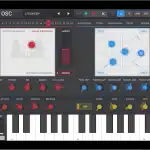
The interface itself is unconventional, eschewing typical sampler terminology for something more poetic and mysterious. At first glance, you might wonder what “Subvert,” “Strike,” or “Smear” actually do. FYI: this is where the inline help becomes invaluable, making it surprisingly easy to dive in quickly despite the unusual naming conventions.

Five Engines, Infinite Possibilities
Outgrowth’s five playback engines are where things get interesting:
- Stem: A traditional one-shot player that repitches samples
- Retain: A granular stretching engine that sustains samples indefinitely while preserving transients
- Reflect: A looping algorithm that maintains consistent loop lengths across all pitches, with tempo sync capabilities
- Radiate: An additive resynthesizer that analyzes harmonics and rebuilds them as sine-wave partials
- Delve: A wavetable synthesizer that transforms your sample into a unique wavetable
Each engine approaches sample playback from a completely different angle. Needless to say, cycling through the five engines with any of the included presets reveals just how transformative these processing methods can be. The same piano sample becomes a shimmering pad in Retain, a rhythmically locked texture in Reflect, or something entirely alien in Radiate.
For those of us drawn to soundscapes, textures, lo-fi aesthetics, and ambient territories, these engines are immediately inspiring. But here’s the thing: while Outgrowth ships with over 100 samples by BlankFor.ms, the real power comes from feeding it your own material. This isn’t just a preset player—it’s an instrument waiting to be personalized.
Sound Shaping That Makes Sense
Beyond the engines, Outgrowth includes five clever audio processors designed to make repitched samples feel more natural and performative:
- Subvert: Analyzes and flattens or inverts a sample’s internal volume contour, letting the ADSR envelope fully define note shape
- Submerge: Applies spectral shaping to combat the “chipmunk effect” when repitching, keeping tonal character closer to the original
- Strike: Adds acoustic-style keyboard response with subtle envelope, filtering, and stereo placement changes based on pitch
- Ripple: A one-knob tape emulation created by BlankFor.ms that ranges from subtle pitch instability to heavy compression and distortion
- Smear: A pre-ADSR reverb that allows reverb tails to blend between notes without washing out attacks
Think of these as acoustic simulators. Strike, for instance, mimics how a piano behaves differently across its range—lower notes feel heavier, higher notes brighter and more delicate. Submerge keeps your pitched-up samples from sounding cartoonish. It’s thoughtful design that encourages organic-sounding results even from synthetic sources.

Modulation for Days
The modulation matrix deserves special attention. Every single parameter in Outgrowth can be modulated via LFOs, random sources, velocity, note pitch, aftertouch, and MPE control. This transforms Outgrowth from a playable instrument into a generative sound design tool.
All I can tell you is this: starting to assign modulation destinations can take a patch to another level. The LFO can crawl at glacially slow rates—up to 100 seconds per cycle—creating evolving textures that shift almost imperceptibly over time. Perhaps future updates could push this even further, but the current range is already perfect for ambient and experimental work.


The BlankFor.ms Connection
The collaboration with BlankFor.ms brings real character to Outgrowth. Tyler Gilmore, the artist behind BlankFor.ms, is known for his work with degraded tape machines, vintage pedals, and unusual signal chains. His Tape Synths library for Spitfire Audio explored similar sonic territory—heavily processed sounds passed through Sony Walkmans, Library of Congress cassette players, and modular systems.
That aesthetic permeates Outgrowth’s included samples and the Ripple effect. The sounds are noisy, impure, and endlessly deep—exactly the kind of material that benefits from Outgrowth’s transformative engines. Check out the included presets to hear how BlankFor.ms has shaped ethereal ambient pads, haunted lofi keys, shimmering tape-infused plucks, and gnarled percussive textures.
Four ADSR Modes You’ll Actually Use
Outgrowth offers four quick ADSR presets: Pluck, Keys, Pad, and Flat. While this might seem like a small detail, these modes fundamentally change how patches respond. A Pluck setting turns sustained samples into percussive hits. Pad mode opens up longer releases for evolving textures. Do yourself a favour and experiment with these alongside the different engines—the combinations yield wildly different results from the same source material.
The Aqeel Aadam Ecosystem
Outgrowth is Aqeel Aadam’s fourth product since founding Aqeel Aadam Sound in 2023. His previous releases—including Weeping Wall, a collection of microloopers that create flowing ribbons of sound—share a common philosophy: making the magic of hardware modular systems accessible regardless of income level or expertise.
There’s a consistency emerging across these tools. Visual interfaces that prioritize exploration over intimidation. Modular-style routing that encourages unexpected results. Parameters that invite interaction rather than demanding technical knowledge. With tools like Waymaker (a MIDI sequencer ecosystem) interacting with Outgrowth, Aqeel is building a unique creative environment.
I recall discovering Weeping Wall earlier this year and being struck by how it turned looping from a technical exercise into an improvisational collaboration. Outgrowth continues that trajectory—it’s not about perfect sample playback, it’s about discovery and transformation.
Practical Tips
- Start with familiar material: Load a vocal phrase or acoustic instrument to hear how the engines reshape recognizable sources
- Exploit the modulation matrix early: Don’t save modulation for later—start assigning LFO and random sources immediately to discover happy accidents
- Layer engines across MIDI channels: Run multiple instances with different engines processing the same sample for complex, evolving textures
- Use Reflect for rhythmic material: The tempo-synced looping creates locked grooves that work beautifully under other elements
- Push Radiate into cross-modulation: Increase the cross-modulation parameter to move from harmonic tones to complex, noisy textures
- Combine Strike and Submerge: These two processors together make repitched samples feel remarkably natural across the keyboard
- Experiment with Smear before ADSR: Since Smear sits pre-envelope, it creates unique blurred textures that traditional reverbs can’t achieve
Pricing and Availability
Outgrowth is currently available for $65 USD. The plugin supports VST3, AU, and AAX formats for macOS (10.13 or later, Intel and Apple Silicon) and Windows (10 or later, 64-bit).
The iOS version is available separately on the App Store, for approx. $/€22.99.
You can purchase Outgrowth for Mac and Windows directly from the Aqeel Aadam Sound website. A one-week free trial is available with full functionality except preset saving. All major audio formats are supported, including WAV, AIFF, FLAC, OGG, and MP3.
For related products in the Aqeel Aadam ecosystem, check out Weeping Wall, the microlooper that started it all.
Final Thoughts
Outgrowth succeeds because it doesn’t try to be everything to everyone. It’s focused: take samples, transform them radically, make them playable and expressive. The five engines aren’t just variations on a theme—they’re fundamentally different approaches to sample playback. The sound-shaping tools aren’t generic processors—they’re specifically designed to solve problems that arise when repitching audio.
Do you need this? If you work in ambient, experimental, lo-fi, or cinematic music, Outgrowth offers immediate inspiration. If you’re frustrated with how unnatural traditional samplers sound when transposing, the Strike and Submerge processors address exactly that. And, if you love modular-style patching but want something easier and immediately musical, the modulation matrix delivers.
Aqeel Aadam is building something different here—a cohesive ecosystem of tools that prioritize curiosity and exploration over technical mastery. Outgrowth might be the most complete expression of that vision yet. How about you? Are you drawn to instruments that transform familiar sounds into something unexpected, or do you prefer traditional sampler workflows?
The plugin landscape has become crowded with tools competing on features lists—more oscillators, more effects, thousands of presets. Outgrowth takes the opposite approach, focusing on depth rather than breadth. Five engines, five processors, deep modulation, done. This kind of focused design makes you work with what’s there, and that constraint often leads to more creative results than endless options ever could.



Thanks for the clear review which helped me understand what Outgrowth is offering — I reckon the “four quick ADSR presets” approach is brilliant, more synths should adopt it, since many sounds are differentiated by these archetypes!
Thank you for your kind words. I checked your profile. Feel free to get in touch with. us if you feel contributing to ANR with reviews, tutorials, etc.